
Gross Pay 3D
Overview
In this Phlow, learners explore how to calculate gross pay per week — the total earnings before any tax or deductions are applied. Using realistic workplace examples, they learn that gross pay is found by multiplying the amount of time worked by the rate of pay.
The Phlow walks students through two relatable examples:
-
Keith’s weekly pay:
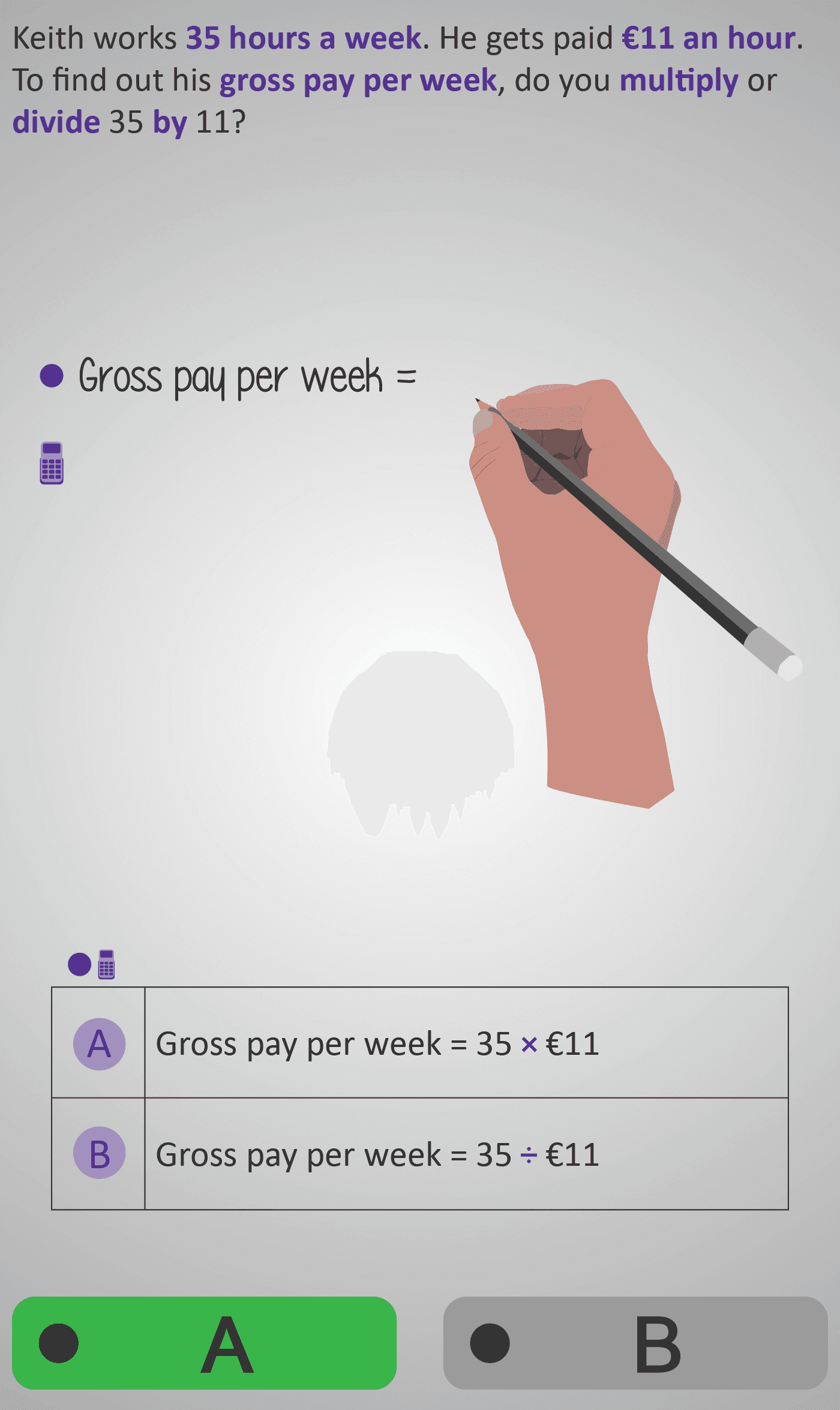
Keith works 35 hours per week and earns €11 per hour.
Students identify that they must multiply (not divide) to find total earnings:
Gross Pay = 35 × €11 = €385. -
James’s weekly pay:
James works 7 days per week and earns €57 per day.
Again, learners apply the same principle:
Gross Pay = 7 × €57 = €399.
Through these examples, students strengthen their understanding of repeated addition (multiplication) in real-world money contexts and see how gross pay directly depends on time and rate of pay.
Visual scaffolding — including purple operation symbols, calculator icons, and an animated hand — reinforces step-by-step reasoning. Students are encouraged to think critically about whether to multiply or divide, deepening conceptual understanding rather than memorising rules.
By the end of this Phlow, learners can confidently set up and solve multiplication equations for hourly and daily wages, preparing them for more complex financial Phlows involving tax, deductions, and net income.
Prerequisite Knowledge Required
- Multiplication 2B – Multiplying Money Values.
- Gross Pay 3A – Calculating Income Tax as a Percentage.
- Gross Pay 3B – Calculating Net Income (Take-Home Pay).
- Understanding multiplication as repeated addition.
- Knowledge of units of time (hours, days, weeks) and how they relate to pay.
- Ability to multiply two-digit numbers accurately.
- Familiarity with the term gross pay as the total before deductions.
Main Category
Financial Maths / Income and Tax
Estimated Completion Time
Approx. 10 seconds per screen (4 screens total). Total Time: 2–2.5 minutes.
Cognitive Load / Step Size
Low — each step isolates a single action: identifying the operation, substituting values, performing the multiplication, and comparing results. The repeated structure builds automaticity while keeping reasoning clear and manageable.
Language & Literacy Demand
Low — instructions use short, consistent phrasing and visual supports. Key terms (gross pay, hours per week, rate of pay, multiply) are colour-highlighted to aid recognition and reinforce financial vocabulary.
Clarity & Design
- Sequential layout builds from understanding to execution.
- Consistent hand animation visualises each step clearly.
- Calculator icons and purple multipliers act as cognitive anchors.
- Minimal visual clutter keeps focus on the calculation process.
Curriculum Alignment
Irish Junior Cycle Mathematics:
- Strand 1 – Number
- Substrand – Financial Mathematics: Income and Taxation
- Learning Outcomes:
- Calculate gross income given rate and time worked.
- Choose and apply the correct mathematical operation in context.
- Use multiplication to solve real-world financial problems.
Engagement & Motivation
High — students relate directly to work scenarios and see how pay is calculated in real life. Realistic examples of hourly and daily wages build curiosity and confidence in applying maths to practical contexts.
Error Opportunities & Misconceptions
- Dividing instead of multiplying.
- Reversing the order of multiplication (mixing rate and time).
- Confusing pay rate units (per hour vs per day).
The Phlow corrects these through contrast questions (“multiply or divide?”) and consistent substitution visuals that reinforce proper reasoning.
Transferability / Real-World Anchoring
Very High — the concept applies directly to interpreting job adverts, estimating weekly or monthly pay, and comparing different wage structures. It builds practical numeracy skills that underpin financial independence and literacy.
Conceptual vs Procedural Balance
Strong conceptual focus — learners understand why multiplication is used to find total pay, not just how to perform it. This bridges concrete workplace reasoning with mathematical operations.
Learning Objectives Addressed
- Recognise the relationship between rate, time, and total earnings.
- Apply multiplication to calculate total pay.
- Select the correct operation using contextual reasoning.
- Interpret gross pay as total income before deductions.
What Your Score Says About You
- Less than 5: Review when to multiply vs divide — think about what “per hour” means.
- 6–7: You understand the concept but may need more accuracy when multiplying money values.
- 8–9: You can calculate gross pay confidently and explain your reasoning.
- 10 / 10: Excellent! You’ve mastered gross pay calculations and are ready for Gross Pay 3E, which combines multiple income and deduction components into a complete payslip.