
Hyp Adj Opp 3
Overview
In this Phlow, learners build visual understanding of the three key sides in a right-angled triangle — opposite, adjacent, and hypotenuse — and how to identify them correctly relative to a marked angle.
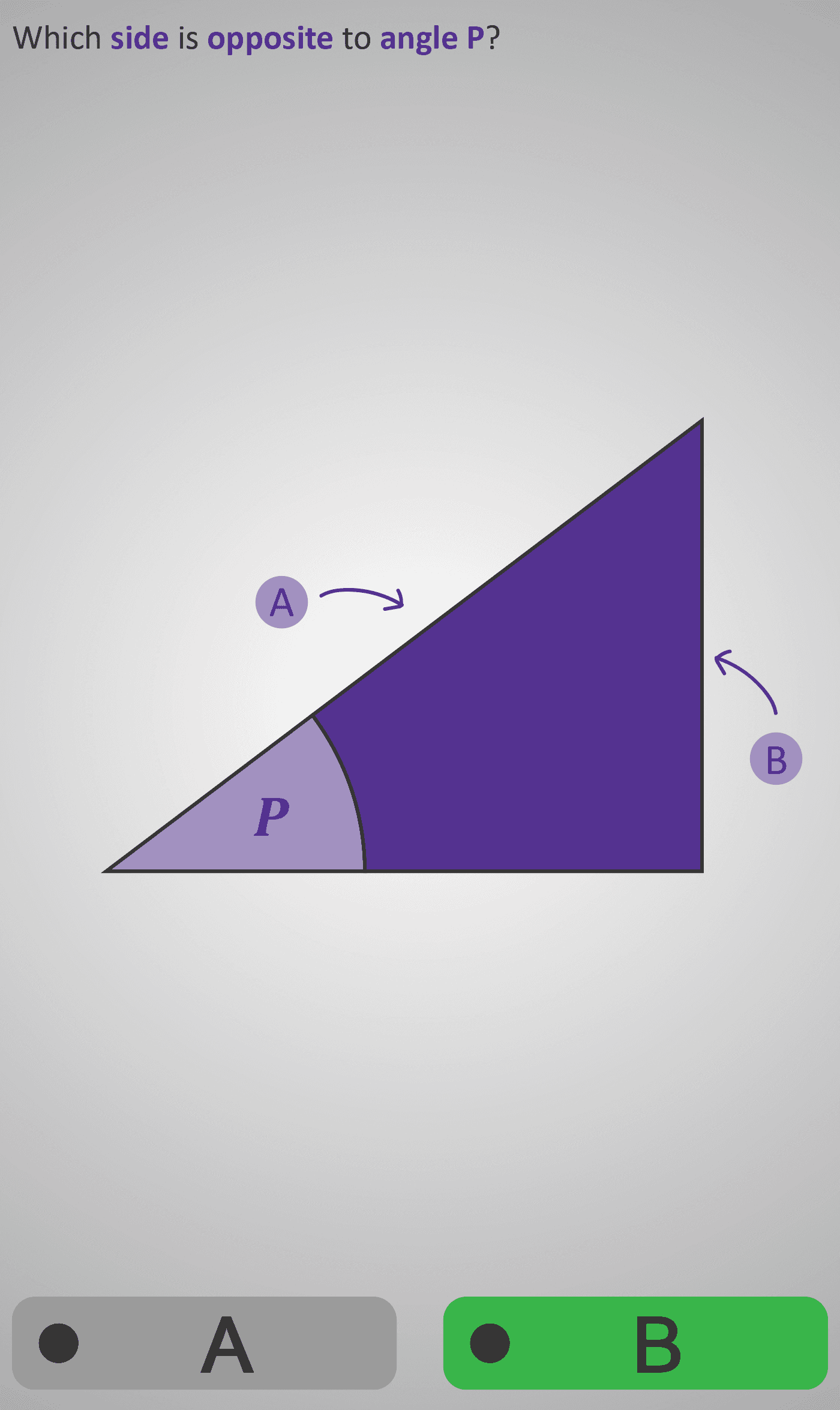
Using a labelled right triangle, students focus on a chosen angle (angle P) and answer two key questions:
-
Which side is opposite angle P?
The side directly across from the angle is identified as the opposite side. In the example, this is side B, which measures 3 units. -
Which side is adjacent to angle P?
The side next to the angle — but not the hypotenuse — is identified as the adjacent side. In this context, side C is adjacent, measuring 4 units.
Through progressive visual prompts, students see how the position of the reference angle changes which sides are labelled “opposite” and “adjacent.” The triangle remains the same shape, but the reference angle changes the naming. The side opposite the right angle — always the hypotenuse — stays constant as the longest side.
This Phlow builds foundational understanding for trigonometry by linking geometric reasoning with side relationships in 3–4–5 triangles. It develops intuition that will later support ratio-based reasoning with sine, cosine, and tangent.
By the end, learners can confidently identify and label all three sides of a right triangle based on a given angle — a critical skill for success in trigonometric calculations and real-world applications.
Prerequisite Knowledge Required
- Angles 2A – Identifying Angles in Triangles.
- Triangles 2B – Naming Sides of Right-Angled Triangles.
- Length 2C – Reading Triangle Side Labels.
- Recognising right-angled triangles and identifying the hypotenuse.
- Understanding that an angle is formed where two sides meet at a vertex.
- Basic spatial reasoning — locating sides that are opposite or next to an angle.
- Knowing that the hypotenuse is always the longest side opposite the right angle.
Main Category
Geometry / Trigonometry Foundations
Estimated Completion Time
Approx. 10 seconds per screen (4 screens total). Total Time: 1.5–2 minutes.
Cognitive Load / Step Size
Low — each screen introduces one visual relationship at a time (opposite → adjacent). Consistent colour highlights and clear triangle orientation minimise extraneous cognitive load.
Language & Literacy Demand
Low — key terms (opposite, adjacent, angle P) are introduced visually and reinforced through repetition. Simple phrasing and direct questions ensure accessibility across reading levels.
Clarity & Design
- Each screen isolates a single concept (opposite or adjacent).
- Triangles are colour-coded for clarity and consistency.
- Side lengths (3, 4, 5) make examples concrete and intuitive.
- Visual emphasis on changing the reference angle builds transferable reasoning.
Curriculum Alignment
Irish Junior Cycle Mathematics:
- Strand 3 – Geometry and Trigonometry
- Substrand – Right-Angled Triangles and Trigonometric Ratios
- Learning Outcomes:
- Identify sides in a right-angled triangle relative to a given angle.
- Distinguish between the hypotenuse, opposite, and adjacent sides.
- Prepare to apply trigonometric ratios (sine, cosine, tangent).
Engagement & Motivation
High — students interact with colour-coded visuals and receive instant feedback. The activity feels intuitive and accessible, building confidence before introducing trigonometric ratios.
Error Opportunities & Misconceptions
- Confusing opposite and adjacent sides.
- Misidentifying the hypotenuse as adjacent.
- Forgetting that changing the reference angle changes which side is opposite or adjacent.
Addressed through repetition, side labelling, and consistent use of directional arrows to reinforce correct identification.
Transferability / Real-World Anchoring
High — this concept underpins practical trigonometry applications like measuring heights, slopes, shadows, and distances. Students learn to visualise geometric relationships that connect directly to real-world measurements.
Conceptual vs Procedural Balance
Strong conceptual focus — this Phlow builds the spatial reasoning and vocabulary needed before any formulaic trigonometry is introduced. It ensures deep conceptual grounding rather than procedural memorisation.
Learning Objectives Addressed
- Identify opposite, adjacent, and hypotenuse sides relative to a given angle.
- Connect visual structure of a triangle with trigonometric language.
- Recognise that side classification depends on the chosen reference angle.
- Develop readiness for applying trigonometric ratios in later Phlows.
What Your Score Says About You
- Less than 5: Review the structure of right triangles — focus on sides relative to the chosen angle.
- 6–7: You’re improving — double-check which side is adjacent versus hypotenuse.
- 8–9: You understand the relationships well — great visual reasoning!
- 10 / 10: Excellent! You’ve mastered side identification and are ready for Hyp Adj Opp 4, which introduces trigonometric ratios: sin = opp/hyp, cos = adj/hyp, tan = opp/adj.