
Measure 3
Overview
In this Phlow, learners develop practical measurement skills using a ruler marked in centimetres. They learn how to align the ruler correctly, read from zero, and record accurate measurements — including half-centimetre readings when required.
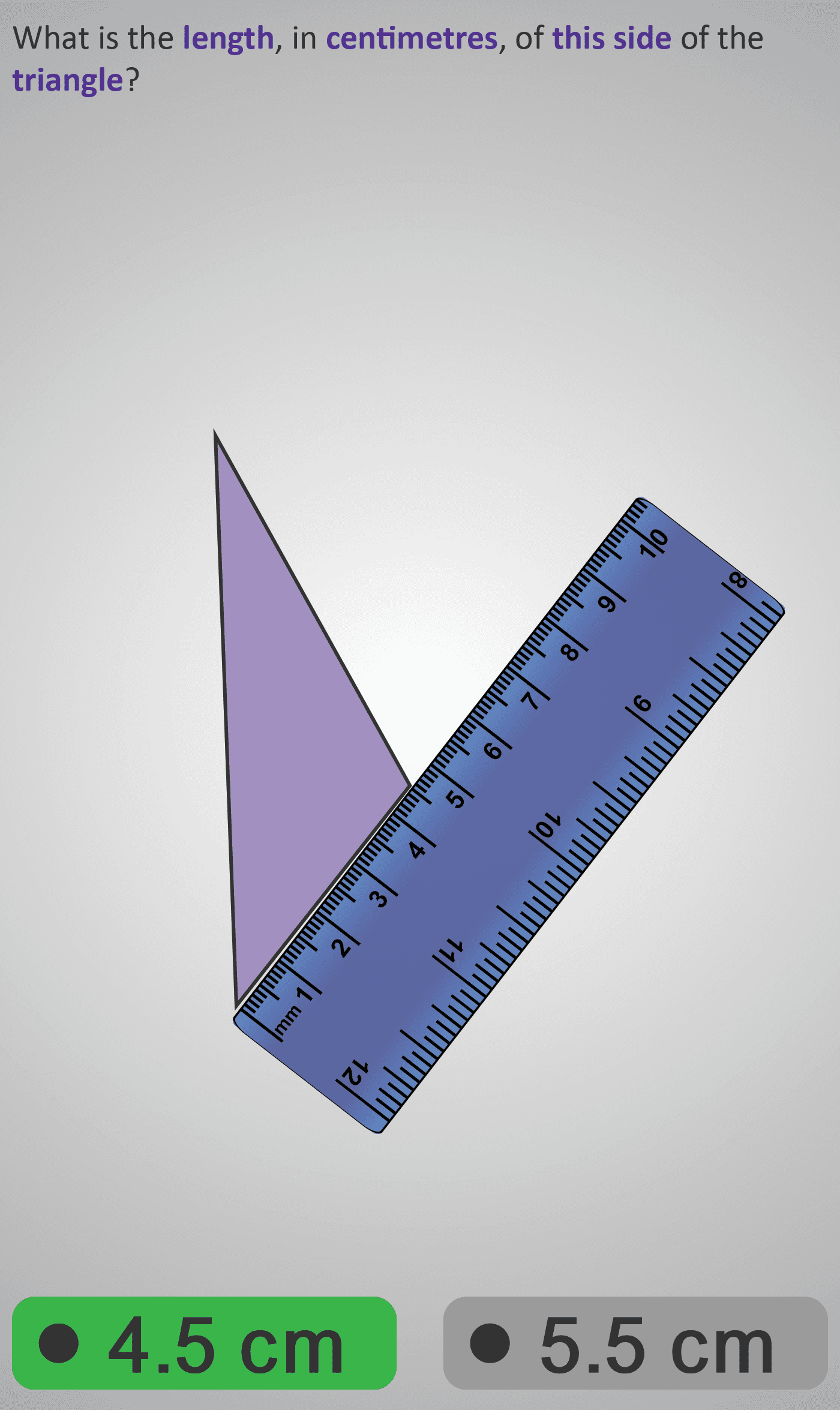
Across three examples, students measure sides and heights of familiar shapes:
-
Triangle:
The ruler is placed along one side of the triangle. Students identify that the correct length reading is 4.5 cm, not 5.5 cm, reinforcing accurate alignment at zero. -
Parallelogram:
Learners measure the diagonal of a parallelogram and find it measures 5.5 cm. This introduces diagonal measurement and spatial orientation. -
Pentagon:
The ruler is placed vertically to find the height of a pentagon, reading 7 cm from base to top. This emphasises reading vertical lengths with precision.
This Phlow reinforces the connection between visual geometry and numerical measurement. The clear ruler graphics model correct positioning, helping learners interpret centimetre marks accurately and record their results with confidence.
By the end of this Phlow, students can use a ruler correctly and consistently to measure sides, diagonals, and heights of shapes in centimetres. This practical skill builds the foundation for later measurement conversions and area or perimeter calculations.
Prerequisite Knowledge Required
- Measure 1 – Identifying Measurement Tools.
- Measure 2 – Estimating Lengths in Centimetres.
- Recognising centimetre (cm) as a unit of length.
- Understanding how to align a ruler correctly at the zero mark.
- Familiarity with basic 2D shapes: triangle, parallelogram, and pentagon.
- Awareness that lines can be horizontal, vertical, or diagonal.
Main Category
Measurement / Geometry Foundations
Estimated Completion Time
Approx. 10 seconds per screen (3 screens total). Total Time: 1.5 minutes.
Cognitive Load / Step Size
Low — each screen introduces one clear measurement task. Students measure one feature at a time, keeping focus narrow and reducing cognitive effort. Repetition across shapes builds procedural fluency.
Language & Literacy Demand
Low — uses short, concrete terms such as length, height, diagonal, and centimetres. Colour-coded terms highlight the key vocabulary needed for measurement.
Clarity & Design
- Realistic ruler visuals show correct zero alignment.
- Purple-highlighted shapes contrast clearly against the measuring tool.
- Centimetre marks are precisely scaled and visible.
- Each shape is isolated per screen to maintain focus.
Curriculum Alignment
Irish Junior Cycle Mathematics:
- Strand 2 – Measures
- Substrand – Length
- Learning Outcomes:
- Use standard metric units (cm) to measure length accurately.
- Read and record measurements from a ruler.
- Recognise and measure linear, vertical, and diagonal distances.
Engagement & Motivation
High — the realistic context of using a ruler gives immediate, tangible feedback. Students experience success quickly, reinforcing accuracy and spatial reasoning through hands-on visual practice.
Error Opportunities & Misconceptions
- Reading from the wrong end of the ruler.
- Starting from the edge instead of the zero mark.
- Confusing centimetres with millimetres.
- Misreading diagonal alignment or slanted edges.
These are mitigated through clear, scaled visuals and guided prompts highlighting correct positioning and measurement technique.
Transferability / Real-World Anchoring
Very High — measuring accurately connects directly to real-world contexts such as design, crafts, construction, and scientific experiments. Students learn to apply measurement principles beyond the classroom.
Conceptual vs Procedural Balance
Procedural with conceptual reinforcement — learners practise repeated ruler measurements while understanding the consistent logic of using centimetres and zero alignment across shapes and orientations.
Learning Objectives Addressed
- Read a ruler accurately in centimetres.
- Measure sides, heights, and diagonals of 2D shapes.
- Record and compare lengths correctly.
- Develop confidence applying measurement to real-world shapes.
What Your Score Says About You
- Less than 5: Recheck ruler alignment — always start from zero.
- 6–7: You’re accurate on simple lengths — keep practising diagonals and heights.
- 8–9: Strong accuracy and awareness of ruler alignment.
- 10 / 10: Excellent! You can measure any shape precisely and are ready for Measure 4, where you’ll convert between centimetres and millimetres.