
Median 3
Overview
In this Phlow, learners explore how to find the median — the middle value — when a data set has an even number of numbers. The step-by-step visuals make the logic of the process clear through ordering, elimination, and averaging.
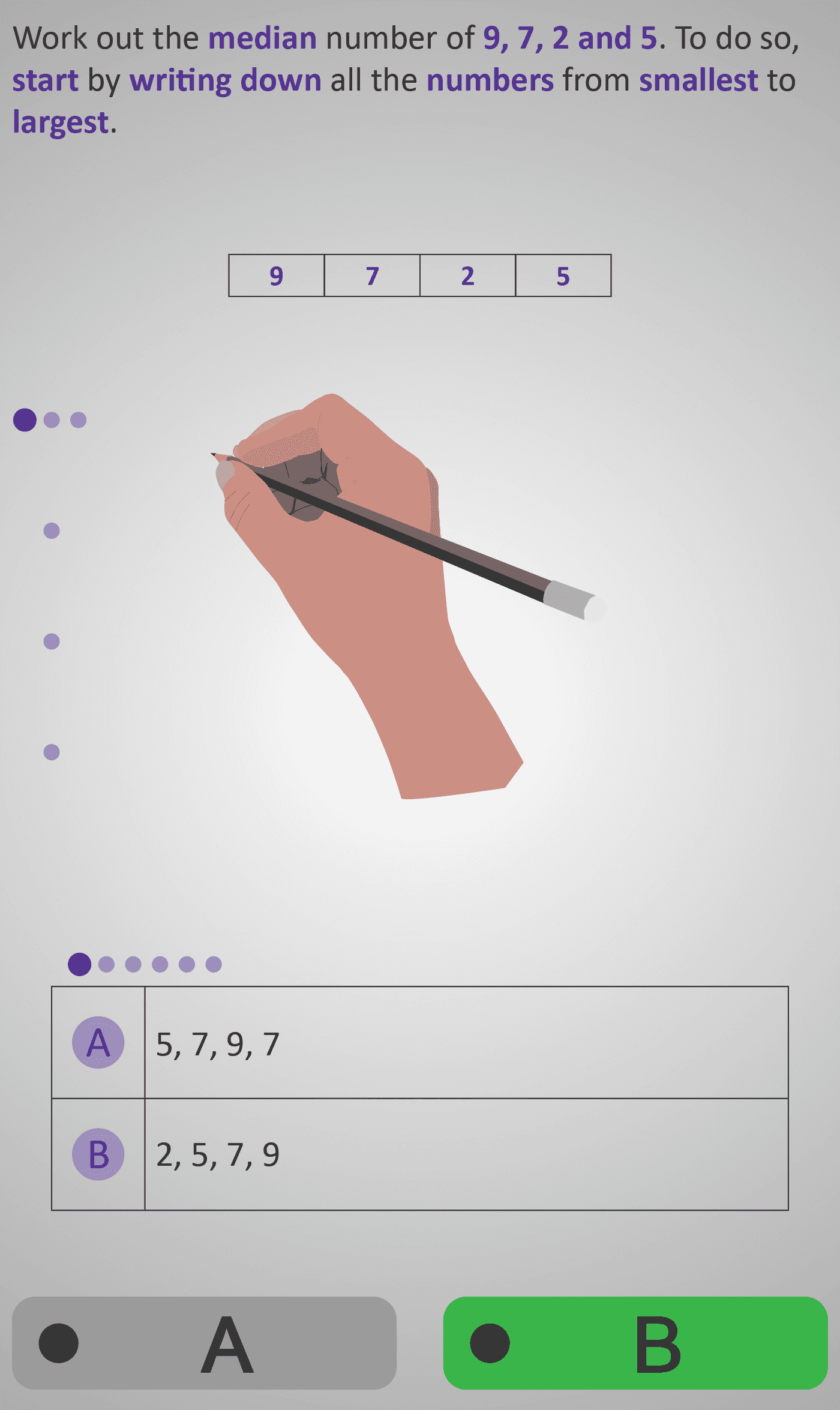
The example uses the numbers 9, 7, 2, and 5, guiding students through three simple, visual stages:
-
Order the numbers:
Students first arrange the data from smallest to largest:
2, 5, 7, 9.
This prepares the list for identifying the central values. -
Cross out from the ends:
Learners cross out the outermost numbers in pairs until only two remain in the middle — 5 and 7. This shows that with an even number of data points, there is no single middle number. -
Find the median:
Students calculate the average of the two middle values:
(5 + 7) ÷ 2 = 12 ÷ 2 = 6.
Therefore, the median of 2, 5, 7, and 9 is 6.
Through animated crossing-out and consistent arithmetic structure, students see why averaging two middle numbers produces the correct median in even-sized data sets. This bridges visual reasoning with procedural skill, setting a strong foundation for understanding mean vs median comparisons later.
By the end of this Phlow, learners can order, identify, and calculate the median confidently, developing deeper understanding of data organisation and central tendency.
Prerequisite Knowledge Required
- Median 1 – Finding the Median (Odd Number of Values).
- Mean 3 – Calculating the Mean (Average).
- Ordering Numbers 2A – Smallest to Largest.
- Ability to order numbers correctly.
- Basic addition and division fluency.
- Awareness that the median is the middle value of an ordered list.
- Familiarity with the term “average” and its arithmetic meaning.
Main Category
Statistics / Data Handling
Estimated Completion Time
Approx. 10–12 seconds per screen (5–6 screens total). Total Time: 2–3 minutes.
Cognitive Load / Step Size
Moderate — learners must recall multiple steps (order, cross out, average), but each is isolated and reinforced on its own screen, allowing for cognitive scaffolding.
Language & Literacy Demand
Low to Moderate — only one new term (median). Key action words (order, cross out, add, divide) are paired with colour cues and animations for clarity.
Clarity & Design
- The visual sequence mirrors real written work on paper.
- Animated handwriting models the correct order of operations.
- Purple highlights emphasise key numbers and mathematical steps.
- Consistent spacing and pacing support comprehension and rhythm.
Curriculum Alignment
Irish Junior Cycle Mathematics:
- Strand 4 – Statistics and Probability
- Substrand – Data and Representation
- Learning Outcomes:
- Identify the median in an ordered data set.
- Calculate the median for even and odd data sets.
- Develop fluency in data organisation and summarisation.
Engagement & Motivation
High — learners interact visually with a step-by-step crossing-out process that mirrors authentic reasoning. The simple structure and immediate clarity promote engagement and confidence.
Error Opportunities & Misconceptions
- Forgetting to order numbers before finding the median.
- Stopping after removing only one pair from each end.
- Adding middle values but forgetting to divide by 2.
- Confusing median with mean.
The Phlow prevents these by sequencing tasks logically and using clear on-screen corrections at each stage.
Transferability / Real-World Anchoring
High — understanding the median helps interpret data in real contexts such as exam scores, wages, or survey results. Learners see how median differs from mean and why it is often a fairer measure when data includes extremes.
Conceptual vs Procedural Balance
Balanced — students understand why the two middle numbers appear and how to calculate their average. This builds conceptual reasoning alongside procedural fluency.
Learning Objectives Addressed
- Order data correctly from smallest to largest.
- Identify middle values in even-numbered data sets.
- Calculate the median by averaging the two central numbers.
- Differentiate median from mean in context.
What Your Score Says About You
- Less than 5: Review ordering and averaging steps — make sure to cross out from both ends.
- 6–7: Good progress — check that you divide the total of the two middle numbers by 2.
- 8–9: You understand and apply the process accurately.
- 10 / 10: Excellent! You’ve mastered finding the median for even sets and are ready for Median 4, where you’ll compare mean and median in the same dataset.