
Mode 3A
Overview
In this Phlow, learners build on their understanding of the mode by analysing data presented in frequency tables. They discover that the modal value is the category with the greatest frequency — the highest number in the table. Through step-by-step examples, students practise reading, comparing, and explaining why one category is the most common.
Each example guides learners through two complementary reasoning stages — identifying the modal category and then justifying why it is the mode:
-
Favourite Month Example:
Students examine a table showing how many children chose each month as their favourite. They compare frequencies and find that December (31) has the largest value, making it the mode. A follow-up question reinforces conceptual reasoning by asking why December is the mode — because it’s the most popular month. -
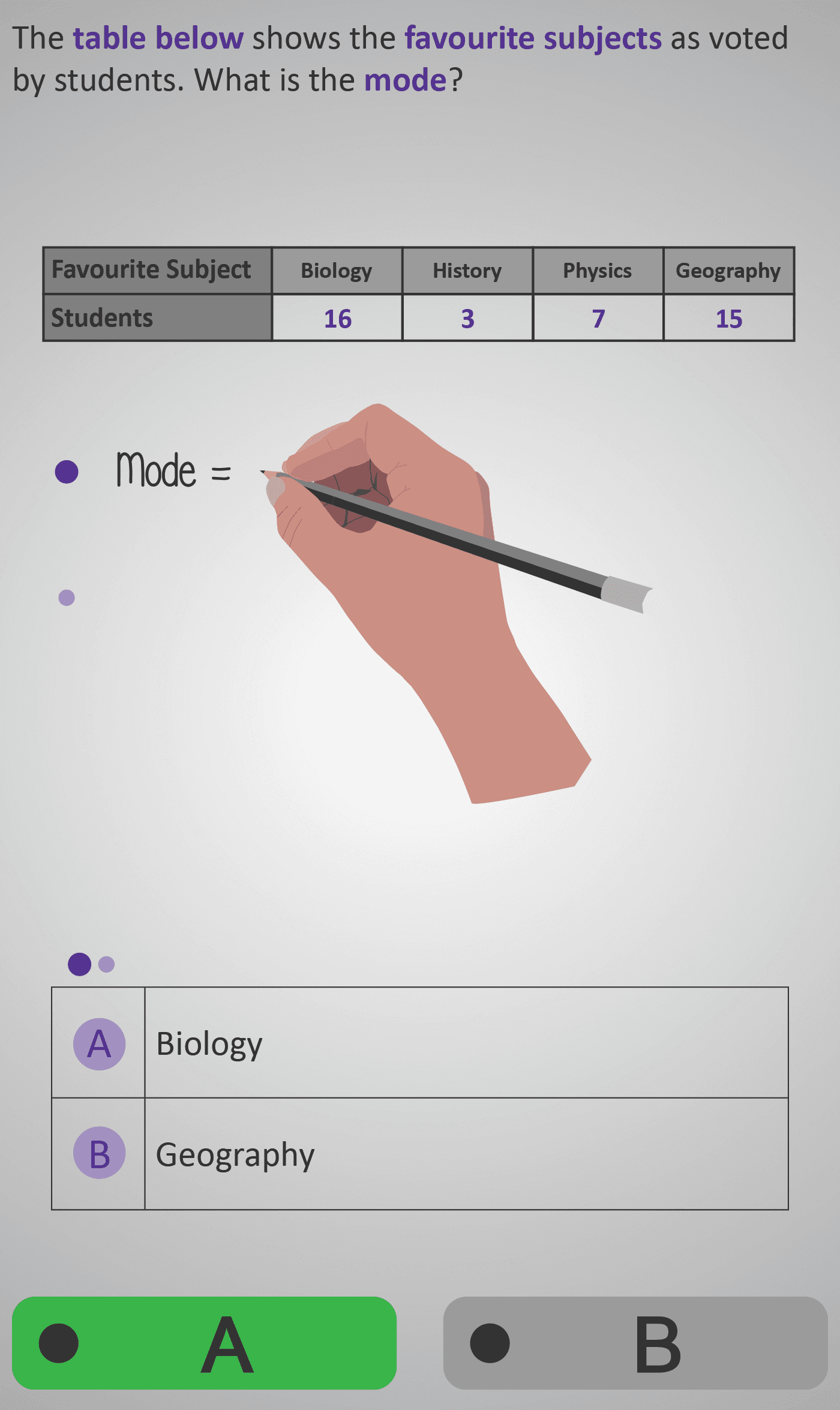
Favourite Subject Example:
A table lists school subjects and the number of votes each received. Students identify Biology (16) as the mode, since it has the greatest number of votes. The reasoning step confirms that the correct explanation relates to frequency, not alphabetical order.
The repetition of Mode = ___ followed by Reason = ___ strengthens both procedural fluency and conceptual understanding. Students learn not only to spot the modal value but also to articulate why it represents the most common category.
By the end, learners can confidently identify and justify the mode in frequency tables — a crucial step toward interpreting data summaries and statistical reasoning.
Prerequisite Knowledge Required
- Modal 3C – Identifying the Mode from a Table of Survey Results.
- Data Representation 2B – Reading Tables.
- Statistics 2A – Frequency and Counting.
- Understanding that mode means “most common” or “most frequent.”
- Ability to read and compare numerical values in a simple table.
- Awareness that higher frequency = more people/items choosing that category.
Main Category
Statistics / Data Handling
Estimated Completion Time
Approx. 12–15 seconds per screen (4 screens total). Total Time: 2–3 minutes.
Cognitive Load / Step Size
Moderate — students transition from visual or pictorial representations to abstract numerical tables. Each screen focuses on a single reasoning step (identify → explain), keeping cognitive demands clear and structured.
Language & Literacy Demand
Moderate — key vocabulary (frequency, mode, most common) is colour-highlighted. Learners also practise forming short written explanations (“because it has the highest number”), supporting mathematical communication skills.
Clarity & Design
- Tables are consistently structured with clear headers and simple numerical data.
- Purple highlighting draws attention to important terms (mode, most common, highest number).
- The handwriting-style animation reinforces process clarity and step-by-step logic.
- Contextual, relatable topics (months, subjects) enhance engagement.
Curriculum Alignment
Irish Junior Cycle Mathematics:
- Strand 4 – Statistics and Probability
- Substrand – Data and Representation
- Learning Outcomes:
- Identify and interpret the mode (most common category) from frequency tables.
- Justify findings using numerical frequency and clear reasoning.
- Use statistical language accurately in explanations.
Engagement & Motivation
High — familiar, real-world examples (favourite month, subject choices) make the task relatable and meaningful. The “Reason =” stage prompts active reflection and builds confidence in understanding why the mode matters.
Error Opportunities & Misconceptions
- Choosing the lowest instead of the highest frequency.
- Confusing mode with mean or median.
- Assuming the first or last item in a table is always the mode.
- Misreading category labels or overlooking frequencies.
These are prevented through consistent layout and explicit use of both Mode = and Reason = formats for each question.
Transferability / Real-World Anchoring
High — students learn to interpret real tables used in reports, surveys, and research. They build transferable skills in identifying and explaining “most popular” or “most frequent” results using data evidence.
Conceptual vs Procedural Balance
Balanced — learners perform a clear numeric procedure (finding the largest frequency) while also developing conceptual understanding of why that value represents the mode. This supports reasoning and communication in data interpretation.
Learning Objectives Addressed
- Identify the mode from a frequency table.
- Explain why the modal value represents the most common category.
- Connect numerical frequency with real-world meaning (e.g. “most popular”).
- Communicate reasoning using mathematical language.
What Your Score Says About You
- Less than 5: Recheck how to find the mode — look for the largest number in the frequency column.
- 6–7: You can identify the mode but should focus on explaining why it’s correct.
- 8–9: Excellent understanding — you link mode and reasoning clearly.
- 10 / 10: Outstanding! You can identify and justify the mode with confidence and are ready for Mode 3B, where you’ll compare two groups’ data to find which mode is higher or more frequent.