
Mode 3B
Overview
In this Phlow, learners are guided through the essential skill of ordering numbers from smallest to largest. Before finding the median or comparing data sets, students must first understand how to organise data logically.
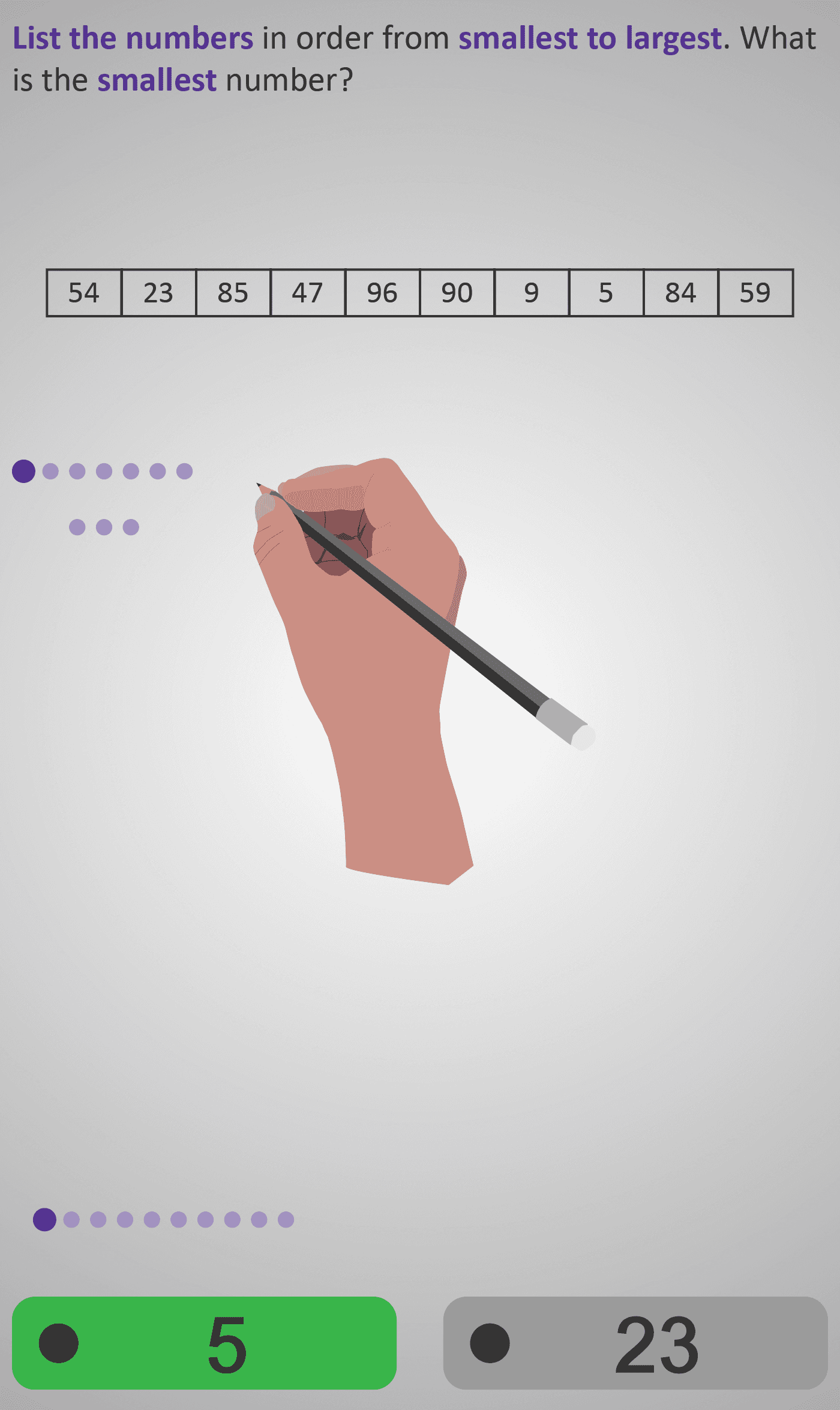
The activity begins with a mixed list of ten numbers displayed in boxes. Students are prompted step by step to:
- Identify the smallest number.
- Select the next smallest.
- Continue in sequence until all numbers are arranged in order.
Each screen builds the sequence progressively:
- Step 1: Select the smallest number (e.g. 5).
- Step 2: Choose the next smallest (e.g. 9).
- Step 3: Continue with 23, 47, and so on until the full ordered list appears.
Learners see the list forming gradually — for example, 5, 9, 23, 47... — which reinforces that ordering is a logical and repeatable process. The handwriting animation visually mimics how students might work the problem on paper, strengthening procedural fluency and attention to detail.
This Phlow builds a solid foundation for later statistical skills such as finding the median and comparing data sets. It promotes number sense, sequencing, and the concept of numerical order — key skills across mathematics and data analysis.
Prerequisite Knowledge Required
- Ordering Numbers 2A – Smallest to Largest (Two-Digit Numbers).
- Place Value 2B – Understanding tens and ones.
- Comparing Numbers 2A – Using greater than / less than symbols.
- Understanding of place value and relative size of numbers.
- Recognition that ascending order means values increase.
Main Category
Statistics / Data Handling
Estimated Completion Time
Approx. 10–12 seconds per screen (4 screens total). Total Time: 2 minutes.
Cognitive Load / Step Size
Moderate — each screen isolates a single comparison step, allowing learners to process one decision at a time. The visual highlighting and handwriting animation support memory and concentration while reinforcing sequencing logic.
Language & Literacy Demand
Low — mathematical words such as smallest, next, and largest are colour-highlighted and supported by clear visuals. Instructions are short and repetitive, making this suitable for learners of varied literacy levels.
Clarity & Design
- Rectangular number boxes are evenly spaced for easy visual comparison.
- Step-by-step hand animation supports gradual construction of ordered lists.
- Consistent purple highlights reinforce key mathematical terms.
- Two-choice prompts at each stage maintain focus and motivation.
Curriculum Alignment
Irish Junior Cycle Mathematics:
- Strand 4 – Statistics and Probability
- Substrand – Organising and Representing Data
- Learning Outcomes:
- Arrange numerical data in ascending order.
- Identify smallest and largest values within a data set.
- Organise information to prepare for finding the median or range.
Engagement & Motivation
High — students actively participate by selecting numbers in the correct order and watching the list take shape. The animation element creates a sense of ownership and progress, making abstract ordering feel tangible.
Error Opportunities & Misconceptions
- Confusing smallest with largest.
- Choosing numbers out of order due to left-to-right scanning.
- Overlooking similar tens digits (e.g. 59 vs 54).
Errors are immediately corrected through visual feedback and highlighting of the correct next number.
Transferability / Real-World Anchoring
High — ordering data underpins many real-world tasks, from ranking results to organising measurements or financial figures. This foundational skill prepares learners for interpreting graphs, calculating medians, and analysing trends.
Conceptual vs Procedural Balance
Primarily procedural, with conceptual reinforcement. Learners practise the sequence repeatedly while also understanding why data must be sorted before deeper analysis.
Learning Objectives Addressed
- Identify smallest and next smallest numbers within a data set.
- Arrange numbers correctly in ascending order.
- Prepare ordered data for median and range calculations.
- Develop number sense and sequencing accuracy.
What Your Score Says About You
- Less than 5: Revisit how to compare numbers — double-check which value is smaller before choosing.
- 6–7: You’re sequencing correctly most of the time — keep using a step-by-step approach.
- 8–9: Excellent — you can reliably order data and recognise patterns in size.
- 10 / 10: Perfect! You’ve mastered ordering numbers and are ready for Median 3A, where you’ll find the middle value once data is sorted.