
Money Notes 3
Overview
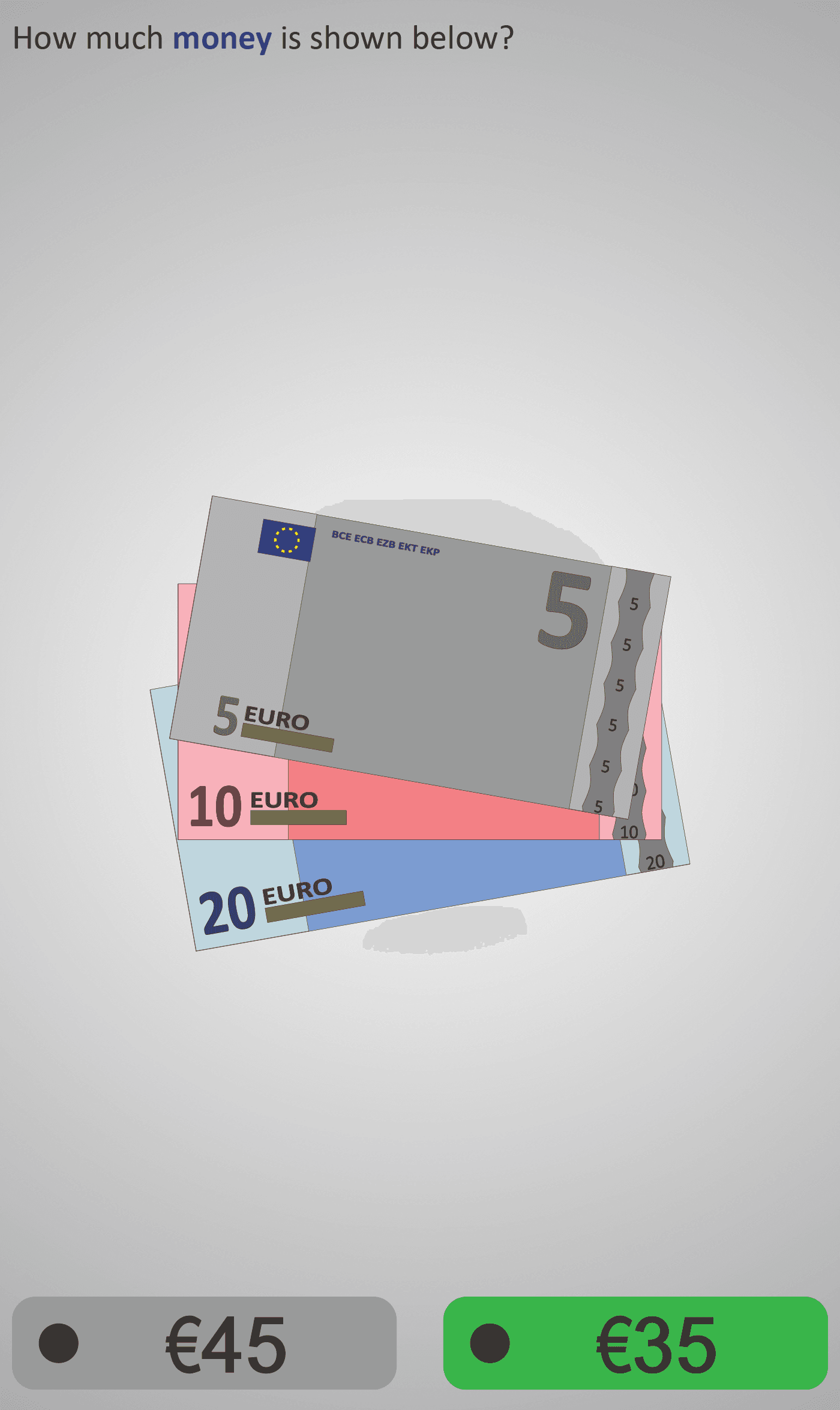
In this Phlow, learners are shown stacks of Euro banknotes and asked, “How much money is shown below?” They identify each note’s value and add them together to calculate the total amount.
The activity helps students connect visual recognition of note colours and denominations with numerical addition. Each example presents a small, realistic set of notes to encourage estimation and mental calculation:
- €5, €10, and €20 → total €35
- €10, €50, and €100 → total €160
- €5, €20, and €50 → total €75
Across these screens, learners internalise the structure of base-ten addition (5 + 10 + 20 = 35) while associating it with everyday contexts such as shopping, saving, or budgeting.
Students are encouraged to look carefully at each note, recognise its colour, size, and label, and then link that visual cue to its numerical value. This develops both money awareness and number fluency.
By practising mental addition with realistic visuals, learners build confidence handling mixed denominations — a key foundation for financial literacy and everyday numeracy.
Prerequisite Knowledge Required
- Money Notes 2 – Recognising Euro Notes.
- Money Coins 2 – Adding Simple Coin Values.
- Addition 2A – Two-Digit Sums Without Regrouping.
- Ability to identify euro note denominations (€5, €10, €20, €50, €100).
- Understanding of addition within 100, extending to simple 3-digit totals.
- Familiarity with the € symbol and reading currency values.
Main Category
Number / Financial Maths
Estimated Completion Time
Approx. 8–10 seconds per screen (3 screens total). Total Time: 1.5–2 minutes.
Cognitive Load / Step Size
Low to Moderate — each question isolates one mental addition involving two or three notes. Visual support and minimal options maintain focus on recognition and addition without distraction.
Language & Literacy Demand
Low — clear, repetitive phrasing (“How much money is shown below?”) supports understanding. Mathematical symbols (€ and +) take precedence over long sentences, minimising reading demand.
Clarity & Design
- Euro notes displayed in accurate colours and proportions for easy recognition.
- Only a few notes shown per screen to maintain visual clarity.
- Consistent layout and phrasing across screens reinforce familiarity and focus.
- Colour scheme mirrors real euro denominations (grey €5, red €10, blue €20, orange €50, green €100).
Curriculum Alignment
Irish Mathematics Curriculum:
- Strand – Measures
- Strand Unit – Money
- Learning Outcomes:
- Recognise and use euro notes up to €100.
- Add combinations of notes to find total amounts.
- Understand money as a numerical representation of value.
Engagement & Motivation
High — the use of realistic euro visuals makes the learning meaningful and practical. Students experience success through relatable, everyday problem-solving contexts like counting cash or estimating totals.
Error Opportunities & Misconceptions
- Confusing similar note values (e.g. €10 vs €100).
- Forgetting to include all notes in the total.
- Miscalculating when mixing tens and hundreds.
These are addressed through structured examples and immediate corrective feedback.
Transferability / Real-World Anchoring
Very High — this Phlow links directly to real financial skills such as counting cash, budgeting, and handling payments. It reinforces numeracy for daily life and early financial independence.
Conceptual vs Procedural Balance
Balanced — learners practise a straightforward procedure (addition) while building conceptual awareness of money values and equivalence between denominations.
Learning Objectives Addressed
- Identify euro notes and their respective values.
- Add different note combinations accurately.
- Link addition to real-world financial scenarios.
- Develop fluency and confidence in everyday money handling.
What Your Score Says About You
- Less than 5: Review euro note values and practise slower, step-by-step addition.
- 6–7: You recognise notes correctly — focus on increasing your speed and confidence.
- 8–9: Great progress — you add quickly and accurately.
- 10 / 10: Excellent! You can confidently count euro notes and are ready for Money Notes 4, where you’ll calculate change and combine notes with coins.