
Multiples 3
Overview
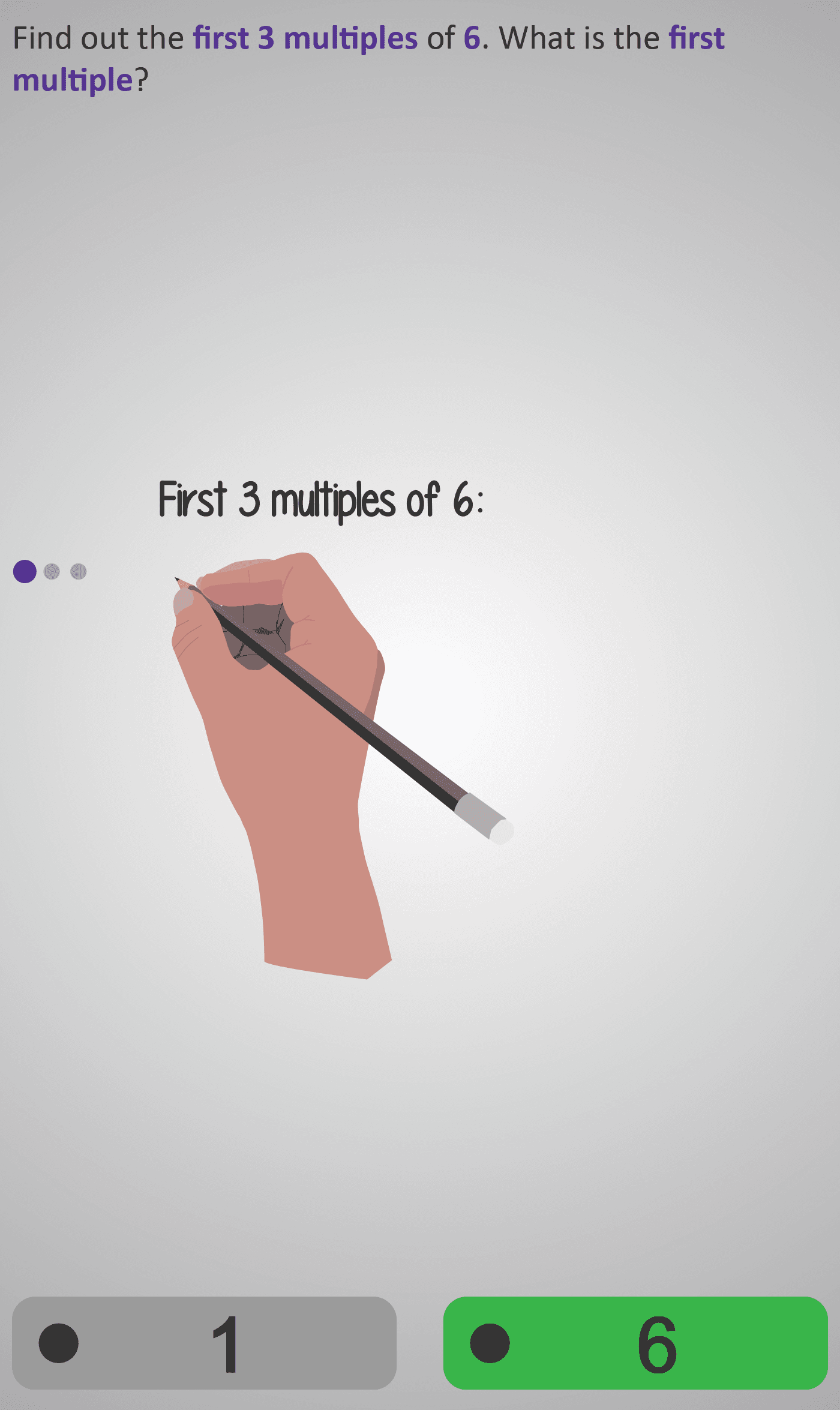
In this Phlow, learners are guided step by step through identifying the first three multiples of 6. The concept of a multiple is introduced through simple, cumulative reasoning — a multiple is the result of multiplying a number by 1, 2, 3, and so on.
Each screen focuses on one part of the sequence:
- First multiple of 6 → 6 × 1 = 6
- Second multiple of 6 → 6 × 2 = 12
- Third multiple of 6 → 6 × 3 = 18
Students see these results appear progressively — 6, 12, 18 — reinforcing the idea that multiples follow a consistent repeated-addition pattern (adding 6 each time). The stepwise visual presentation supports both conceptual understanding and fluency.
By focusing on one calculation per screen, the Phlow maintains clarity and ensures that learners understand why multiples occur at regular intervals. The handwriting animation mirrors classroom note-taking, strengthening retention.
By the end, students can generalise the rule:
“To find the next multiple, keep adding the same number or multiply by 1, 2, 3, 4…”
This prepares them for later Phlows on factors,
common multiples, and times tables.
Prerequisite Knowledge Required
- Multiplication 2A – Repeated Addition.
- Times Tables 2B – Understanding Groups of Numbers.
- Skip Counting 2C – Counting in Steps of 2, 3, 4, etc.
- Understanding that multiplication means repeated addition (e.g. 6 × 3 = 6 + 6 + 6).
- Confidence counting in steps (6, 12, 18, 24, …).
- Familiarity with the concept of a number sequence.
Main Category
Number / Multiplication & Division
Estimated Completion Time
Approx. 8–10 seconds per screen (3 screens total). Total Time: 1.5–2 minutes.
Cognitive Load / Step Size
Low to Moderate — each screen isolates one multiplication, allowing understanding to build gradually without overwhelming working memory. The repetition of a single structure supports mastery through pattern recognition.
Language & Literacy Demand
Low — instructions use short, familiar phrasing (“first multiple,” “second multiple,” “multiply by”). Mathematical notation and colour-coding replace heavy text, reducing literacy demand.
Clarity & Design
- Each calculation is shown clearly, one at a time.
- Key terms like first 3 multiples are highlighted for focus.
- Handwriting animation mirrors real problem-solving steps.
- Clean layout ensures visual clarity and sequential flow.
Curriculum Alignment
Irish Junior Cycle Mathematics:
- Strand 3 – Number
- Substrand – Operations (Multiplication)
- Learning Outcomes:
- Identify and generate multiples of a given number.
- Recognise multiplication as repeated addition.
- Describe and extend numerical patterns in multiples.
Engagement & Motivation
High — learners gain satisfaction from seeing clear, predictable patterns form. The immediate feedback from each calculation encourages confidence and reinforces understanding through success-based repetition.
Error Opportunities & Misconceptions
- Confusing multiples with factors (thinking of divisors instead of products).
- Skipping or adding incorrectly between steps (e.g. 6, 13, 18).
- Forgetting that the first multiple is the number itself.
These are addressed through consistent reinforcement of the rule “multiply by 1, 2, 3…” and immediate corrective feedback.
Transferability / Real-World Anchoring
Moderate to High — understanding multiples supports real-world skills like grouping items, time intervals, or quantities (e.g. packs of 6 cans, minutes in multiples of 5). It also underpins proportional reasoning and divisibility concepts.
Conceptual vs Procedural Balance
Balanced — students perform clear procedures while also understanding why multiples follow regular intervals. This dual focus strengthens long-term retention and reasoning.
Learning Objectives Addressed
- Define and identify multiples of a number.
- Generate the first few multiples through multiplication or repeated addition.
- Recognise and describe the sequential nature of multiples.
- Build readiness for factors, common multiples, and LCM (Lowest Common Multiple).
What Your Score Says About You
- Less than 15: Revisit what a multiple means — start with smaller numbers like 2, 3, or 4.
- 16–22: You’re identifying the pattern — keep practising your times tables for fluency.
- 23–29: Great pattern recognition and understanding of repeated addition.
- 30 / 30: Excellent! You’re fluent in generating multiples and ready for Multiples 4, where you’ll explore common multiples of two numbers.