
Multiply 3
Overview
In this Phlow, learners develop fluency with multiplication by solving simple equations such as:
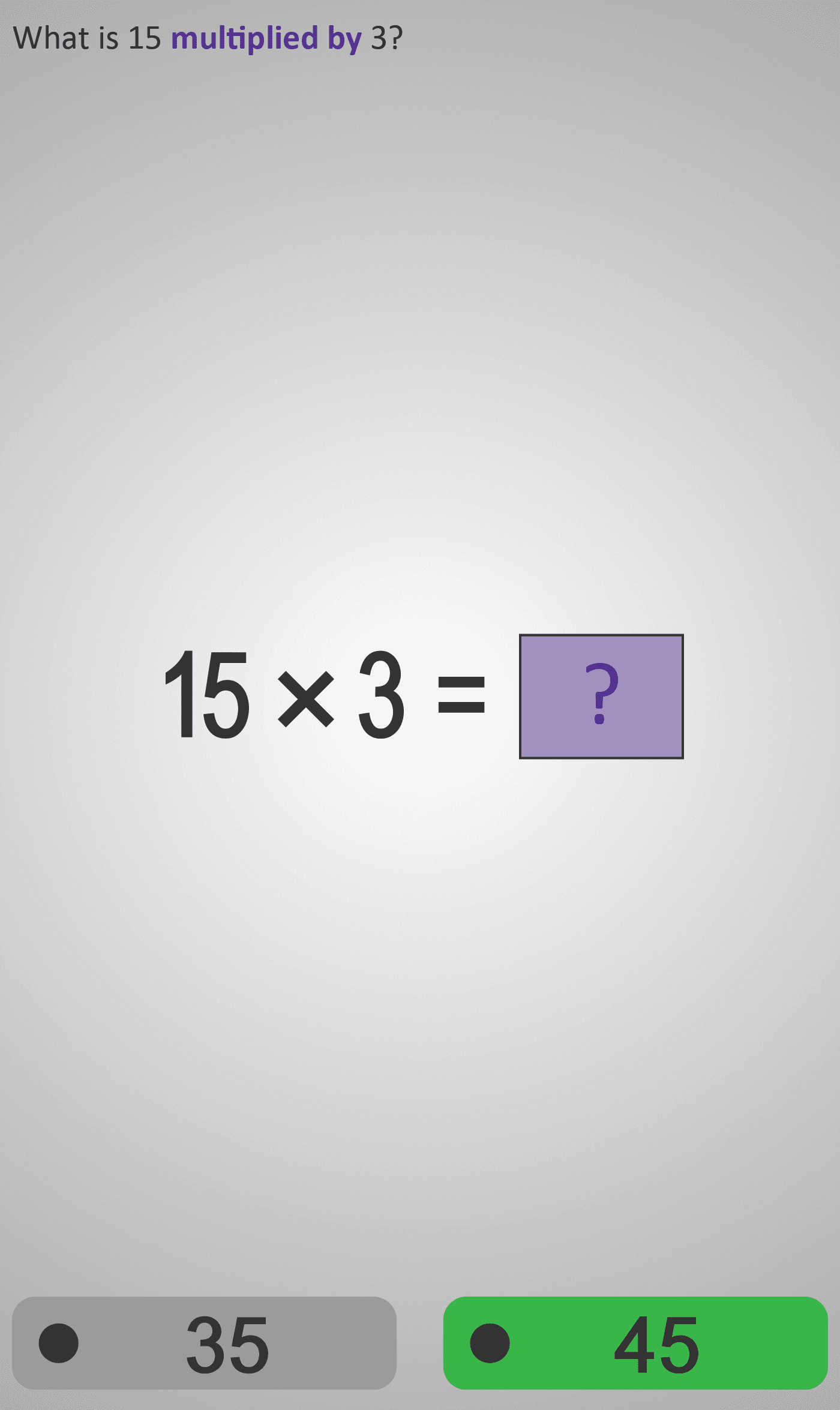
15 × 3 = 45
2 × 12 = 24
16 × 2 = 32
Each question presents a clear multiplication sentence with one missing value (the product), encouraging pattern recognition and recall. The question prompt — “What is 15 multiplied by 3?” — reinforces key mathematical language and supports the transition from verbal reasoning to symbolic understanding (× = “multiplied by”).
By isolating one problem per screen, the learner focuses purely on conceptual and procedural fluency. The variation in examples (smaller × larger, even × odd) strengthens number sense and promotes flexible thinking about multiplication.
Through repetition, students internalise multiplication as a faster way of adding equal groups. The gradual variation of examples also reinforces commutativity (2 × 12 = 12 × 2) and builds confidence for larger calculations.
This Phlow bridges the step between learning multiplication as repeated addition and applying it to real-world or algebraic contexts in later levels.
Prerequisite Knowledge Required
- Multiply 2 – Multiplying by 1-digit Numbers.
- Repeated Addition 2A – Understanding Equal Groups.
- Times Tables 2B – Building Patterns.
- Understanding that multiplication represents equal groups or repeated addition.
- Recall of key multiplication facts up to 12 × 12.
- Familiarity with the × symbol and the phrase “multiplied by.”
- Ability to interpret simple equations with one missing value.
Main Category
Number / Multiplication & Division
Estimated Completion Time
Approx. 8–10 seconds per screen (3 screens total) → 1.5–2 minutes total.
Cognitive Load / Step Size
Moderate — each screen isolates one multiplication, focusing attention on mental recall rather than multi-step reasoning. The structure maintains challenge while keeping the learner in flow.
Language & Literacy Demand
Low — key terms (multiplied by, equals) are colour-highlighted for recognition. Repeated sentence structures minimise reading load and reinforce mathematical language.
Clarity & Design
- Bold numerals and purple highlight draw focus to the unknown value.
- Only one equation per screen to reduce distraction.
- Consistent visual layout supports schema-building for symbolic multiplication.
- Immediate feedback (green highlight) reinforces mastery.
Curriculum Alignment
Irish Junior Cycle Mathematics – Strand 3: Number
- Recall and apply multiplication facts.
- Recognise and use the commutative property of multiplication.
- Solve problems involving two-digit × one-digit multiplication.
Engagement & Motivation
High — learners receive instant confirmation for each answer, creating momentum and confidence. The clean design and rapid feedback sustain engagement through quick wins.
Error Opportunities & Misconceptions
- Confusing multiplication with addition (e.g. 15 + 3 = 18).
- Swapping factors and thinking order matters (3 × 15 ≠ 15 × 3).
- Addition slips, e.g. writing 2 × 12 = 14 instead of 24.
These are prevented through repetition, clear layout, and immediate corrective feedback.
Transferability / Real-World Anchoring
Moderate — reinforces strategies for everyday tasks like calculating totals, scaling recipes, or estimating costs. Multiplication simplifies repeated addition across real contexts.
Conceptual vs Procedural Balance
Procedural with conceptual reinforcement — while practising recall, learners also deepen understanding of grouping, scaling, and proportional reasoning.
Learning Objectives Addressed
- Multiply two numbers accurately and efficiently.
- Interpret multiplication as repeated addition.
- Apply mental strategies and recall facts to solve problems.
- Strengthen symbolic understanding of multiplication equations.
What Your Score Says About You
- Less than 15: Review your times tables and practise smaller multiplication facts.
- 16–22: You understand the process — focus on accuracy and recall speed.
- 23–29: You’re strong in multiplication fluency and mental recall.
- 30 / 30: Excellent! You’re ready for Multiply 4, where you’ll apply multiplication to real-world problems and area calculations.