
Numbers 3A
Overview
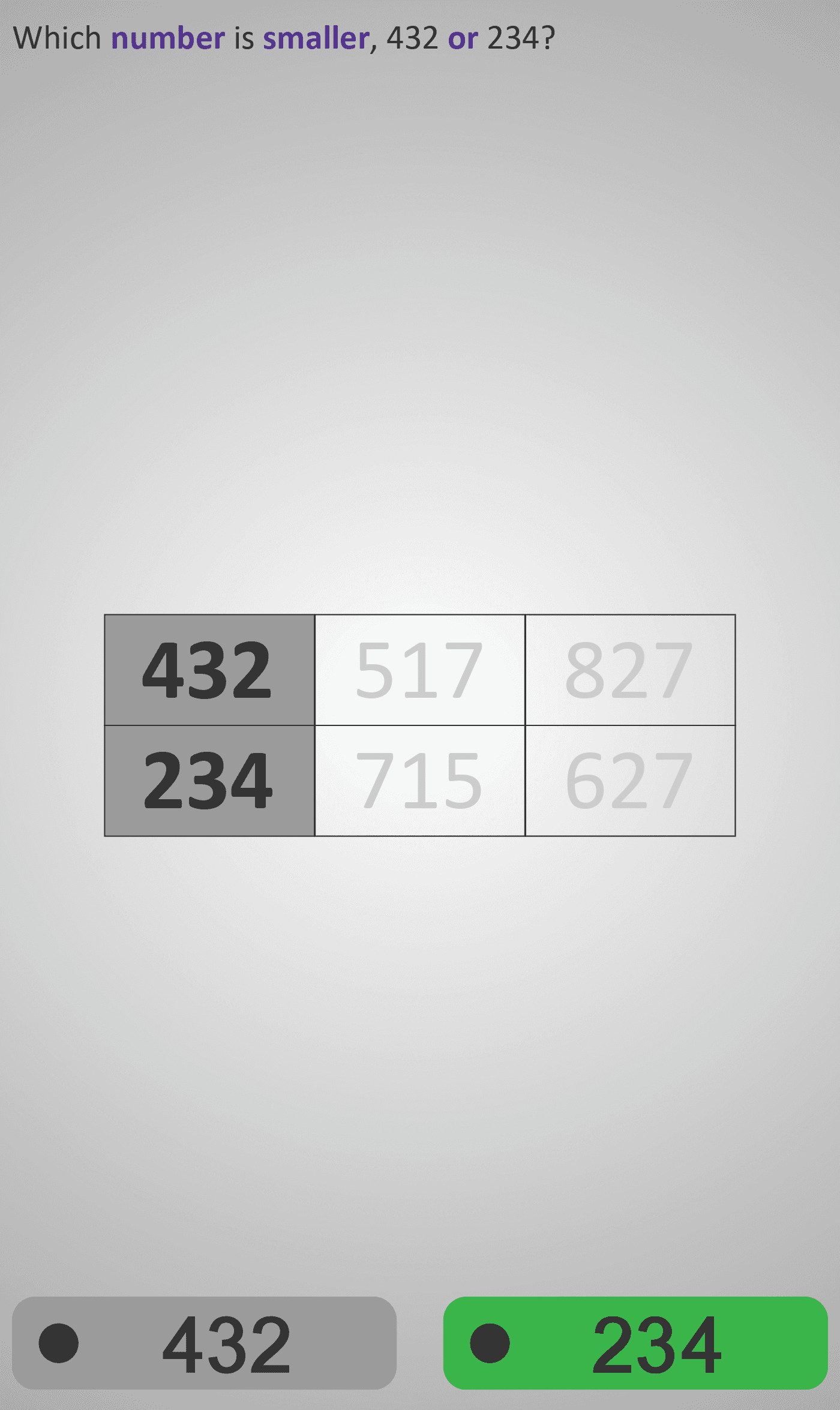
In this Phlow, learners focus on comparing 3-digit numbers by identifying which of two numbers is smaller. They are guided through a sequence of questions that reinforce place-value reasoning:
- Which number is smaller, 432 or 234?
- Which number is smaller, 517 or 715?
- Which number is smaller, 827 or 627?
The design presents pairs of numbers side by side in a grid format, allowing learners to compare visually before choosing between two options. Through repeated examples, students begin to understand that the digit in the hundreds place is the most significant when comparing whole numbers. If the hundreds digits are the same, they move on to compare the tens, then the ones.
This process develops a structured way of thinking about number comparison — a skill central to ordering, rounding, and estimation in later topics. By isolating one pair at a time, the Phlow reduces cognitive load and ensures students practise consistent reasoning without distraction.
The consistent pattern of questioning (“Which number is smaller?”) and immediate visual feedback (highlighting the correct choice) reinforce accuracy, confidence, and number intuition. By the end, learners can independently determine which of two multi-digit numbers is smaller or larger by applying place-value logic step-by-step.
Prerequisite Knowledge Required
- Numbers 2B – Comparing 2-Digit Numbers.
- Place Value 2A – Understanding Hundreds, Tens, and Ones.
- Counting in Hundreds 2C – Base-10 Expansion.
- Understanding that digits in the hundreds, tens, and ones places represent different magnitudes.
- Ability to compare two-digit numbers.
- Familiarity with the terms smaller, larger, greater than, and less than.
- Confidence reading and writing 3-digit numbers up to 999.
Main Category
Number / Place Value & Comparison
Estimated Completion Time
Approx. 8–10 seconds per screen (3 screens total) → 1.5–2 minutes total.
Cognitive Load / Step Size
Moderate — each screen focuses on one clear comparison with visually distinct number pairs. The grid layout aids attention and supports reasoning through pattern recognition.
Language & Literacy Demand
Low to Moderate — key words (number, smaller, or) are highlighted to reinforce comprehension. The repeated phrasing strengthens familiarity with mathematical language and structure.
Clarity & Design
- Grid layout aligns numbers vertically for direct comparison.
- Each screen focuses on a single decision to minimise distraction.
- Alternating left/right placement prevents pattern guessing.
- Immediate feedback reinforces correct place-value reasoning.
Curriculum Alignment
Irish Mathematics Curriculum – Number Strand / Junior Cycle Strand 3: Number
- Compare and order whole numbers up to 999.
- Apply place-value knowledge to determine which number is greater or smaller.
- Explain comparisons using hundreds, tens, and ones.
Engagement & Motivation
High — the clear question–response format offers quick success moments. Students feel a growing sense of challenge as numbers become more complex while maintaining clarity and pace.
Error Opportunities & Misconceptions
- Reversing the comparison (choosing the larger instead of the smaller).
- Comparing only the last digit instead of starting from the hundreds place.
- Assuming that “more digits” always means larger.
These are corrected through immediate feedback, clear layout, and repeated reinforcement of place-value order.
Transferability / Real-World Anchoring
High — comparing numbers underpins practical reasoning such as comparing prices, distances, or data values in daily life.
Conceptual vs Procedural Balance
Balanced — learners apply a step-by-step procedure (compare hundreds → tens → ones) while developing conceptual insight into number structure.
Learning Objectives Addressed
- Compare two 3-digit numbers using place value.
- Understand that the hundreds place determines magnitude.
- Use correct mathematical language to describe comparisons.
- Build readiness for ordering lists and using < and > symbols.
What Your Score Says About You
- Less than 15: Review place value — practise comparing by hundreds, tens, and ones.
- 16–22: You understand the concept but may need more accuracy or pace.
- 23–29: You’re confident at comparing 3-digit numbers.
- 30 / 30: Excellent! You’ve mastered this and are ready for Numbers 3B, where you’ll order multiple 3-digit numbers from smallest to largest.