
Numbers 3B
Overview
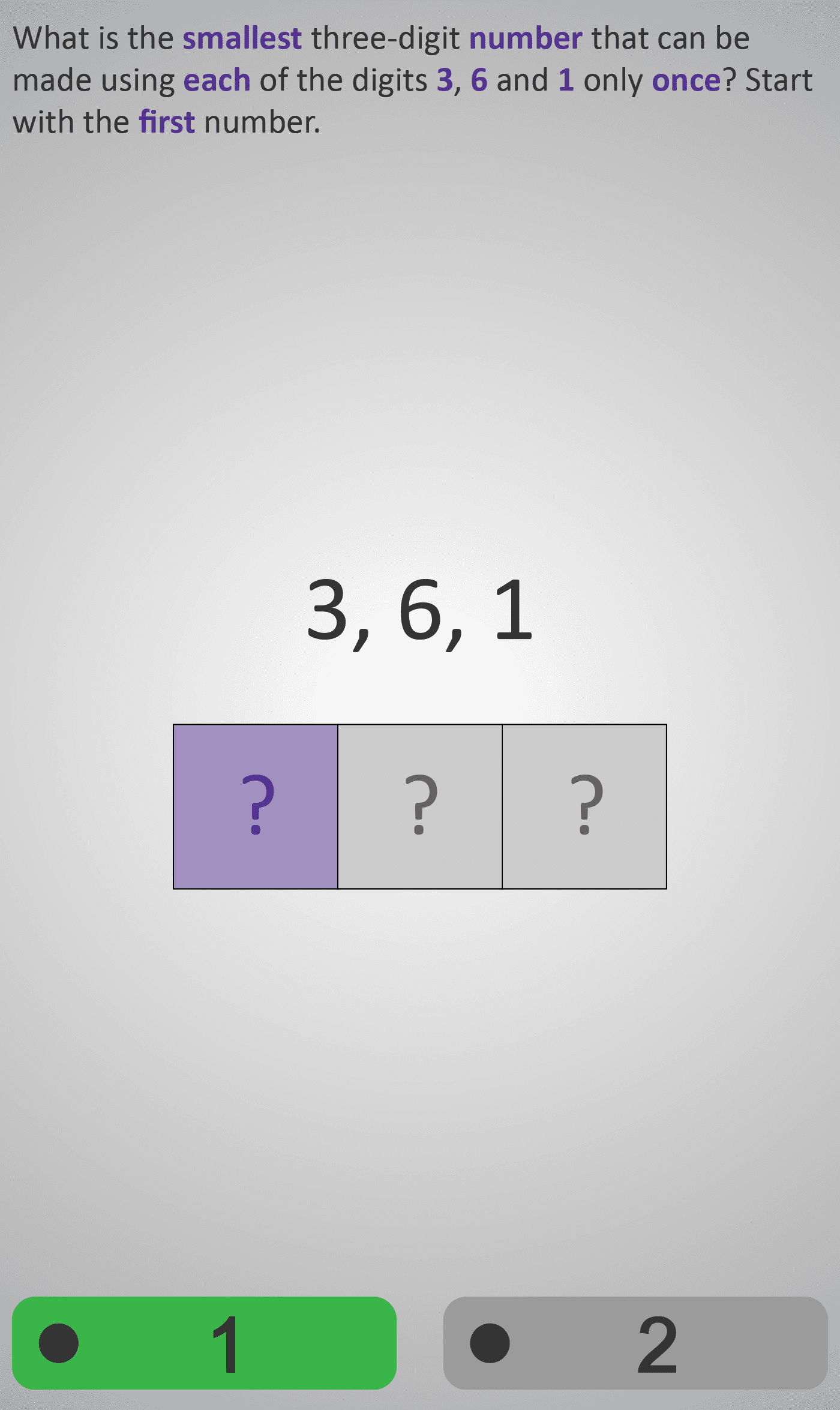
In this Phlow, learners explore how the position of digits affects the size of a number. They are given sets of digits (e.g. 7, 8, 3 or 3, 6, 1) and must decide how to arrange them to make the largest or smallest possible 3-digit number, using each digit only once.
- Forming the largest number from 7, 8, 3 → 873
- Forming the smallest number from 3, 6, 1 → 136
Each step isolates one decision — choosing the first, second, and last digit — guiding students to reason systematically through place value. By starting with prompts like “Start with the first number,” then “Then the next number,” the learner experiences how the position of a single digit changes the overall value.
The design encourages reflective reasoning: to make the largest number, the biggest digit goes in the hundreds place; to make the smallest, the smallest digit goes there. This visual and interactive process strengthens the understanding that digit position determines value, a foundation for comparing, ordering, and rounding numbers at higher levels.
Learners also experience an early form of combinatorial reasoning — understanding that digits can form different numbers depending on order — which underpins future algebraic and logical thinking.
Prerequisite Knowledge Required
- Numbers 3A – Comparing 3-Digit Numbers.
- Place Value 2B – Hundreds, Tens, and Ones.
- Order 2A – Sequencing Numbers.
- Understanding how digit position (hundreds, tens, ones) affects number size.
- Ability to compare and order digits from smallest to largest.
- Familiarity with constructing 2- and 3-digit numbers.
- Comprehension of terms like largest, smallest, digit, number, next, and last.
Main Category
Number / Place Value & Number Construction
Estimated Completion Time
Approx. 10 seconds per screen (6 screens total) → 2–3 minutes total.
Cognitive Load / Step Size
Moderate — each screen isolates one decision (first, next, last digit), making reasoning sequential and easy to follow. Repetition deepens understanding of how digit order impacts magnitude.
Language & Literacy Demand
Moderate — sentences highlight key mathematical terms (largest, smallest, next, number, once) to reinforce reasoning. Phrasing scaffolds logical thought in clear, accessible language.
Clarity & Design
- Digits are displayed separately from empty boxes for placement clarity.
- Each step focuses on one position to avoid overload.
- Purple highlights guide attention to the current decision point.
- Immediate feedback (green highlight) reinforces correct reasoning.
Curriculum Alignment
Irish Mathematics Curriculum – Number Strand / Junior Cycle Strand 3: Number
- Construct and compare numbers up to 999 using place value reasoning.
- Understand that rearranging digits changes the size of a number.
- Identify patterns and rules in forming the largest and smallest numbers.
Engagement & Motivation
High — the puzzle-like, step-by-step process keeps learners curious and engaged. Each successful placement gives a sense of progress, maintaining focus and flow.
Error Opportunities & Misconceptions
- Reversing the rule (placing the smallest digit first when forming the largest number).
- Repeating digits instead of using each once.
- Confusing largest with smallest.
Consistent language and visual cues help correct these errors quickly.
Transferability / Real-World Anchoring
High — understanding how digits form numbers connects directly to reading prices, measurements, and numerical data, all of which rely on interpreting order and size correctly.
Conceptual vs Procedural Balance
Strongly conceptual — learners practise constructing numbers while internalising the deeper logic of positional value and magnitude.
Learning Objectives Addressed
- Form 3-digit numbers from given digits.
- Use place value to identify the largest and smallest possible number.
- Recognise the effect of digit position on number value.
- Strengthen sequencing, reasoning, and comparison skills.
What Your Score Says About You
- Less than 15: Review place value — practise how digit order changes number size.
- 16–22: You understand the logic but need more accuracy when choosing the next digit.
- 23–29: Excellent grasp of place value reasoning and sequencing.
- 30 / 30: Perfect! You’ve mastered digit ordering — you’re ready for Numbers 4A, where you’ll apply place value in rounding and estimating larger numbers.