
Patterns & Sequence 3A
Overview
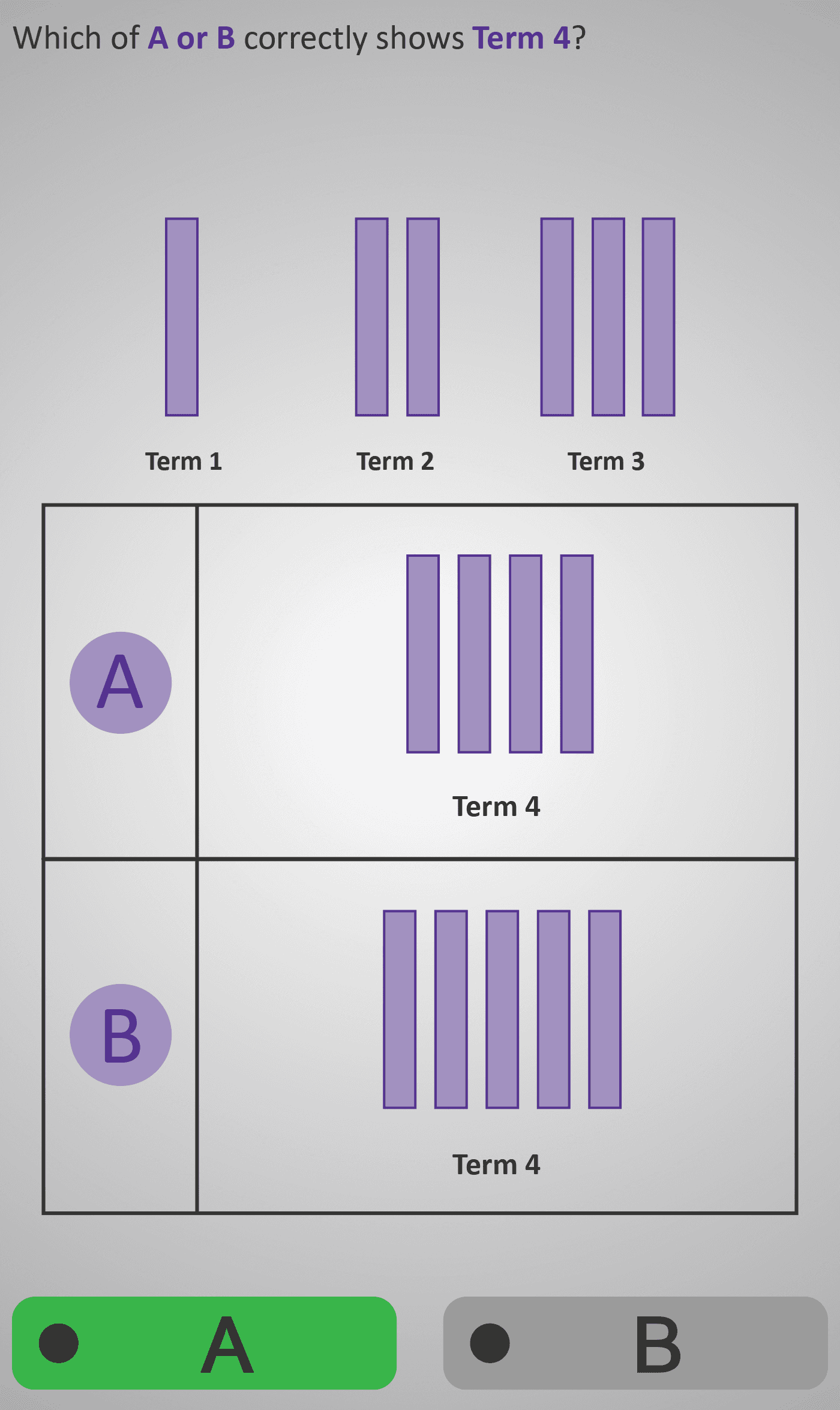
In this Phlow, learners practise recognising repeating and growing patterns using visual sequences of shapes and arrangements. Each question shows the first three terms (Term 1, Term 2, Term 3), and asks the student to select which of two options, A or B, correctly shows Term 4.
- Example 1: Vertical bars increasing by one each time (1, 2, 3, then 4 bars).
- Example 2: Groups of ovals arranged diagonally, increasing consistently.
- Example 3: Tilted rectangles growing in number, showing rotation consistency and repetition.
By observing how each pattern develops, students infer the rule and apply it to identify the next stage. This develops both mathematical reasoning (recognising consistent numerical increases) and spatial reasoning (tracking position, orientation, and quantity).
Through visual pattern growth, learners begin to understand that patterns can represent rules — an essential idea that underpins algebra, sequences, and functional relationships in later learning. This exercise builds confidence in identifying, predicting, and generalising patterns, preparing learners for symbolic sequence notation in later Phlows.
Prerequisite Knowledge Required
- Patterns & Sequence 2A – Repeating Patterns.
- Count 2B – Counting Forward and Backward.
- Shape Patterns 2B – Recognising Repetition and Rotation.
- Ability to recognise repeating and growing patterns visually.
- Understanding that patterns follow a rule that can be extended.
- Familiarity with ordinal order (Term 1, Term 2, Term 3, Term 4).
- Comfort counting simple increases (e.g., adding one more element each time).
Main Category
Algebra / Patterns & Sequences
Estimated Completion Time
Approx. 10 seconds per screen (3 screens total) → 1.5–2 minutes total.
Cognitive Load / Step Size
Moderate — learners analyse one variable at a time (quantity, arrangement, or orientation). By keeping the background neutral and shapes uniform, visual focus remains on structure recognition.
Language & Literacy Demand
Low — key terms (A or B, Term 4, correctly shows) are short and highlighted, supporting comprehension even for early readers. Sentence phrasing is concise and repeated for consistency.
Clarity & Design
- Clean layout with distinct separation between pattern terms.
- Predictable top-to-bottom structure (pattern → choices → question) maintains clarity.
- Alternating A/B placements prevent guessing through repetition.
- Consistent purple shading links visual continuity and guides attention.
Curriculum Alignment
Irish Mathematics Curriculum – Algebra Strand / Junior Cycle Specification
- Recognise and describe patterns and relationships in shapes and numbers.
- Predict and extend patterns logically.
- Understand that rules can describe how patterns grow or repeat.
Engagement & Motivation
High — each screen feels like solving a visual puzzle, promoting curiosity and flow. The visible change between terms maintains attention, while correct answers are reinforced with instant green feedback.
Error Opportunities & Misconceptions
- Confusing repeating with growing patterns.
- Focusing on rotation rather than number of elements.
- Miscounting or misinterpreting spatial arrangements.
Feedback and consistent examples reinforce accurate recognition and correction.
Transferability / Real-World Anchoring
High — recognising patterns connects to design, music, coding, and data reasoning, laying the foundation for later algebraic and functional thinking.
Conceptual vs Procedural Balance
Conceptual — learners explore pattern rules rather than following fixed procedures, developing early generalisation skills for algebra.
Learning Objectives Addressed
- Identify and continue visual patterns accurately.
- Predict the next term in a growing pattern.
- Recognise that all patterns follow consistent rules.
- Strengthen reasoning and generalisation skills.
What Your Score Says About You
- Less than 15: Review visual sequences and practise counting or orientation-based growth.
- 16–22: You can spot patterns but may need to check direction or rotation carefully.
- 23–29: Strong pattern recognition and logical reasoning.
- 30 / 30: Excellent! You’re ready for Patterns & Sequence 3B, where patterns move from visuals to number-based sequences.