
Patterns & Sequence 3B
Overview
In this Phlow, learners build on their understanding of growing patterns by moving from visual to numerical patterns. The story context — John saving money weekly — helps students connect pattern growth to real-life arithmetic situations.
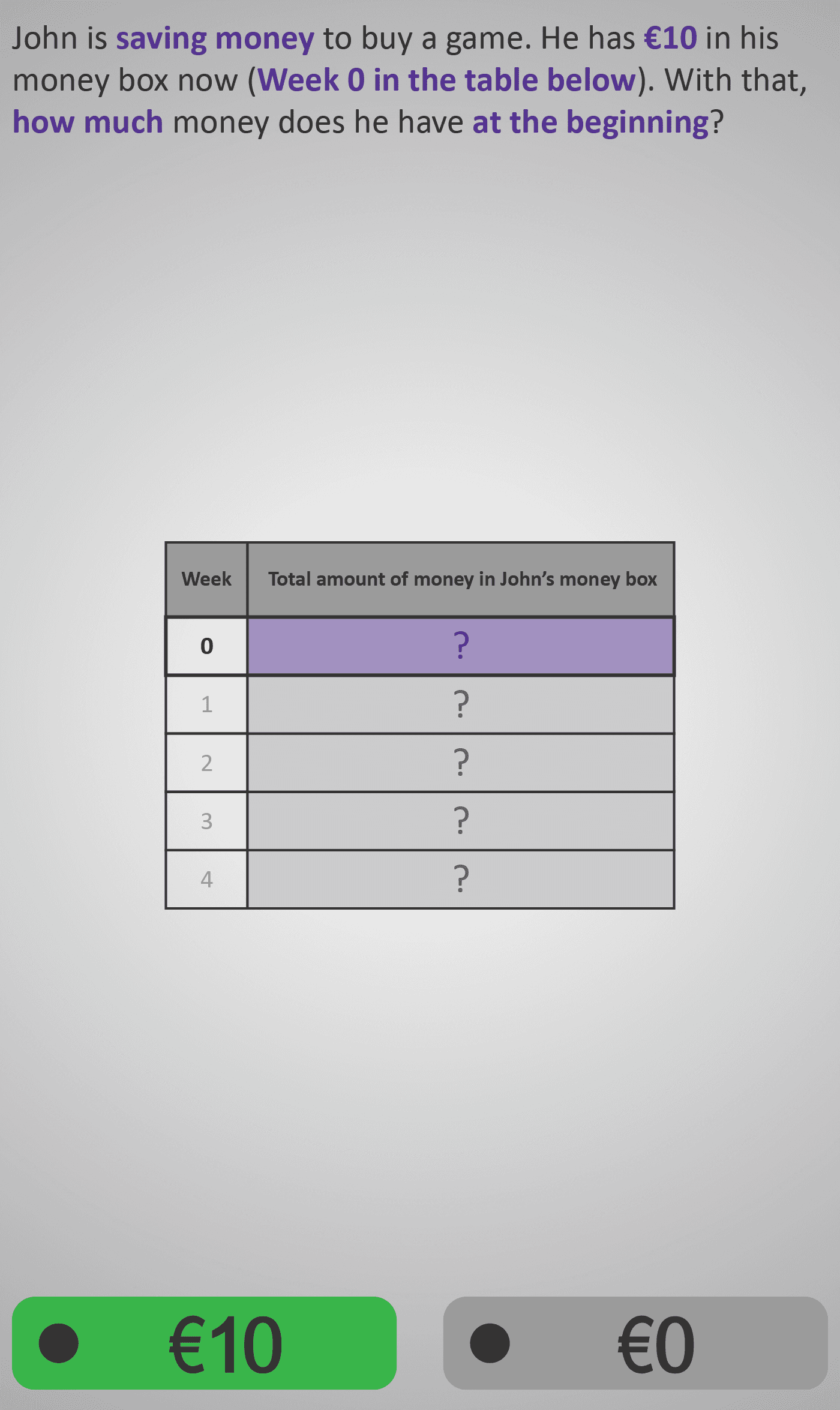
Students see that John begins with €10 and saves €3 per week. They calculate the total amount after 1, 2, 3, and 4 weeks by adding €3 each time, observing that the total increases by a fixed difference: €10, €13, €16, €19, €22 …
- A table showing the pattern of weeks (0–4) and the growing total.
- Visual support (notes and coins) linking numeric and concrete representations.
- Incremental prompts (“after 1 week,” “after 2 weeks,” etc.) that guide reasoning step-by-step.
In the final question, students revisit Week 0, confirming that €10 was the starting amount — reinforcing the concept of the first term in a sequence. This Phlow builds understanding of how a constant rate of change forms a predictable pattern — a key foundation for algebra and functions. Learners recognise that “adding the same amount each time” is the rule driving linear sequences.
Prerequisite Knowledge Required
- Patterns & Sequence 3A – Visual Patterns.
- Add 2C – Adding Small Numbers Mentally.
- Numbers 3A – Comparing and Ordering Numbers.
- Understanding of addition and how numbers increase by a consistent amount.
- Ability to read and interpret tables.
- Familiarity with money and counting in euro values.
- Recognition of “starting value” and “next value” as key parts of a pattern.
Main Category
Algebra / Patterns & Sequences
Estimated Completion Time
Approx. 10 seconds per screen (5 screens total) → 3–4 minutes total.
Cognitive Load / Step Size
Moderate — each screen isolates one calculation (Week 1 → Week 4) using consistent phrasing and layout. Embedding the task in a money-saving context introduces arithmetic patterning through real-world logic.
Language & Literacy Demand
Moderate — key mathematical words (beginning, week, total amount, each week, after) are highlighted and repeated. The euro symbol (€) supports contextual understanding and reduces abstraction.
Clarity & Design
- Consistent layout combining context sentence, visual, and table.
- Step-by-step progression mirrors arithmetic reasoning.
- Purple highlight emphasises the current week’s value and change.
- Green feedback reinforces the rule “add 3 each time.”
Curriculum Alignment
Irish Mathematics Curriculum – Algebra Strand / Junior Cycle Learning Outcomes 3.1 & 3.2
- Recognise and describe patterns that increase or decrease by a constant difference.
- Represent patterns using words, tables, and visuals.
- Identify the starting value and rule in a linear sequence.
Engagement & Motivation
High — the saving-money storyline provides a meaningful reason to calculate and predict. Each week’s growth mirrors real-world experience and visually reinforces progress.
Error Opportunities & Misconceptions
- Adding €3 incorrectly (e.g., forgetting to start from €10).
- Confusing week number with total in the table.
- Assuming multiplication rather than addition.
Visual cues and consistent questioning prevent confusion, reinforcing the additive growth pattern.
Transferability / Real-World Anchoring
Very High — understanding arithmetic growth supports financial literacy, budgeting, and recognition of steady increases in everyday contexts.
Conceptual vs Procedural Balance
Balanced — learners apply repeated addition while conceptually understanding that a constant difference defines a linear sequence.
Learning Objectives Addressed
- Identify a pattern that increases by a fixed amount.
- Use a table to track a growing sequence.
- Describe a real-world rule such as “add 3 each time.”
- Recognise the starting term and the relationship between successive terms.
What Your Score Says About You
- Less than 15: Review addition patterns — check how the total increases each week.
- 16–22: You understand the pattern but may need to recheck consistency when extending it.
- 23–29: Excellent grasp of linear growth patterns — your reasoning is consistent and logical.
- 30 / 30: Perfect! You’re ready for Patterns & Sequence 4A, where you’ll express patterns using number rules and algebraic expressions.