
Patterns & Sequence 3C
Overview
In this Phlow, learners make the critical transition from identifying numerical patterns to expressing them algebraically. They are introduced to using letters (like n) to represent any pattern number, building understanding of generalisation — the essence of algebra.
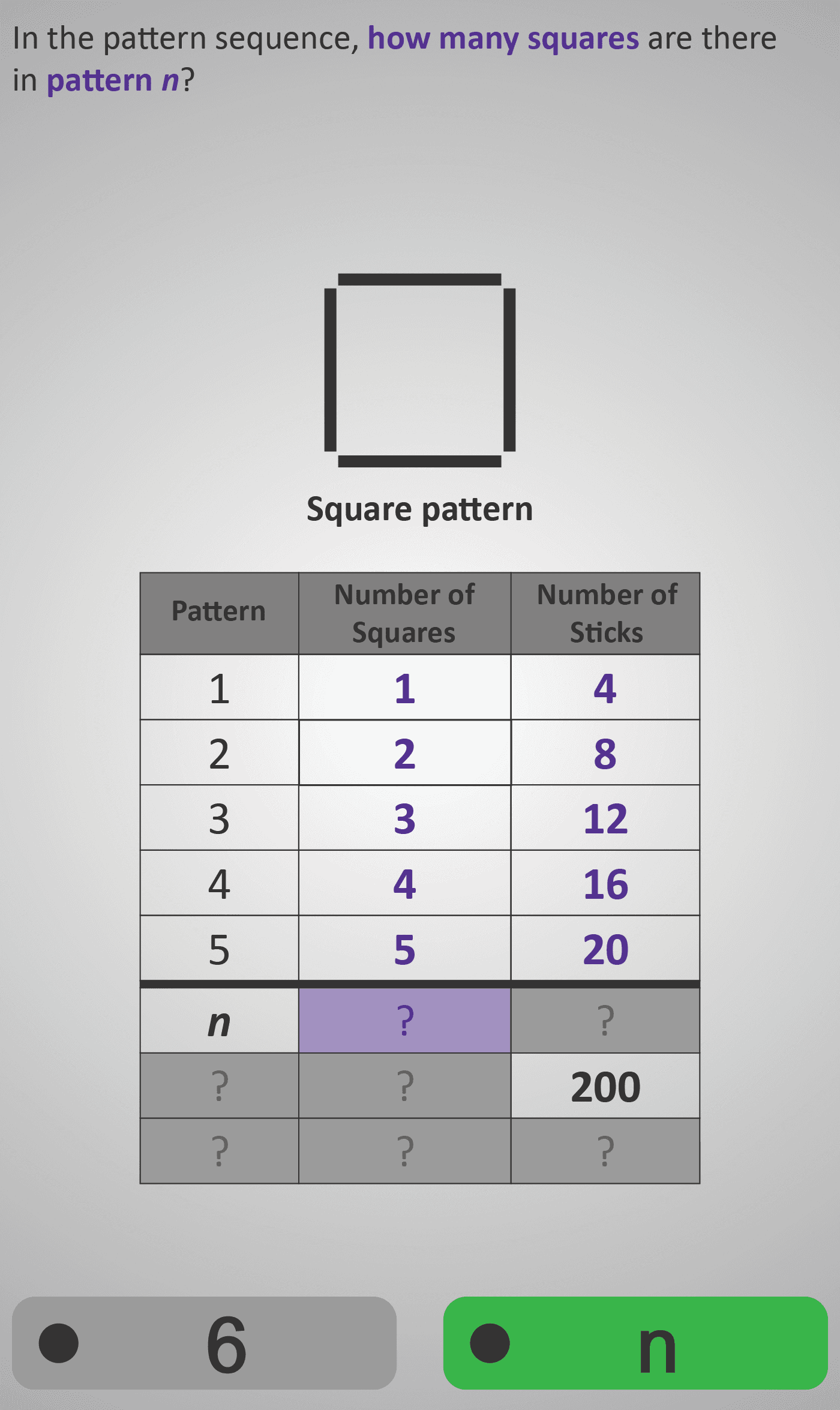
The example shows a square pattern built from sticks:
- Each square requires 4 sticks.
- Pattern 1 → 4 sticks, Pattern 2 → 8 sticks, Pattern 3 → 12 sticks, Pattern 4 → 16 sticks, etc.
Students complete a table showing:
| Pattern | Number of Squares | Number of Sticks |
|---|---|---|
| 1 | 1 | 4 |
| 2 | 2 | 8 |
| 3 | 3 | 12 |
| 4 | 4 | 16 |
| n | n | 4n |
They then answer questions such as:
- How many squares are in Pattern 50?
- How many sticks are in Pattern n?
- If there are 200 sticks, what pattern number is it?
Through these problems, learners discover that the relationship between the number of squares and sticks can be written as a rule: Number of sticks = 4 × number of squares → 4n.
This Phlow gently introduces algebraic thinking in context, allowing students to use visuals, tables, and reasoning to find the rule before seeing its symbolic form. By the final step, learners confidently use the formula to find distant terms — a key milestone in understanding pattern generalisation.
Prerequisite Knowledge Required
- Patterns & Sequence 3B – Number Patterns (Linear Growth in Context).
- Multiples 3A – Recognising Equal Jumps.
- Multiply 3B – Multiplying by Whole Numbers.
- Understanding of repeated addition as multiplication.
- Familiarity with number patterns that increase by a constant difference.
- Basic understanding of tables and corresponding values.
- Awareness that letters can represent unknown or varying quantities.
Main Category
Algebra / Patterns & Sequences
Estimated Completion Time
Approx. 10 seconds per screen (4 screens total) → 2–3 minutes total.
Cognitive Load / Step Size
Moderate to Challenging — each screen introduces a small conceptual shift: from pattern → number → rule → symbol. Scaffolding with visuals and tables ensures abstraction remains accessible and builds algebraic intuition.
Language & Literacy Demand
Moderate — key algebraic terms (pattern, rule, n, number of squares, number of sticks) are repeated and highlighted. Purple text draws attention to mathematical relationships and symbols.
Clarity & Design
- Tables clearly show progression and structure.
- Single variable (n) is colour-coded and consistently aligned with meaning.
- Visual cues (squares and sticks) ground abstract ideas in concrete representations.
- Clean, logical layout focuses on pattern-to-rule reasoning.
Curriculum Alignment
Irish Mathematics Curriculum – Algebra Strand / Junior Cycle Learning Outcomes 3.3 & 3.4
- Describe and represent linear patterns using words, tables, and symbols.
- Understand that variables can represent pattern terms.
- Use expressions such as 4n to find any term in a sequence.
- Relate numeric and visual patterns through algebraic rules.
Engagement & Motivation
High — the growing square pattern creates curiosity and a satisfying “aha” moment when learners discover the general rule. Seeing how arithmetic patterns connect to algebra builds confidence and ownership of learning.
Error Opportunities & Misconceptions
- Misinterpreting n as a fixed number instead of a changing one.
- Confusing 4n with n + 4.
- Reading table columns incorrectly (mixing pattern number and total sticks).
Gradual scaffolding, consistent structure, and clear labelling address and correct these misunderstandings.
Transferability / Real-World Anchoring
High — recognising “for every 1, there are 4” relationships underpins real-world proportional reasoning in design, tiling, speed-time, and scaling contexts.
Conceptual vs Procedural Balance
Strongly Conceptual — students discover the rule before formalising it, developing an intuitive understanding of algebraic generalisation.
Learning Objectives Addressed
- Recognise and represent a growing pattern using a rule.
- Use letters to describe any term in a sequence.
- Translate a relationship from a table to an algebraic expression.
- Apply the rule to find distant terms (e.g. Pattern 50 or Pattern n).
What Your Score Says About You
- Less than 5: Review the pattern’s logic — check how the total sticks increase by 4 each time.
- 6–7: You can identify the rule but need more practice expressing it with n.
- 8–9: Excellent reasoning — you understand both the arithmetic and the general rule.
- 10 / 10: Perfect! You’ve mastered early algebraic thinking — you’re ready for Patterns & Sequence 4A, where you’ll work with two-variable rules and equations.