
Percentage 3A
Overview
In this Phlow, learners are introduced to the concept of percentages as a way of expressing part of a whole. They learn that percent means “per hundred” and discover how to find a percentage of a quantity through clear, relatable examples.
Each screen presents a simple question:
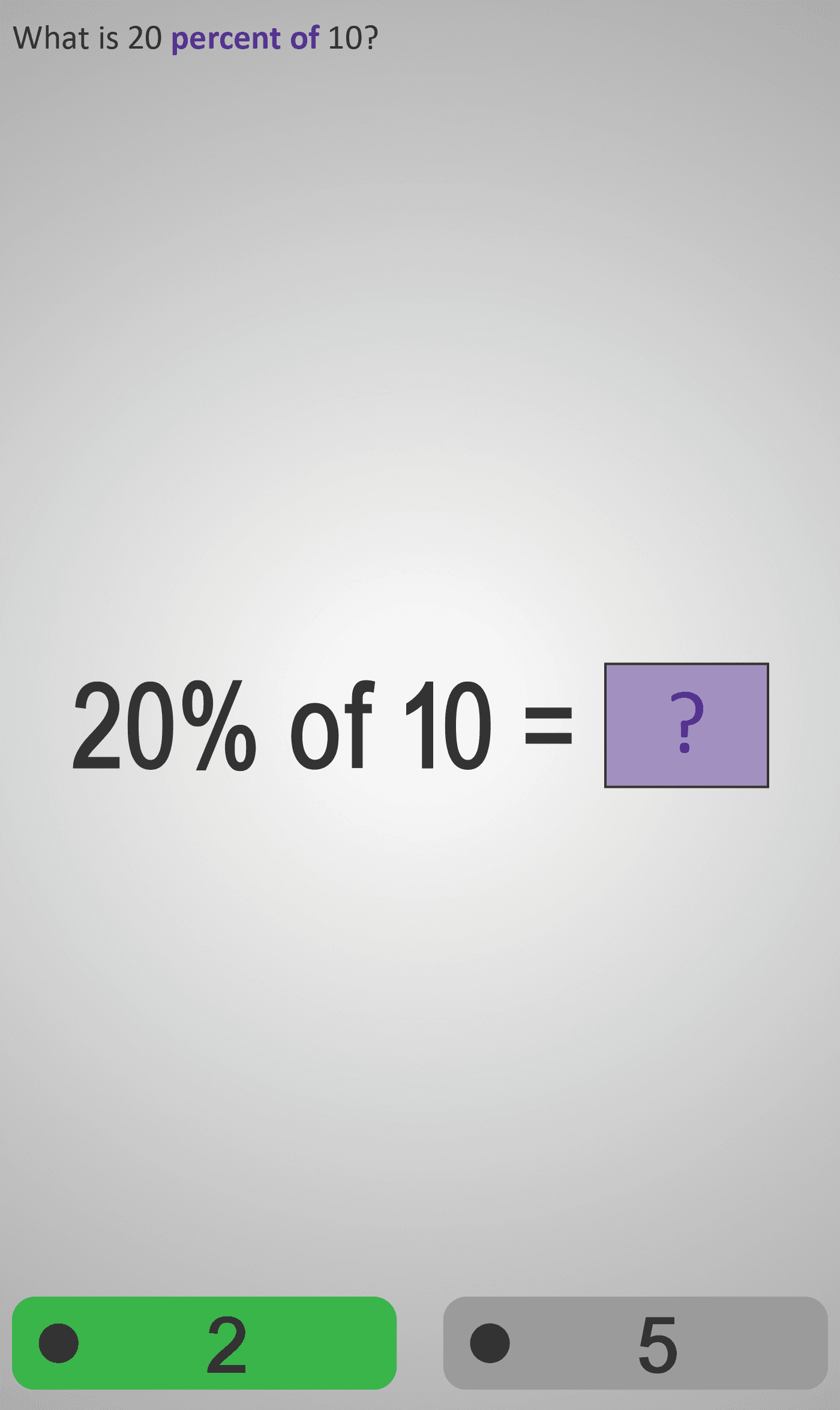
- What is 20% of 10?
- What is 50% of 8?
- What is 10% of 30?
Students practise identifying that:
- 10% means one tenth (divide by 10),
- 50% means one half,
- 20% means multiply by 0.2 or divide by 5.
The question structure stays consistent, helping learners focus on understanding rather than memorisation. Each correct answer receives immediate feedback, reinforcing the link between percentage, fraction, and decimal forms.
This Phlow acts as a bridge between fractions, decimals, and percentages — showing that all three describe parts of a whole. It lays the foundation for later applications such as discounts, increases, and comparisons by first mastering simple conceptual steps.
Prerequisite Knowledge Required
- Fractions 2C – Simple Fractions of Numbers.
- Decimals 2B – Tenths and Hundredths.
- Multiply 3A – Multiplying by 10, 100, 1000.
- Understanding of fractions as part–whole relationships.
- Comfort dividing and multiplying small numbers by 2, 5, and 10.
- Awareness of decimal and fraction equivalences (e.g., ½ = 50%, ⅒ = 10%).
Main Category
Number / Percentages
Estimated Completion Time
Approx. 10 seconds per screen (3 screens total) → 2–3 minutes total.
Cognitive Load / Step Size
Low to Moderate — each example isolates one new percentage while keeping the sentence and visual structure identical. Repetition helps learners internalise the pattern for calculating percentages of whole numbers.
Language & Literacy Demand
Low — short, familiar phrasing (percent of, equals) keeps text simple. Mathematical keywords are highlighted in purple, and the large equation layout (e.g., 20% of 10 = ?) strengthens visual recognition.
Clarity & Design
- Minimalistic layout keeps attention on the core numbers.
- Large, centred text and consistent spacing aid focus.
- Purple highlights and grey/green options guide correct reasoning.
- Clean presentation supports conceptual clarity and memory formation.
Curriculum Alignment
Irish Mathematics Curriculum – Number Strand / Junior Cycle Learning Outcome 2.5
- Understand that percentage means “out of 100”.
- Find simple percentages of whole numbers (10%, 20%, 50%).
- Connect percentages to fractions and decimals.
Engagement & Motivation
High — each quick calculation gives an immediate sense of success. Percentages feel familiar from everyday life (sales, tests, savings), making the learning practical and confidence-building.
Error Opportunities & Misconceptions
- Confusing “percent” with “per number” (forgetting it means per 100).
- Adding instead of multiplying (e.g., 10 + 20 instead of 10 × 20%).
- Forgetting to divide by 100 when converting from percent to decimal.
Gradual, repeated phrasing prevents overload and reinforces the correct calculation process.
Transferability / Real-World Anchoring
Very High — directly applies to sales, test scores, savings, and everyday comparisons. Builds immediate numerical literacy for real-life percentage contexts.
Conceptual vs Procedural Balance
Strongly Conceptual — students learn why percentages work before practising how to calculate them, ensuring deep understanding over rote recall.
Learning Objectives Addressed
- Explain what “percent” means.
- Calculate simple percentages of whole numbers.
- Recognise equivalent fractions and decimals for common percentages.
- Build confidence for later applications involving percentage change.
What Your Score Says About You
- Less than 5: Revisit what “percent” means — link 10% to dividing by 10.
- 6–7: You’re grasping the pattern; practise connecting percentages to fractions (e.g., 20% = ⅕).
- 8–9: Strong understanding of calculating percentages of whole numbers.
- 10 / 10: Excellent! You’re ready for Percentage 3B, where you’ll apply this to larger amounts and reverse-percentage problems.