
Percentage 3B
Overview
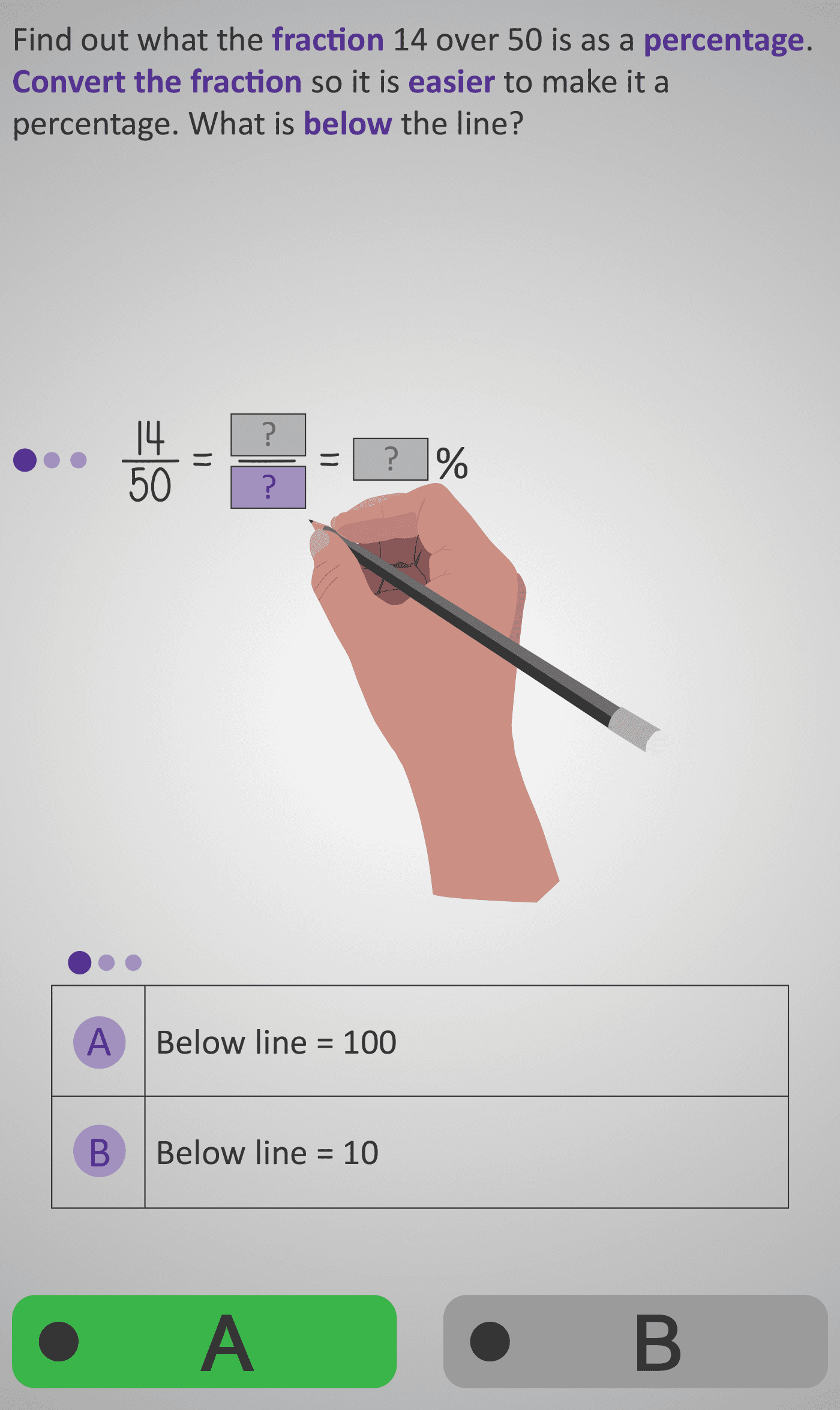
In this Phlow, learners build on their understanding of percentages by connecting them directly to fractions. They explore how to convert a fraction like 14/50 into a percentage through step-by-step reasoning rather than memorisation.
Each screen walks students through a scaffolded process:
- Recognise the denominator (the number below the line) and decide what it must become to make the fraction “out of 100”. → Below line = 100
- Find the equivalent numerator by applying the same multiplication to both top and bottom. → 14/50 = 28/100
- Convert the new fraction into a percentage. → 28/100 = 28%
The visuals support understanding by showing the transformation being written by hand — reinforcing that this is a logical conversion process, not a memorised trick. Students see that whenever the denominator is 100, the numerator shows the percentage directly.
By the end, learners can confidently explain: “To turn a fraction into a percentage, make the bottom 100 and the top tells you the percent.” This activity strengthens number sense, proportional reasoning, and symbolic fluency, preparing learners for later work with decimals and percentages in real-world contexts.
Prerequisite Knowledge Required
- Fractions 2C – Equivalent Fractions.
- Percentage 3A – Finding a Percentage of a Number.
- Multiply 3A – Multiplying by Whole Numbers.
- Understanding of fractions as parts of a whole (numerator and denominator).
- Knowledge of equivalent fractions and multiplying both top and bottom by the same number.
- Awareness that “percent” means “out of 100”.
- Comfort with basic multiplication and doubling.
Main Category
Number / Fractions, Decimals & Percentages
Estimated Completion Time
Approx. 10 seconds per screen (3 screens total) → 3–4 minutes total.
Cognitive Load / Step Size
Moderate — each step isolates one concept (denominator → numerator → percentage), supporting deep understanding through gradual visual and symbolic progression.
Language & Literacy Demand
Moderate — mathematical terms (fraction, convert, below the line, percentage) are introduced gradually and reinforced with visual cues. Key actions and relationships are colour-highlighted for clarity.
Clarity & Design
- Sequential layout mirrors the conversion process step by step.
- Purple boxes highlight editable parts of each equation.
- Handwriting animation personalises learning and demonstrates reasoning.
- Progress dots show mini-sequence completion and encourage flow.
Curriculum Alignment
Irish Mathematics Curriculum – Number Strand / Junior Cycle Learning Outcome 2.6
- Recognise that percentages are fractions with a denominator of 100.
- Convert between fractions and percentages.
- Use equivalent fractions to express values as percentages.
Engagement & Motivation
High — the clear, animated conversion process encourages participation. Immediate feedback and the “out of 100” anchor make the learning intuitive and rewarding.
Error Opportunities & Misconceptions
- Forgetting to multiply both numerator and denominator.
- Choosing the wrong multiplier (e.g., doubling the top only).
- Confusing “out of 100” with “multiply by 100”.
Each screen explicitly addresses these misconceptions, reinforcing the rule of equivalent scaling.
Transferability / Real-World Anchoring
High — converting between fractions and percentages is essential for interpreting data, test scores, discounts, and sports statistics. Learners build flexibility in switching between these representations.
Conceptual vs Procedural Balance
Balanced — the procedure (convert → multiply → write as %) is grounded in conceptual understanding of equivalence and scaling. Students see why the method works.
Learning Objectives Addressed
- Convert simple fractions to equivalent fractions with a denominator of 100.
- Express equivalent fractions as percentages.
- Understand the relationship between fractions and percentages.
- Apply this skill to real-world contexts such as test results and discounts.
What Your Score Says About You
- Less than 5: Revisit how to make the denominator 100 — check you’re multiplying both numbers.
- 6–7: You’re recognising fraction–percentage links — practise setting both parts of the fraction correctly.
- 8–9: Great understanding — you can now explain why we make the denominator 100.
- 10 / 10: Excellent! You’re ready for Percentage 3C, where you’ll convert decimals to percentages and back again.