
Perimeter 3A
Overview
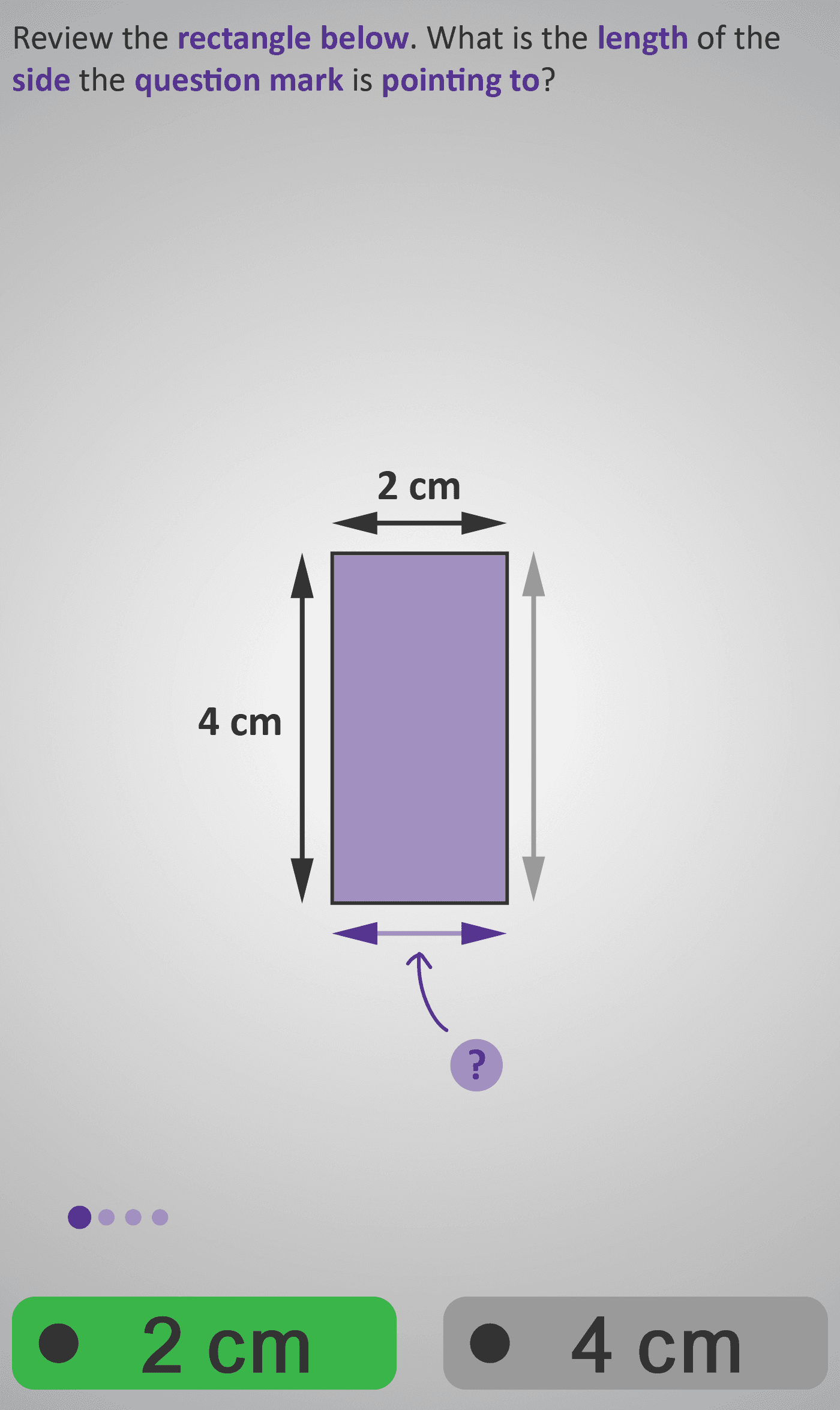
In this Phlow, learners explore how to calculate the perimeter — the total distance around the edge of a 2D shape. The focus is on understanding that opposite sides of a rectangle are equal, and the perimeter can be found by adding together all four sides.
The lesson begins by identifying the sides:
- The long sides (vertical) each measure 4 cm.
- The short sides (horizontal) each measure 2 cm.
Students are then guided step by step:
- Recognise which side the question mark is pointing to (top, bottom, left, or right).
- Identify that opposite sides are equal in length (e.g., both vertical sides = 4 cm).
- Choose the correct method to find the perimeter: → 4 + 2 + 4 + 2 = 12 cm
This structure builds procedural fluency while reinforcing spatial reasoning and the concept of equality in rectangles. By the end, learners can both calculate the perimeter and explain why opposite sides are equal — forming a foundation for later geometry topics such as area and compound shapes.
Prerequisite Knowledge Required
- Shapes 2B – Recognising Rectangles and Squares.
- Length 2B – Measuring in Centimetres.
- Add 2B – Adding Small Numbers.
- Understanding that shapes have sides and corners.
- Recognising that rectangles have two pairs of equal sides.
- Ability to read and compare simple measurements in centimetres.
- Basic addition of small numbers (e.g., 2 + 4 + 2 + 4).
Main Category
Measurement / Perimeter
Estimated Completion Time
Approx. 10 seconds per screen (4 screens total) → 3–4 minutes total.
Cognitive Load / Step Size
Low to Moderate — each step isolates a single idea: Recognising sides → Identifying equal sides → Adding sides → Finding the total perimeter. This clear sequence reduces confusion and builds mastery gradually.
Language & Literacy Demand
Low — short, direct phrasing (e.g., “side the question mark is pointing to”) supports understanding without heavy reading demand. Key mathematical terms (rectangle, length, perimeter) are highlighted in purple to link vocabulary to concept.
Clarity & Design
- Consistent arrows, labels, and prompts maintain clarity and focus.
- Purple and black text distinguish measurement from explanation.
- Step indicators show progress through the activity sequence.
- Visual balance and clear spacing promote comprehension and confidence.
Curriculum Alignment
Irish Mathematics Curriculum – Measurement Strand / Junior Cycle Learning Outcome 3.8
- Identify and measure the sides of rectangles using standard units.
- Understand that opposite sides in a rectangle are equal in length.
- Calculate the perimeter of a rectangle by adding all four sides.
- Begin to apply the perimeter formula (2 × length + 2 × width).
Engagement & Motivation
High — the visual design makes learning feel like a shape-based puzzle. Each step brings students closer to the complete perimeter calculation, creating a sense of progress and satisfaction.
Error Opportunities & Misconceptions
- Confusing perimeter with area.
- Forgetting to count both pairs of sides.
- Mixing up vertical and horizontal sides.
- Adding only one of each side instead of both.
Guided repetition across screens helps correct these common mistakes and solidify the correct process.
Transferability / Real-World Anchoring
High — finding perimeters applies to real-world contexts such as measuring fences, picture frames, or room borders. Learners see the relevance of their calculation skills immediately.
Conceptual vs Procedural Balance
Balanced — learners develop both conceptual understanding (what perimeter means) and procedural skill (how to calculate it). Visual reinforcement ensures comprehension before formula memorisation.
Learning Objectives Addressed
- Identify the sides of rectangles and their equal lengths.
- Calculate the perimeter by adding side lengths.
- Recognise the difference between perimeter and area.
- Develop accuracy in reading and combining centimetre measures.
What Your Score Says About You
- Less than 5: Recheck how many sides a rectangle has and which ones are equal.
- 6–7: You can identify sides correctly — now practise adding all four together.
- 8–9: Very good! You’re accurate and understand that opposite sides are the same.
- 10 / 10: Excellent! You can now move on to Perimeter 3B, where you’ll find perimeters of irregular shapes and combined rectangles.