
Perimeter 3B
Overview
In this Phlow, learners extend their understanding of perimeter from rectangles to triangles and irregular polygons. They build on the concept that perimeter means the total distance around a shape, applying it to figures with three or more different side lengths.
The sequence begins with clear, guided questions:
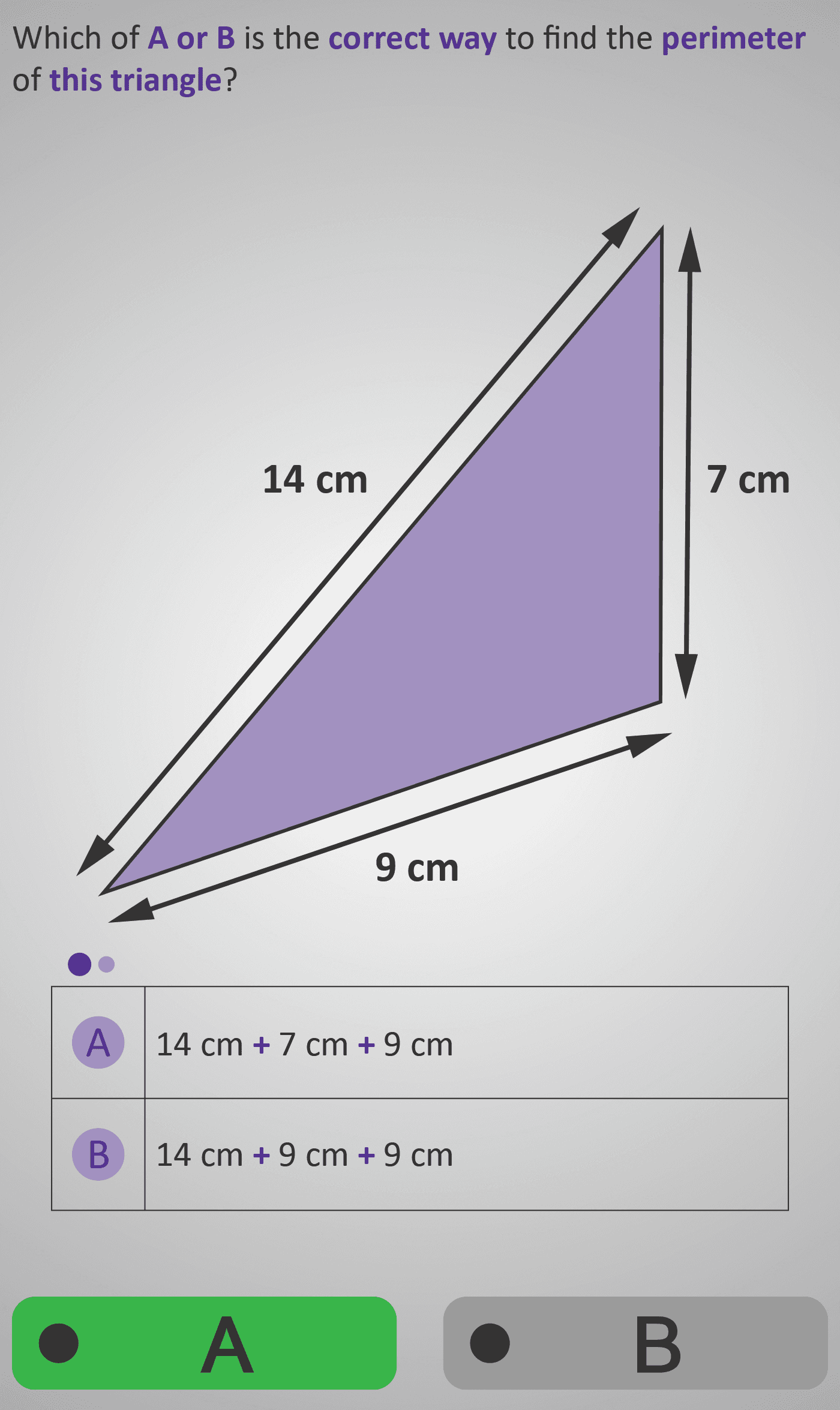
- For a triangle, identify all three sides and choose the correct expression for the perimeter: → 14 cm + 7 cm + 9 cm = 30 cm
- For a quadrilateral with four different side lengths, decide which equation correctly includes every side: → 3 cm + 4 cm + 5 cm + 9 cm = 21 cm
Finally, students calculate the total perimeter of each shape, practising mental addition or using a calculator when needed.
By moving from regular to irregular shapes, learners discover that the rule for perimeter stays the same — add up all the sides. This reinforces pattern recognition, spatial reasoning, and number fluency in practical geometry contexts.
Prerequisite Knowledge Required
- Perimeter 3A – Perimeter of a Rectangle.
- Shapes 2B – Recognising Sides and Angles.
- Add 2C – Multi-Step Addition.
- Understanding what a side is in a 2D shape.
- Knowing that perimeter means the total distance around a shape.
- Ability to add 2–4 numbers accurately.
- Familiarity with measuring and comparing lengths in centimetres (cm).
Main Category
Measurement / Perimeter
Estimated Completion Time
Approx. 10–12 seconds per screen (4 screens total) → 3–4 minutes total.
Cognitive Load / Step Size
Moderate — shapes now vary in side length and number of sides, requiring learners to visually track and sum multiple measurements. The consistent question structure (select → confirm → total) keeps the task manageable.
Language & Literacy Demand
Moderate — key mathematical words (triangle, shape, side, perimeter) are repeated and colour-highlighted in purple. Supportive phrasing such as “Try solve in your head but use your calculator if needed” encourages independence.
Clarity & Design
- Clear geometric diagrams with labelled sides ensure easy reading.
- Purple highlighting draws attention to active terms (shape, perimeter).
- Gradual complexity from triangles to irregular shapes aids comprehension.
- Each equation appears beneath the shape to link visual and numerical reasoning.
Curriculum Alignment
Irish Mathematics Curriculum – Measurement Strand / Junior Cycle Learning Outcome 3.8
- Recognise and measure sides of a variety of shapes.
- Find the perimeter of triangles and irregular polygons by adding all sides.
- Apply the perimeter concept beyond rectangles to diverse shapes.
Engagement & Motivation
High — the range of shapes adds variety and challenge while reinforcing a single consistent idea. Encouraging mental addition builds number confidence and provides satisfying success moments.
Error Opportunities & Misconceptions
- Omitting one side when adding.
- Forgetting to include measurement units (cm).
- Adding repeated sides incorrectly.
- Assuming each shape needs a new formula.
Consistent visual prompts and repeated instructions help learners avoid these mistakes and understand that the same perimeter rule applies to all shapes.
Transferability / Real-World Anchoring
High — this skill applies directly to everyday measurement tasks like calculating fence lengths, frame edges, or the boundaries of irregular plots. Students see perimeter as a universal and practical concept.
Conceptual vs Procedural Balance
Balanced — learners practise the procedure (add all sides) while reinforcing the conceptual meaning of perimeter as total boundary distance, independent of shape type.
Learning Objectives Addressed
- Calculate the perimeter of triangles and irregular shapes.
- Identify and include every side in the calculation.
- Understand that perimeter is the same process for all shapes.
- Apply measurement reasoning to varied geometric contexts.
What Your Score Says About You
- Less than 5: Review how to identify all sides in a shape before adding.
- 6–7: You understand the concept — double-check your additions for accuracy.
- 8–9: Great work! You can confidently find perimeters of both triangles and 4-sided shapes.
- 10 / 10: Excellent! You’re ready for Perimeter 3C, where you’ll explore perimeters of compound shapes and shapes with missing sides.