
Possible Choices 3B
Overview
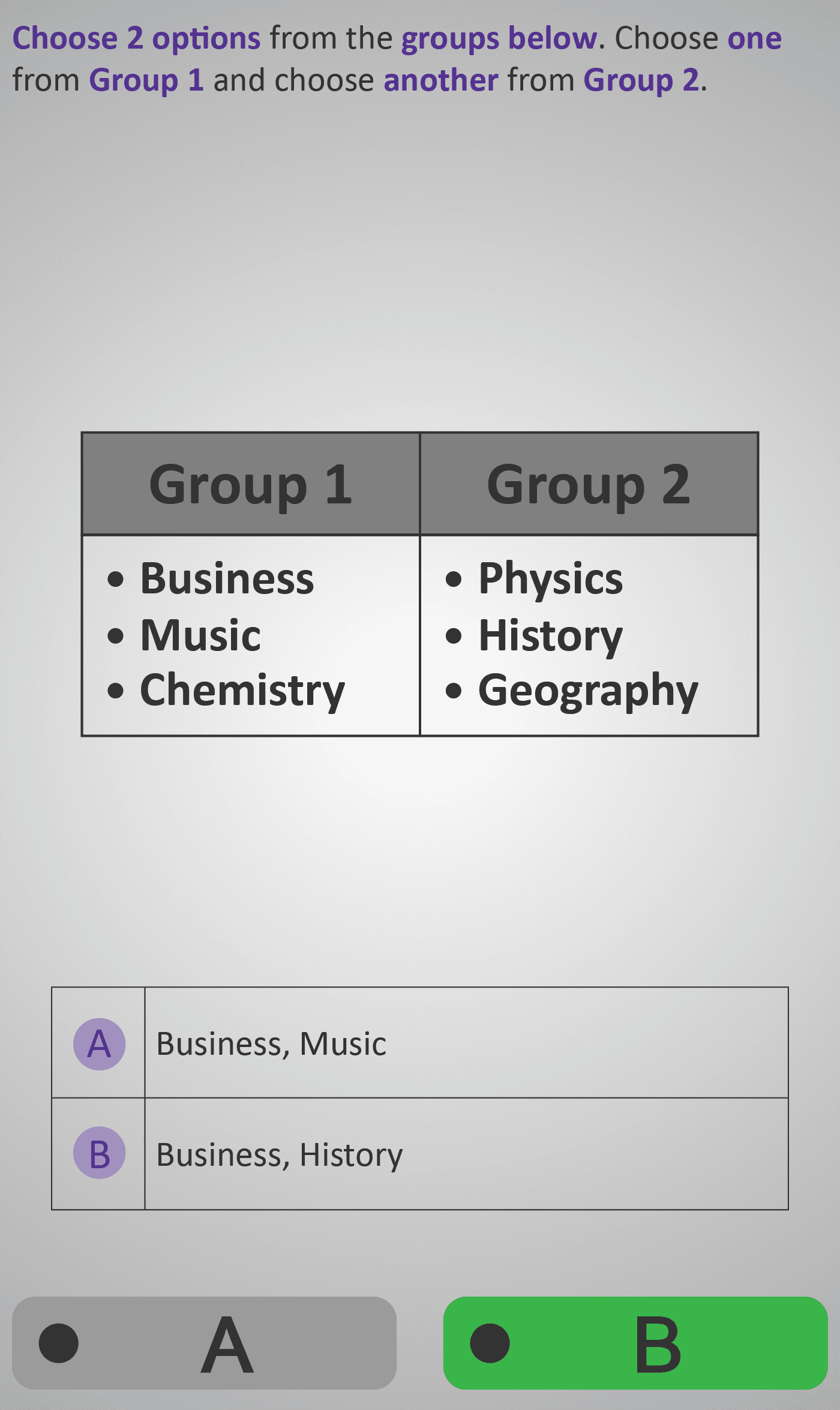
In this Phlow, learners are asked to choose two options — one from Group 1 and another from Group 2. The groups contain subjects such as Business, Music, Chemistry (Group 1) and Physics, History, Geography (Group 2). Each question presents two answer choices, but only one follows the given rule: selecting one subject from each group.
Through this exercise, students strengthen their ability to:
- Read and interpret grouped data.
- Follow multi-step instructions (e.g., “Choose one from Group 1 and another from Group 2”).
- Eliminate invalid combinations that pick two from the same group.
This Phlow helps learners understand how grouping rules affect possible selections — a key skill for interpreting tables, sets, and survey questions later in data handling. By repeatedly testing pairs, they build confidence in reasoning and rule-based decision making through a simple, visual activity.
Prerequisite Knowledge Required
- Understanding of categories and grouping.
- Ability to follow selection rules (e.g., “one from each group”).
- Familiarity with reading lists and bullet points.
- Completion of Possible Choices 3A (identifying and matching data attributes).
Main Category
Data Handling / Sorting and Classifying Information
Estimated Completion Time
Approx. 4–5 minutes (three short interactive steps).
Cognitive Load / Step Size
Low — each question focuses on applying one clear rule at a time. Visual grouping and clear separation reduce cognitive demand, helping learners internalise the rule through repetition.
Language & Literacy Demand
Low — vocabulary is simple and familiar (choose, one, another, group). Visual layout supports understanding, reducing text dependency.
Clarity & Design
- Distinct shading and borders separate each group visually.
- The rule (“one from Group 1 and another from Group 2”) is repeated for every screen.
- Options are clearly spaced for quick and accurate selection.
- Minimal clutter keeps attention on the task’s logical structure.
Curriculum Alignment
Irish Primary Curriculum / Junior Cycle Mathematics
- Sort and classify information based on two or more criteria.
- Understand how rules affect possible choices and outcomes.
- Identify valid and invalid combinations from grouped data.
(Aligned with Junior Cycle Learning Outcomes for Data and Reasoning: “Organise and interpret data in lists, tables, and groups.”)
Engagement & Motivation
Moderate to High — students enjoy the sense of puzzle-solving as they identify valid combinations. The subject-based theme keeps it familiar, and immediate feedback rewards logical accuracy.
Error Opportunities & Misconceptions
- Choosing both items from the same group.
- Ignoring the “one from each group” rule.
- Misreading or overlooking group headings.
These are corrected through clear visual grouping, repetition of instructions, and instant feedback for invalid choices.
Transferability / Real-World Anchoring
Strong — this concept mirrors everyday decision-making scenarios, such as selecting one meal and one drink, or one course and one elective. It builds logical reasoning used later in data analysis, probability, and combinations.
Conceptual vs Procedural Balance
Procedural focus with conceptual underpinning — learners practise following selection rules while understanding the logic behind why only certain combinations are valid.
Learning Objectives Addressed
- Identify and select items correctly based on grouping rules.
- Distinguish between valid and invalid pairings.
- Develop logical and rule-based decision-making skills.
- Strengthen classification and reasoning ability for grouped data.
What Your Score Says About You
- Below 4: Review how to identify which group each option belongs to — look carefully at headings.
- 5–7: You’re improving at applying the rule — double-check that your selections are from different groups.
- 8–9: Great understanding — you can apply logical rules consistently.
- 10 / 10: Excellent! You’re ready for Possible Choices 3C, where you’ll learn to represent all possible combinations visually in a grid or diagram.