
Possible Choices 3C
Overview
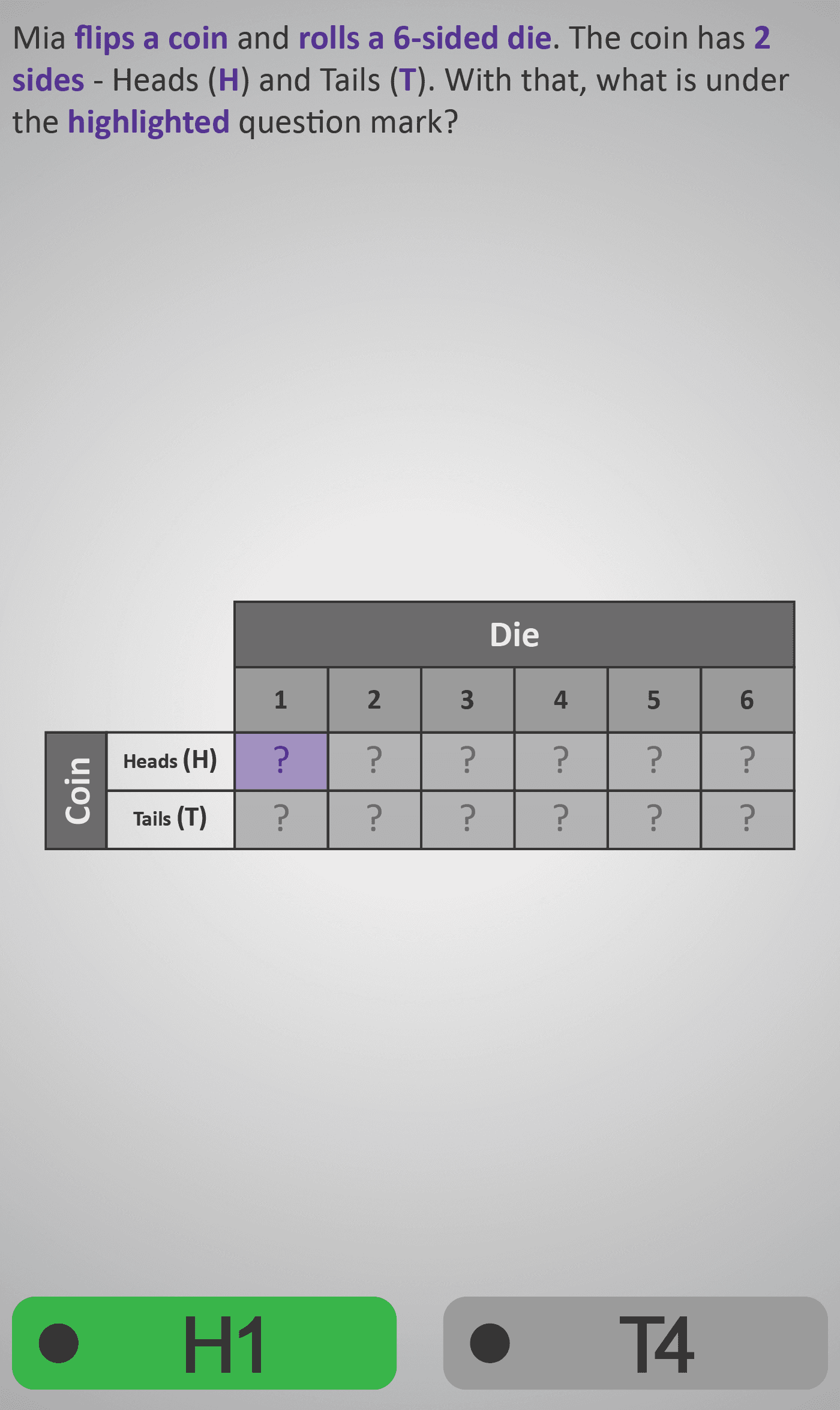
In this Phlow, learners are introduced to systematic listing — an essential skill in early probability. They complete a two-way table showing all possible outcomes of flipping a coin (Heads or Tails) and rolling a 6-sided die (1–6). Each cell represents one possible result, such as H1 (Heads and 1) or T5 (Tails and 5).
Students answer step-by-step questions that gradually fill the table, identifying what goes under each highlighted cell. Through repetition, they discover that every die number pairs with both Heads and Tails, leading to 12 total outcomes (2 × 6). This teaches students how to represent all possible events clearly — a concept that underpins probability reasoning in later levels.
By the end, learners understand how to combine two independent events systematically and recognise the complete outcome space visually.
Prerequisite Knowledge Required
- Understanding of coin flips (Heads/Tails) and numbered dice (1–6).
- Familiarity with reading rows and columns in a table.
- Ability to interpret combinations (e.g., “one from each set”).
- Completion of Possible Choices 3B (selecting from two groups).
Main Category
Data & Probability / Listing Possible Outcomes
Estimated Completion Time
Approx. 5–6 minutes (four to five guided steps).
Cognitive Load / Step Size
Moderate — learners juggle two dimensions (coin and die), but the grid provides clear visual structure and consistent cues to support reasoning.
Language & Literacy Demand
Low to Moderate — key vocabulary includes flip, roll, outcomes, sides, and table. Visual representations (H for Heads, T for Tails) and numerical cues minimise literacy demand.
Clarity & Design
- Two-way table clearly labelled with bold headings (Coin and Die).
- Purple highlighting directs focus to the active cell for each question.
- Consistent colour coding differentiates Heads/Tails and die numbers.
- Clear visual feedback reinforces the idea of pairing two independent variables.
Curriculum Alignment
Irish Junior Cycle Mathematics – Learning Outcome 1.11
- Recognise and represent all possible outcomes of combined events.
- Use tables and grids to organise and display outcomes systematically.
- Understand that total outcomes can be found by multiplying the number of choices for each event.
Engagement & Motivation
High — the activity feels like a puzzle, inviting learners to predict and test which result belongs in each cell. The familiar context (coin and die) makes the task concrete and enjoyable, supporting curiosity and flow.
Error Opportunities & Misconceptions
- Reversing the order of pairs (e.g., writing 1H instead of H1).
- Forgetting that each die number pairs with both Heads and Tails.
- Misreading row or column headings.
These are corrected through immediate visual feedback and consistent, repetitive structure across questions.
Transferability / Real-World Anchoring
Strong — systematic listing supports probability, logic puzzles, and algorithmic thinking. Learners can apply the same reasoning to predict results in games, experiments, and everyday random events.
Conceptual vs Procedural Balance
Conceptual: recognising that each event combines with all others.
Procedural: filling in the grid accurately and using correct notation (H1, H2, …, T6).
Learning Objectives Addressed
- Combine two sets of outcomes systematically.
- Use a table to represent multiple possibilities clearly.
- Understand independence and completeness in outcome lists.
- Develop confidence in structured reasoning and data organisation.
What Your Score Says About You
- Below 4: Review how rows and columns connect — try matching one coin outcome with each die number.
- 5–7: You’re identifying most outcomes correctly — make sure you include both Heads and Tails for each die number.
- 8–9: Excellent — you’re reasoning systematically through the grid.
- 10 / 10: Perfect! You’ve mastered combining outcomes — ready for Possible Choices 4A, where you’ll use these results to explore probability and likelihood.