
Possible Choices 3D
Overview
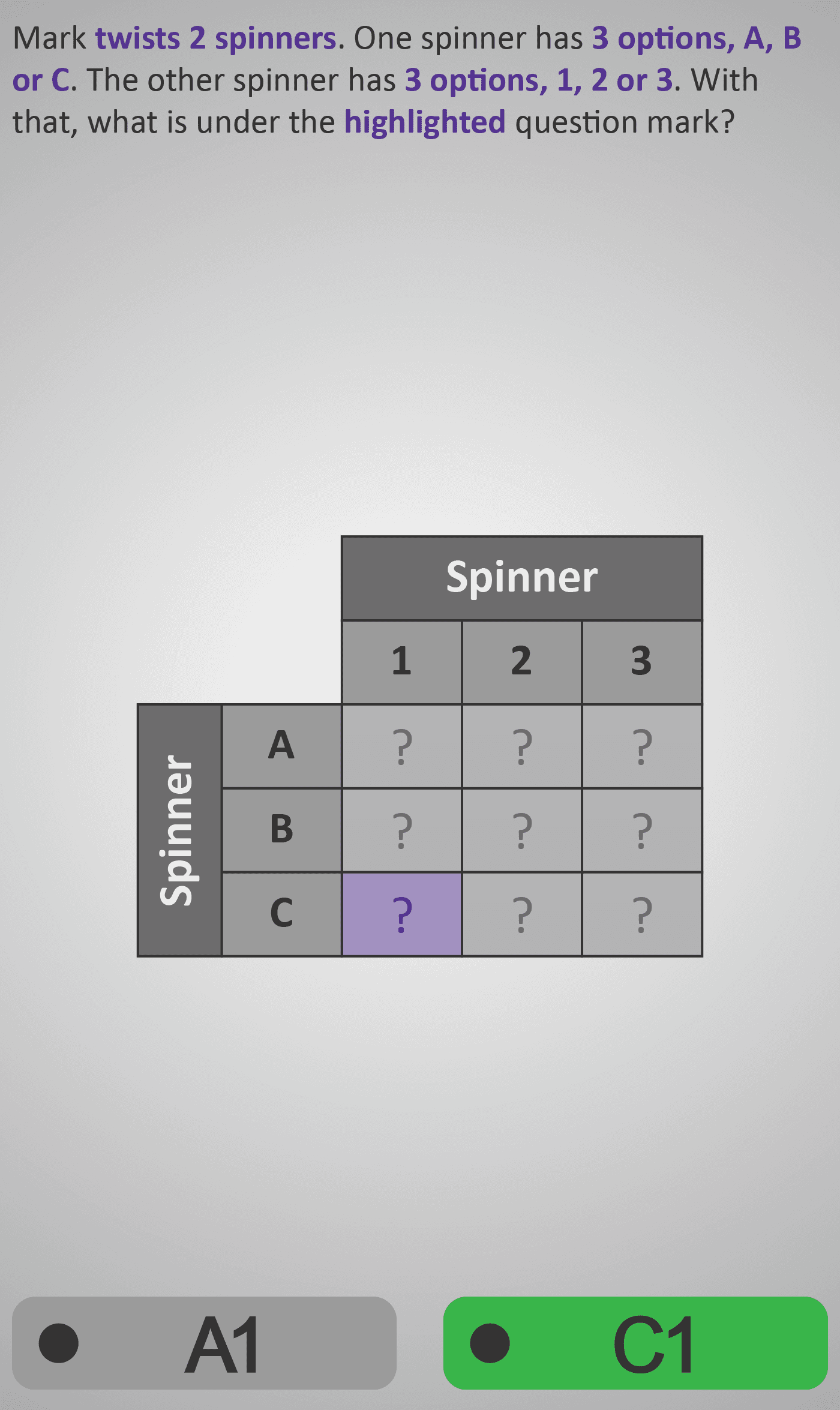
In this Phlow, learners explore how to systematically record all possible results from two spinners. One spinner has three lettered sections (A, B, C) and the other has three numbered sections (1, 2, 3). Each outcome is a pair combining one result from each spinner — examples include A1, B2, and C3.
Students fill in a two-way table showing how every lettered result pairs with every number. Each interactive step highlights a blank cell, prompting learners to deduce what belongs there using the table’s structure. They begin with examples (like A1, B2, C1) and gradually generalise the pattern, discovering that there are 3 × 3 = 9 total outcomes.
Through this structured reasoning process, students develop systematic and logical thinking — learning to identify patterns, follow a grid layout, and link independent events. This activity builds essential skills for probability, data representation, and Cartesian combinations.
Prerequisite Knowledge Required
- Understanding of categories and matching pairs (e.g., one from each list).
- Familiarity with rows and columns in tables.
- Experience from Possible Choices 3B (two-group selections) and 3C (coin and die outcomes).
- Awareness that each spinner is independent, so all pairings are possible.
Main Category
Data & Probability / Listing Possible Outcomes
Estimated Completion Time
Approx. 5–6 minutes (four structured questions).
Cognitive Load / Step Size
Moderate — learners manage two dimensions (A–C and 1–3), but the grid layout and focused highlight per step reduce complexity and help maintain understanding of the combination logic.
Language & Literacy Demand
Low to Moderate — terms such as spinner, options, outcomes, and highlighted cell are reinforced visually. Clear icons and labels make the task accessible for all literacy levels.
Clarity & Design
- Tables clearly labelled with both spinner categories visible at a glance.
- Highlighted purple cell directs attention to the current task.
- Alternating white and shaded rows enhance legibility.
- Consistent layout and repetition promote mastery without introducing new terms mid-activity.
Curriculum Alignment
Irish Junior Cycle Mathematics – Learning Outcome 1.11
- Represent all possible outcomes of two events using tables or grids.
- Understand that the total outcomes equal the product of the number of choices for each event.
- Begin to describe and record combinations systematically.
Engagement & Motivation
High — the spinner theme is playful and interactive, encouraging curiosity and focus. Filling in the table feels like solving a logic puzzle, providing small successes and a growing sense of mastery as the table completes.
Error Opportunities & Misconceptions
- Reversing the order (writing 1A instead of A1).
- Forgetting that each letter (A, B, C) pairs with all three numbers (1, 2, 3).
- Leaving cells blank or duplicating combinations.
These are corrected through visual feedback and the repeating pattern of the grid, which reinforces the logic of independence.
Transferability / Real-World Anchoring
Strong — this skill mirrors real-life reasoning such as matching products, building schedules, or testing combinations. It also lays a conceptual foundation for future work with Cartesian coordinates, probability trees, and logical data organisation.
Conceptual vs Procedural Balance
Balanced —
Conceptual: recognising relationships and independence between two events.
Procedural: accurately completing a structured table using pattern-based reasoning.
Learning Objectives Addressed
- Combine two sets of results systematically.
- Represent all outcomes in a clear two-way table.
- Recognise that every option from one spinner links to all options from the other.
- Develop systematic reasoning and confidence in structured listing.
What Your Score Says About You
- Below 4: Review how the two spinners link — remember that each letter combines with all three numbers.
- 5–7: You’re reasoning clearly — double-check that each combination follows the correct order.
- 8–9: Excellent understanding — you’re completing the table accurately and systematically.
- 10 / 10: Perfect! You’ve mastered combinations from two events — ready for Possible Choices 3E, where you’ll explore listing all outcomes and total counts visually.