
Possible Choices 3F
Overview
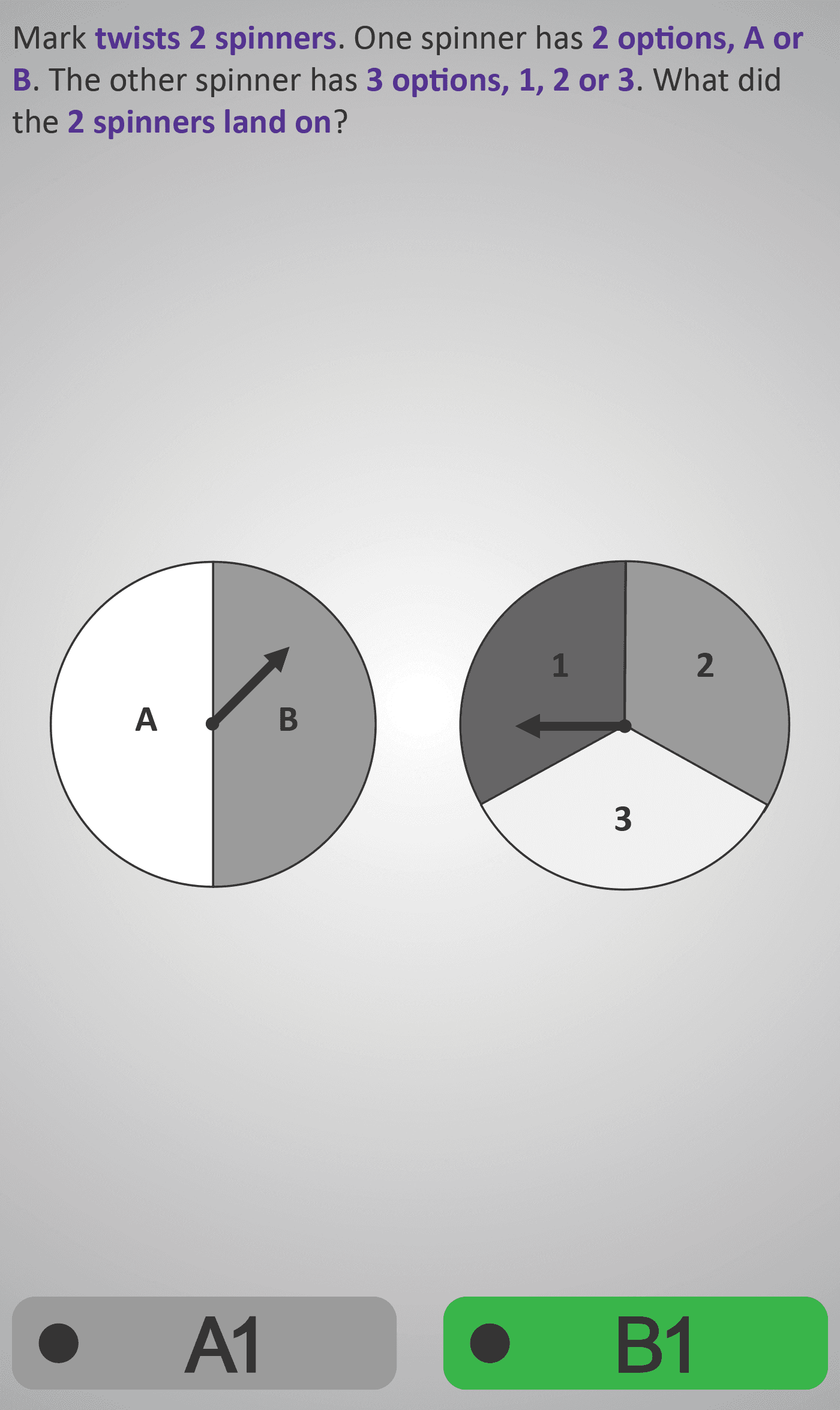
In this Phlow, learners practise recognising and recording combined outcomes when two spinners are spun simultaneously. One spinner is labelled with letters (A, B, C), and the other with numbers (1, 2, 3). When both stop, their results combine to form a single outcome such as A1, B2, or C3.
Through multiple examples, students interpret what each spinner shows and select the correct symbolic outcome. Each question presents realistic spinner diagrams with arrows pointing to results, helping learners visualise the random process before identifying the matching symbol.
The activity builds on earlier Phlows involving tables and coins/dice, encouraging learners to apply similar logic visually. By understanding that one outcome comes from each spinner, students begin to grasp systematic pairing of independent events — a key foundation for probability and data representation.
By the end, learners confidently read visual data and express outcomes using two-part notation, preparing them for constructing outcome tables and probability spaces in future lessons.
Prerequisite Knowledge Required
- Understanding that each spinner produces one result per spin.
- Familiarity with simple combinations (one from each group).
- Recognition of letters and numbers as distinct sets of outcomes.
- Completion of Possible Choices 3D (spinner combinations table) and 3E (coin and die outcomes).
Main Category
Data & Probability / Representing Combined Outcomes
Estimated Completion Time
Approx. 5 minutes (five visual examples with immediate feedback).
Cognitive Load / Step Size
Low to Moderate — students interpret simple visual spinners and translate what they see into symbolic outcomes. Each step isolates one pair of results, keeping focus on combining rather than calculating.
Language & Literacy Demand
Low — key words like spinner, options, land on, and result are reinforced visually. Learners rely on observation and reasoning rather than text-heavy instructions, ensuring accessibility across literacy levels.
Clarity & Design
- Each spinner clearly labelled with contrasting colours and direction arrows.
- Spinners consistently shown side by side for predictability and comfort.
- Answer options mirror the visual order (Letter first, Number second).
- Green highlighting confirms correct answers and reinforces feedback visually.
Curriculum Alignment
Irish Junior Cycle Mathematics – Learning Outcome 1.11
- Identify and represent all possible outcomes for combined random events.
- Use visual and symbolic methods to describe outcomes systematically.
- Understand that each event contributes one part to a combined result.
Engagement & Motivation
High — the dual-spinner setup feels game-like and interactive. Immediate feedback encourages curiosity, persistence, and satisfaction as learners correctly match visual and symbolic outcomes.
Error Opportunities & Misconceptions
- Reversing order (e.g., writing 3A instead of A3).
- Confusing which spinner represents letters or numbers.
- Ignoring one spinner’s result when combining outcomes.
Visual cues such as consistent layout and colour coding help correct these intuitively through guided repetition.
Transferability / Real-World Anchoring
Strong — the concept applies to real-world reasoning such as random games, experiments, and decision-making scenarios. It prepares learners for future probability tasks like grids, tree diagrams, and sample spaces.
Conceptual vs Procedural Balance
Conceptual: recognising that two random events combine independently.
Procedural: reading and writing combined results correctly as ordered pairs (LetterNumber).
Learning Objectives Addressed
- Observe two simultaneous random events.
- Combine outcomes systematically and record them using notation.
- Develop independence in interpreting and writing results from visual experiments.
- Build conceptual understanding for sample spaces and probability calculations.
What Your Score Says About You
- Below 4: Recheck which spinner represents letters and which represents numbers.
- 5–7: You’re reasoning clearly — focus on the order (Letter first, Number second).
- 8–9: Excellent — you understand how to read and combine spinner outcomes accurately.
- 10 / 10: Perfect! You’ve mastered visual-to-symbolic reasoning — ready for Possible Choices 4A, where you’ll explore likelihood and probability patterns.