
Probability 3A
Overview
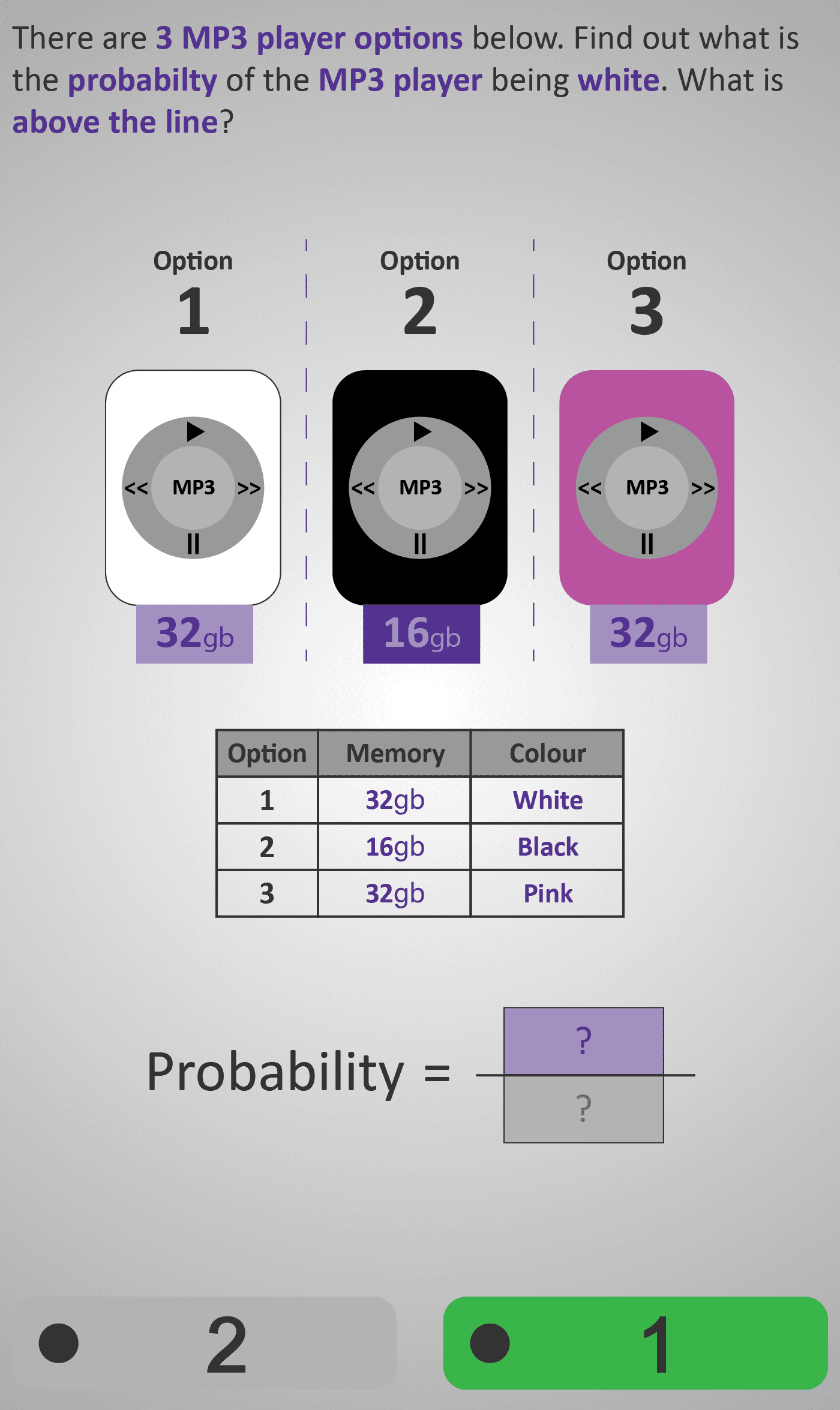
In this Phlow, learners are introduced to the basic concept of probability as a fraction. They explore real-world scenarios where there are several distinct options — for example, MP3 players in different colours and memory sizes — and work out how likely a particular colour is to be chosen.
Students are guided step by step through the logic of what goes above and below the probability line:
- The number of desired outcomes goes above (numerator).
- The total number of possible outcomes goes below (denominator).
Each screen presents clear visual options (e.g., orange, black, and brown MP3 players), alongside a simple data table. Students then reason through prompts such as “What is the probability of the MP3 player not being orange?”
By visually counting how many options match or don’t match a condition, learners build intuition before formalising probability notation. This Phlow solidifies the idea of probability as a ratio of favourable to total outcomes, preparing them for later work with spinners, dice, and sample spaces.
Prerequisite Knowledge Required
- Understanding of counting discrete options.
- Familiarity with fractions — numerator (top) and denominator (bottom).
- Awareness that probability expresses how likely an event is to occur.
- Completion of Possible Choices 3E–3F (combined outcomes and symbolic results).
Main Category
Data & Probability / Introducing Probability as a Fraction
Estimated Completion Time
Approx. 6 minutes (four visual and numerical reasoning screens).
Cognitive Load / Step Size
Low to Moderate — visuals (MP3 players and data table) reduce abstraction. Each screen focuses on one concept — first “above the line”, then “below the line”, and finally applying both together.
Language & Literacy Demand
Moderate — short, conversational text reinforces mathematical terms such as probability, above the line, and below the line. Visual cues help anchor comprehension for learners developing language confidence.
Clarity & Design
- Three MP3 player options consistently displayed with strong colour contrast.
- Visual + text pairing (dual-coding) supports comprehension.
- Purple highlighting shows which part of the fraction is in focus.
- Design scaffolds learning by alternating between numerator and denominator focus.
Curriculum Alignment
Irish Junior Cycle Mathematics – Learning Outcome 1.11
- Express simple probabilities as fractions.
- Identify total and favourable outcomes in everyday contexts.
- Distinguish between “is” and “is not” statements in probability.
Engagement & Motivation
High — the use of real-life examples (MP3 players) makes probability relatable. Each question feels like a small puzzle — identifying what part of the fraction fits where.
Error Opportunities & Misconceptions
- Mixing up numerator and denominator positions.
- Forgetting to count all total options.
- Misreading “not being” as including the stated colour.
These are corrected using colour-coded visual feedback and consistent phrasing across screens.
Transferability / Real-World Anchoring
Strong — this mirrors real-life choices (products, colours, preferences). It provides a tangible anchor for abstract probability problems later involving spinners, dice, and cards.
Conceptual vs Procedural Balance
Conceptual: understanding what probability represents.
Procedural: building fluency with fractional representation (numerator ÷ denominator).
Learning Objectives Addressed
- Define probability as a ratio of favourable to total outcomes.
- Identify numerator and denominator correctly in context.
- Interpret “not” or complementary probabilities.
- Connect probability notation with visual reasoning.
What Your Score Says About You
- Below 4: Review what “favourable” and “total” mean — focus on numerator and denominator placement.
- 5–7: You understand the structure — practise identifying the correct part (“above” or “below”).
- 8–9: Strong progress — you’re accurately translating visuals into probability fractions.
- 10 / 10: Excellent! You can calculate and explain simple probabilities — ready for Probability 3B, where you’ll compare likelihoods using words and numbers.