
Probability 3B
Overview
In this Phlow, learners deepen their understanding of probability by working with grouped lists of options — such as colours, shapes, or school subjects. Each question asks students to find the probability of an item being or not being chosen, introducing complementary probability in simple, visual terms.
For example: “A colour or shape is chosen at random from the two groups below. What is the probability of Red not being chosen?”
Students count all possible outcomes (e.g. 6 total items) and determine how many match the required condition (e.g. 5 that are not Red). They then place these values correctly in a probability fraction:
- Above the line = number of favourable outcomes.
- Below the line = total number of possible outcomes.
- “Not” means all outcomes except the one named.
The Phlow progresses through several examples:
- Choosing from combined groups (colours + shapes).
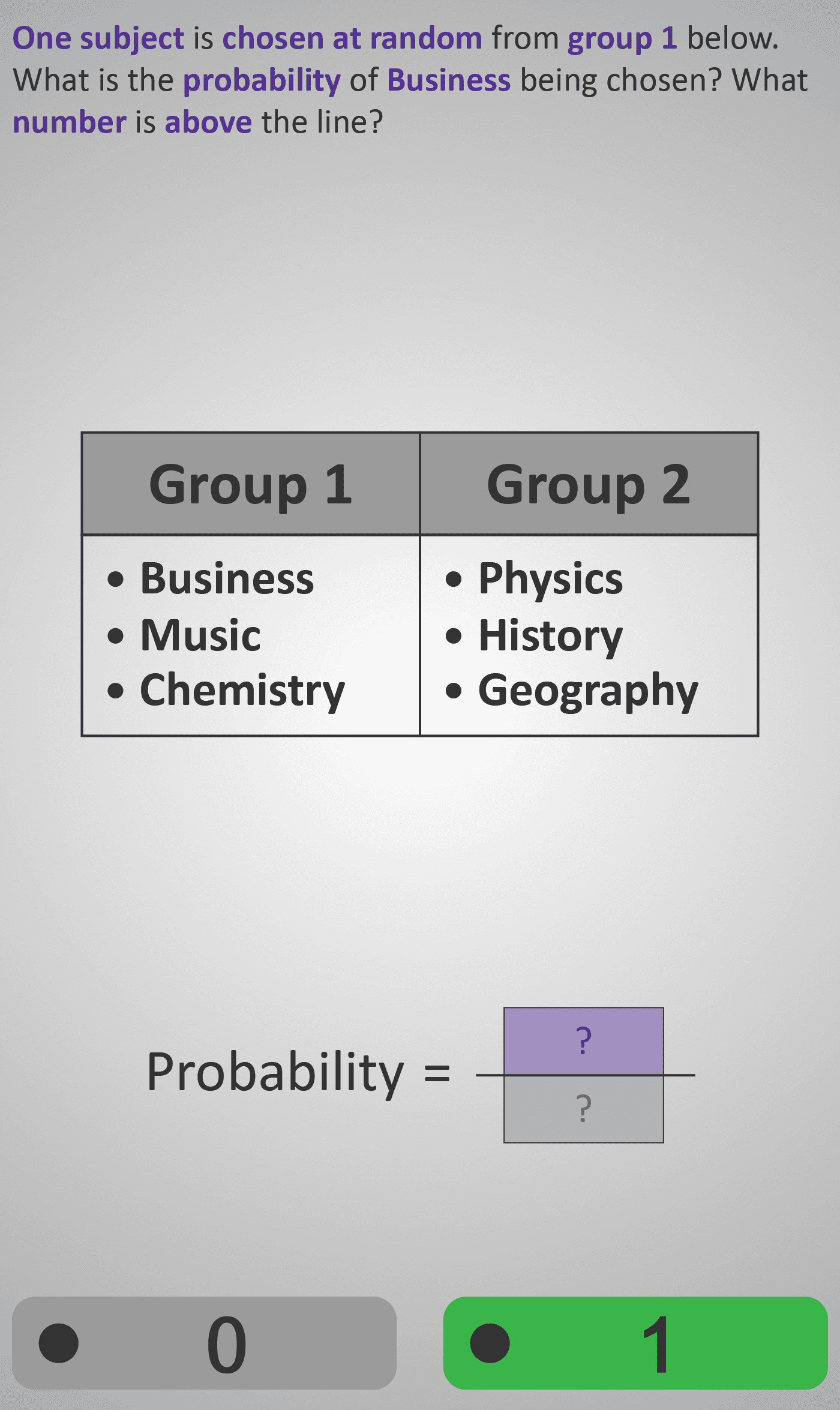
- Focusing on a single group (e.g. subjects).
- Alternating between “above” and “below the line” questions.
By the end, learners understand that probability represents the ratio of favourable to total outcomes, and they can apply this logic consistently — even when the question involves “not” conditions.
Prerequisite Knowledge Required
- Understanding probability as a fraction (favourable ÷ total).
- Ability to count and group items from lists.
- Understanding that “not” means taking the complement of a set.
- Completion of Probability 3A (what goes above/below the line).
Main Category
Data & Probability / Comparing and Complementary Events
Estimated Completion Time
Approx. 6–7 minutes (four visual and contextual examples).
Cognitive Load / Step Size
Moderate — the Phlow introduces the logic of “not” and two-group counting but keeps visuals and text simple. Alternating between “above/below” maintains clarity while building fluency.
Language & Literacy Demand
Moderate — key phrases like “not being chosen” and “above/below the line” are introduced with repetition and visual prompts. Bulleted lists help scaffold comprehension for diverse reading levels.
Clarity & Design
- Tables clearly separate Group 1 and Group 2 for easy comparison.
- Bold category labels (Colours, Shapes, Subjects) maintain context recognition.
- Purple highlighting guides attention to numerator or denominator.
- Consistent phrasing — “What number is above/below the line?” — reinforces structure.
Curriculum Alignment
Irish Junior Cycle Mathematics – Learning Outcome 1.11
- Identify and calculate probabilities of simple events.
- Distinguish between events that can and cannot occur.
- Understand complementary (“not”) events.
Engagement & Motivation
High — learners interact with familiar examples (colours, shapes, subjects). The alternating question style feels like a quick logic puzzle, encouraging focus and rewarding pattern recognition.
Error Opportunities & Misconceptions
- Forgetting to combine groups when counting total outcomes.
- Mixing up numerator and denominator positions.
- Misinterpreting “not” as meaning “none of”.
Visual scaffolds, group separation, and immediate feedback help resolve these effectively.
Transferability / Real-World Anchoring
Excellent — the concept mirrors real-life classification and selection, such as choosing from lists or categories. This foundation supports reasoning about sampling, decision-making, and chance.
Conceptual vs Procedural Balance
Conceptual: grasping complementary probability and fraction structure.
Procedural: counting accurately and writing probabilities systematically.
Learning Objectives Addressed
- Recognise and calculate simple probabilities.
- Identify the complement (“not”) in probability contexts.
- Strengthen fluency with numerator–denominator structure.
- Develop confidence applying counting strategies to grouped data.
What Your Score Says About You
- Below 4: Revisit what “not” means — it includes all other outcomes.
- 5–7: You understand the structure — focus on counting total outcomes carefully.
- 8–9: You’re accurately identifying numerators and denominators.
- 10 / 10: Excellent! You can interpret and calculate probabilities for grouped and complementary events — ready for Probability 3C, where you’ll explore visual sample spaces and multi-step reasoning.