
Probability 3C
Overview
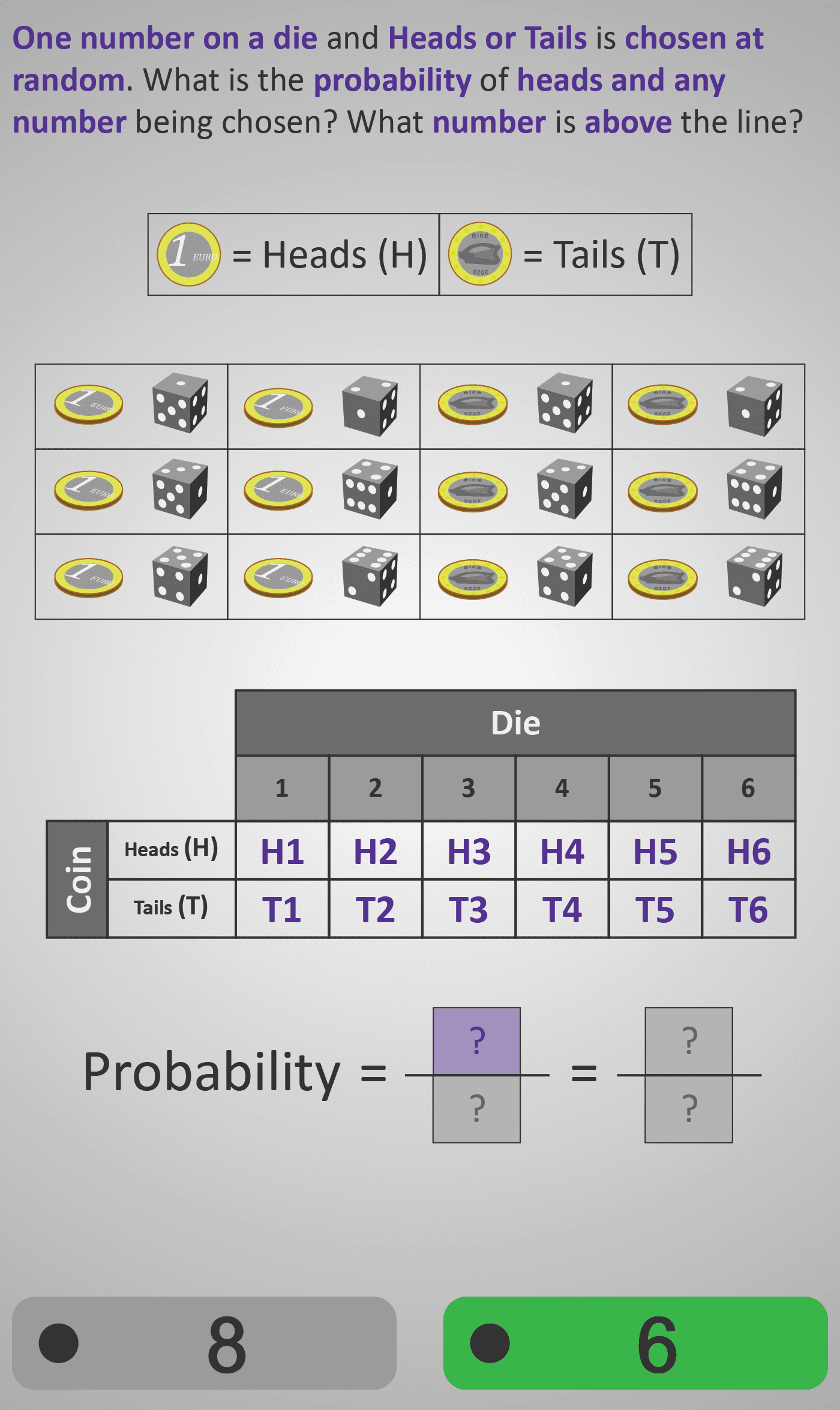
In this Phlow, learners build on their understanding of simple probability by exploring combined events — in this case, flipping a coin and rolling a six-sided die. They are introduced to a visual sample space showing all 12 possible outcomes (H1–H6, T1–T6), connecting concrete images (coins and dice) to symbolic probability notation.
Students are guided through a clear, step-by-step process:
- Understanding total outcomes: 2 for the coin × 6 for the die = 12 total.
- Identifying favourable outcomes: e.g., all results showing Heads (6 total).
- Writing the probability: favourable over total → 6/12.
- Simplifying the fraction: e.g., 6/12 = 1/2.
Each screen isolates one skill — finding the numerator, denominator, or simplifying — before combining them. Visual counting and numerical reasoning work together to strengthen understanding of how probability connects to fractions.
The activity reinforces the rule: Probability = Number of favourable outcomes ÷ Total possible outcomes, while linking to prior fraction work. This integration prepares students for more abstract probability calculations using spinners, tables, and tree diagrams in later levels.
Prerequisite Knowledge Required
- Understanding of basic probability from single events.
- Knowledge of fractions and simplifying to simplest form.
- Recognition that probability = favourable ÷ total outcomes.
- Completion of Probability 3A (fractions) and 3B (complements).
Main Category
Data & Probability / Probability from Combined Events
Estimated Completion Time
Approx. 7 minutes (four progressive visual + symbolic tasks).
Cognitive Load / Step Size
Moderate — combines multiple previously learned ideas (fractions, counting, simplification) but supports learners through clear grids and consistent phrasing. Each screen introduces one new layer at a time.
Language & Literacy Demand
Low to Moderate — key terms like favourable, simplest form, and numerator/denominator are repeated and paired with visuals. Purple highlights and labelled grids help decode meaning without heavy text reliance.
Clarity & Design
- Grid of outcomes (coin × die) shows all 12 possibilities clearly.
- Symbolic table (H1–T6) reinforces systematic thinking.
- Purple highlighting connects questions to fraction structure.
- Alternating conceptual (visual) and procedural (simplification) tasks maintain flow.
Curriculum Alignment
Irish Junior Cycle Mathematics – Learning Outcome 1.11
- Identify all possible outcomes of two combined random events.
- Calculate probabilities using sample spaces.
- Simplify probability fractions to simplest form.
Engagement & Motivation
High — the use of coins and dice connects mathematics to familiar, game-like contexts. Moving from pictures to tables to fractions provides a tangible and rewarding sense of progress.
Error Opportunities & Misconceptions
- Forgetting that there are 12 total outcomes (2 × 6).
- Inverting the fraction (total ÷ favourable).
- Errors in simplifying fractions.
Each misconception is isolated and addressed with feedback, examples, and colour cues.
Transferability / Real-World Anchoring
Strong — learners connect to everyday random processes like games, experiments, or fair draws. The concepts apply directly to reasoning about fairness, odds, and sample modelling in real-world data.
Conceptual vs Procedural Balance
Conceptual: understanding how events combine to form all outcomes.
Procedural: writing, simplifying, and reasoning with probability fractions.
Learning Objectives Addressed
- List and interpret outcomes of combined random events.
- Calculate probability fractions from total and favourable outcomes.
- Simplify probabilities accurately to their simplest form.
- Link visual reasoning to formal probability notation.
What Your Score Says About You
- Below 4: Review how to count total outcomes — check each combination (H1–T6).
- 5–7: You understand combined events — practise simplifying fractions correctly.
- 8–9: Excellent progress — you can interpret and simplify probabilities with confidence.
- 10 / 10: Perfect! You’ve mastered probability fractions — ready for Probability 3D, where you’ll apply these ideas to fairness and real-world comparisons.