
Probability 3D
Overview
In this Phlow, learners extend their understanding of probability from single and combined events to situations involving two spinners. They visualise every possible outcome using a table that lists all combinations — for example, Spinner 1 (A, B) and Spinner 2 (1, 2, 3) create six total outcomes: A1, A2, A3, B1, B2, B3.
Students answer questions such as: “What is the probability of B and 1 being chosen?” They identify the total number of possible outcomes (below the line) and the favourable outcomes (above the line), reinforcing the meaning of each part of a probability fraction.
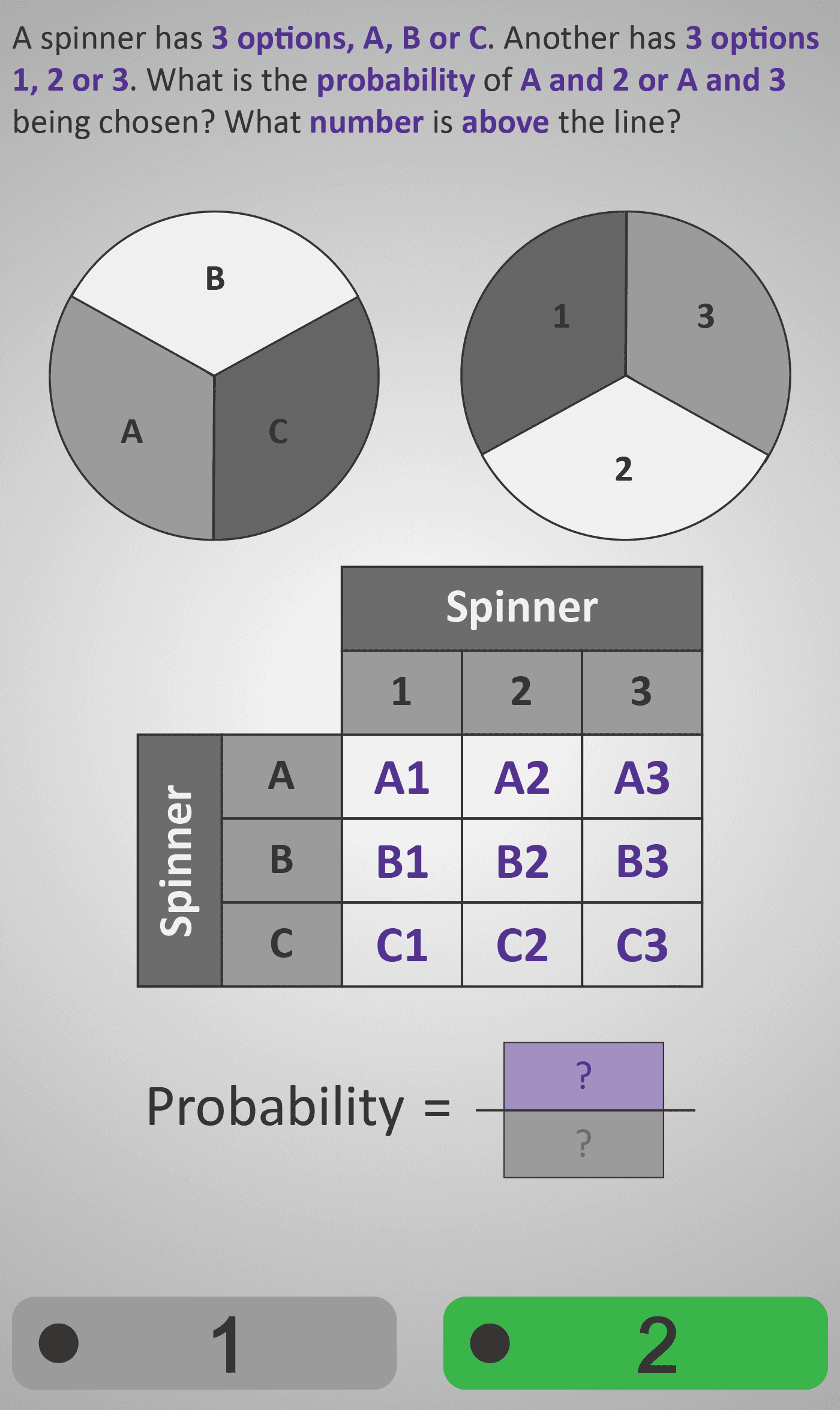
Later screens introduce larger spinners — for example, 3 options × 3 options = 9 total outcomes — and comparisons such as “What is the probability of A and 2 or A and 3 being chosen?” This helps learners recognise when multiple outcomes can be grouped together under one event.
By the end of the Phlow, students can:
- Represent combined outcomes in a clear table or grid.
- Identify single or multiple favourable outcomes.
- Write and interpret probabilities as fractions.
- Compare probabilities visually and numerically.
This activity completes the foundational stage of probability before moving to tree diagrams and experimental probability in Level 4.
Prerequisite Knowledge Required
- Understanding that probability = favourable ÷ total outcomes.
- Familiarity with combined events from Probability 3C.
- Ability to read and interpret a two-way table or outcome grid.
- Basic understanding of fractions and how multiple outcomes can count as one event.
Main Category
Data & Probability / Combined Events & Comparison
Estimated Completion Time
Approx. 8 minutes (four interactive examples with growing complexity).
Cognitive Load / Step Size
Moderate — students must track two random events simultaneously, but visuals, colour-coded spinners, and systematic tables keep the process clear. Each example builds incrementally, from one favourable outcome to grouped ones.
Language & Literacy Demand
Moderate — key words like and, or, above, and below are repeated in simple, consistent phrasing. Visuals make logical relationships clear without requiring advanced reading.
Clarity & Design
- Two distinct spinners shown side by side, each clearly labelled.
- Outcome tables visually connect spinner results to probability notation (A1, B2, etc.).
- Grey/purple shading distinguishes numerator and denominator focus.
- Alternating question types (“above the line” vs “below the line”) sustain engagement.
Curriculum Alignment
Irish Junior Cycle Mathematics – Learning Outcome 1.11
- Identify and represent outcomes of two combined random events.
- Calculate probabilities using tables or grids.
- Compare probabilities through reasoning and simplification.
Engagement & Motivation
High — learners relate to the spinner activity as a familiar, playful context. Each task feels like a mini puzzle, encouraging pattern recognition and logical deduction.
Error Opportunities & Misconceptions
- Forgetting to count all possible outcomes correctly.
- Leaving out one or more favourable outcomes when “or” is used.
- Reversing the numerator and denominator in probability fractions.
These are addressed through step-by-step structure, visual grids, and consistent feedback loops.
Transferability / Real-World Anchoring
Strong — this Phlow reflects real-world logic behind random pairing, decision-making, and fairness in games. It lays the groundwork for more advanced probability analysis such as experimental testing and theoretical comparisons.
Conceptual vs Procedural Balance
Conceptual: understanding how combined events and “and/or” logic operate.
Procedural: systematically counting, expressing, and comparing probabilities as fractions.
Learning Objectives Addressed
- List all possible outcomes for two combined spinners.
- Calculate and simplify probability fractions.
- Recognise when multiple outcomes contribute to a single event.
- Compare probabilities using numerical and visual methods.
What Your Score Says About You
- Below 15: Review how total outcomes are formed — recheck the outcome grid carefully.
- 16–22: You understand how combined events work — practise grouping outcomes with “and/or”.
- 23–29: Excellent reasoning — you can identify and write probability fractions accurately.
- 30 / 30: Fantastic! You can interpret, compare, and calculate probabilities for combined events — ready for Probability 4A, where you’ll explore experimental probability and fairness in real-world situations.