
Probability 3F
Overview
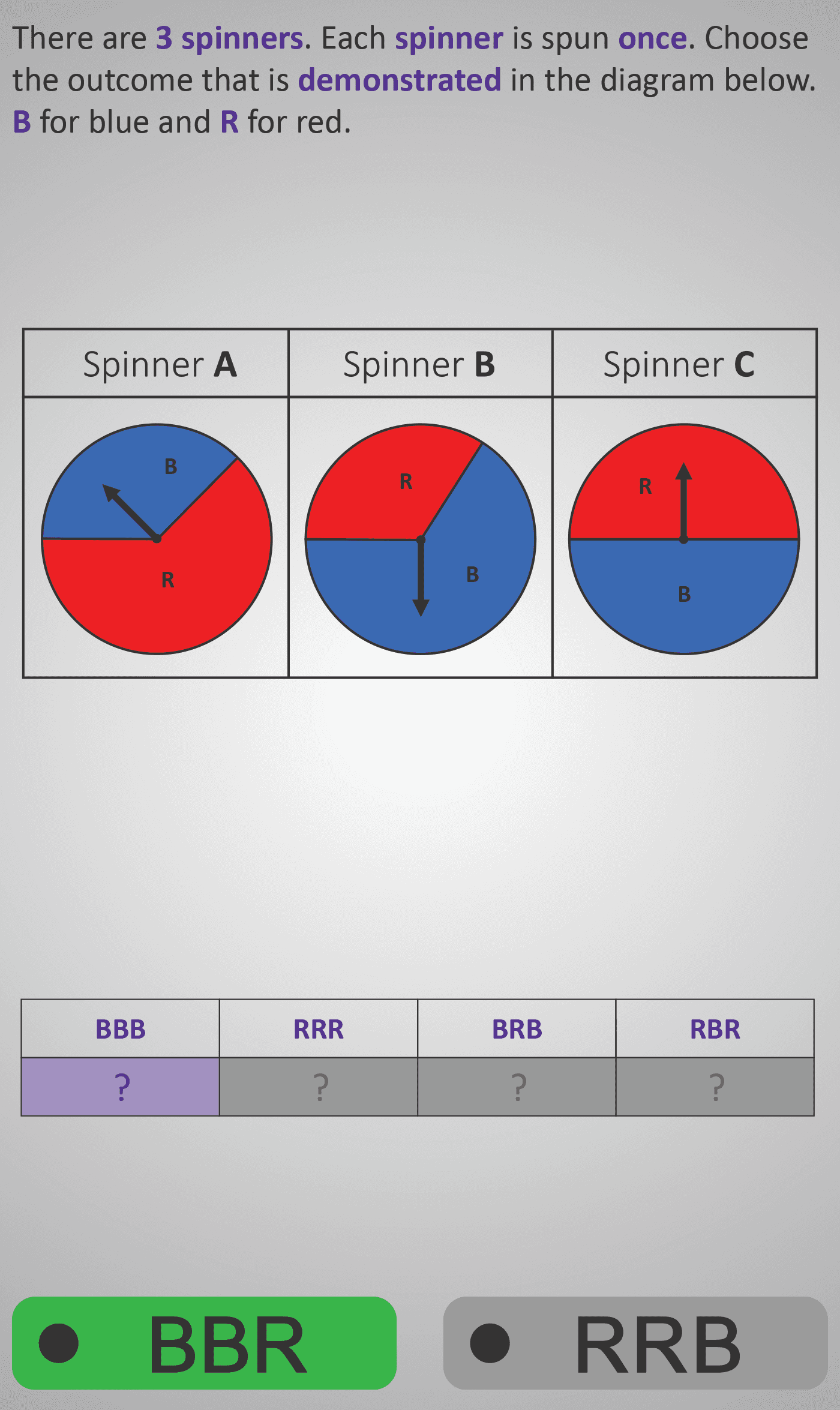
In this Phlow, learners extend their understanding of combined events by exploring multiple spinners spun once each. Each spinner is divided into red (R) and blue (B) sectors, and students must correctly record the outcome using letters that represent the colours shown.
For example:
Spinner A → B, Spinner B → B, Spinner C → R gives the outcome BBR.
Each question shows three spinners and asks students to choose the correct outcome from options like BBB, RRR, BRB, and RBR. As the questions progress, students interpret pointer directions more carefully, strengthening their ability to read, interpret, and encode probabilistic outcomes.
This Phlow helps students visualise that:
- Each spinner adds another layer of possibility, increasing total outcomes (2 × 2 × 2 = 8).
- The order of outcomes matters — BBR and BRB are different.
- Probability becomes more complex as combinations grow, setting the stage for future topics like tree diagrams.
By the end, learners confidently connect visual results to symbolic representations, understanding how to organise outcomes clearly and systematically.
Prerequisite Knowledge Required
- Understanding of single and two-event probabilities (from Probability 3C–3E).
- Familiarity with representing outcomes as letter combinations (e.g., R and B).
- Awareness that total outcomes increase with each additional event.
- Basic understanding of how symbolic probability notation represents visual results.
Main Category
Data & Probability / Representing and Counting Outcomes
Estimated Completion Time
Approx. 7–8 minutes (four interactive matching and reasoning tasks).
Cognitive Load / Step Size
Moderate — students interpret three simultaneous visuals and map them to symbolic outcomes. Consistent layout, colour coding, and repeated structure reduce working memory load while promoting systematic reasoning.
Language & Literacy Demand
Low to Moderate — clear, repeated phrasing such as “Each spinner is spun once.” Letter coding (B for Blue, R for Red) allows universal comprehension and minimal reading dependency.
Clarity & Design
- Clear and consistent spinner graphics for all questions.
- Strong colour contrast between red and blue ensures visual clarity.
- Uniform layout supports left-to-right scanning and comparison.
- Outcome tables below reinforce systematic organisation and counting.
Curriculum Alignment
Irish Junior Cycle Mathematics – Learning Outcome 1.11
- Identify all possible outcomes for multiple random events.
- Represent outcomes using letters, tables, or systematic listings.
- Recognise that order matters when describing combined outcomes.
Engagement & Motivation
High — the visual, interactive design resembles a mini game, keeping learners focused and curious. The “match the result” format rewards accuracy and careful observation with instant feedback.
Error Opportunities & Misconceptions
- Reversing the order of letters (e.g., writing RBR instead of BRR).
- Forgetting to include one spinner’s result or misreading pointer direction.
- Assuming all outcomes are equally likely without checking section sizes.
Repetition and consistent visual feedback correct these quickly.
Transferability / Real-World Anchoring
Strong — introduces systematic listing, a vital foundation for probability in real-life contexts like game design, computer simulations, and data modelling. Students learn to represent complex outcomes precisely using concise notation.
Conceptual vs Procedural Balance
Conceptual: recognising all possible outcomes and understanding order significance.
Procedural: writing, matching, and verifying symbolic outcomes systematically.
Learning Objectives Addressed
- Identify and record outcomes of multiple independent events.
- Use systematic listings to represent combined outcomes clearly.
- Interpret symbolic outcomes from visual data accurately.
- Develop readiness for probability trees and experimental analysis.
What Your Score Says About You
- Less than 15: Revisit how spinner directions match colour outcomes — check each carefully.
- 16–22: You identify outcomes correctly but may mix up order — practise reading left to right.
- 23–29: Great progress — you can match and record outcomes quickly and accurately.
- 30 / 30: Excellent! You can represent and interpret outcomes for multiple events — ready for Probability Level 4, where you’ll explore complete listings and probability calculations.