
QMARK by 10 3A
Overview
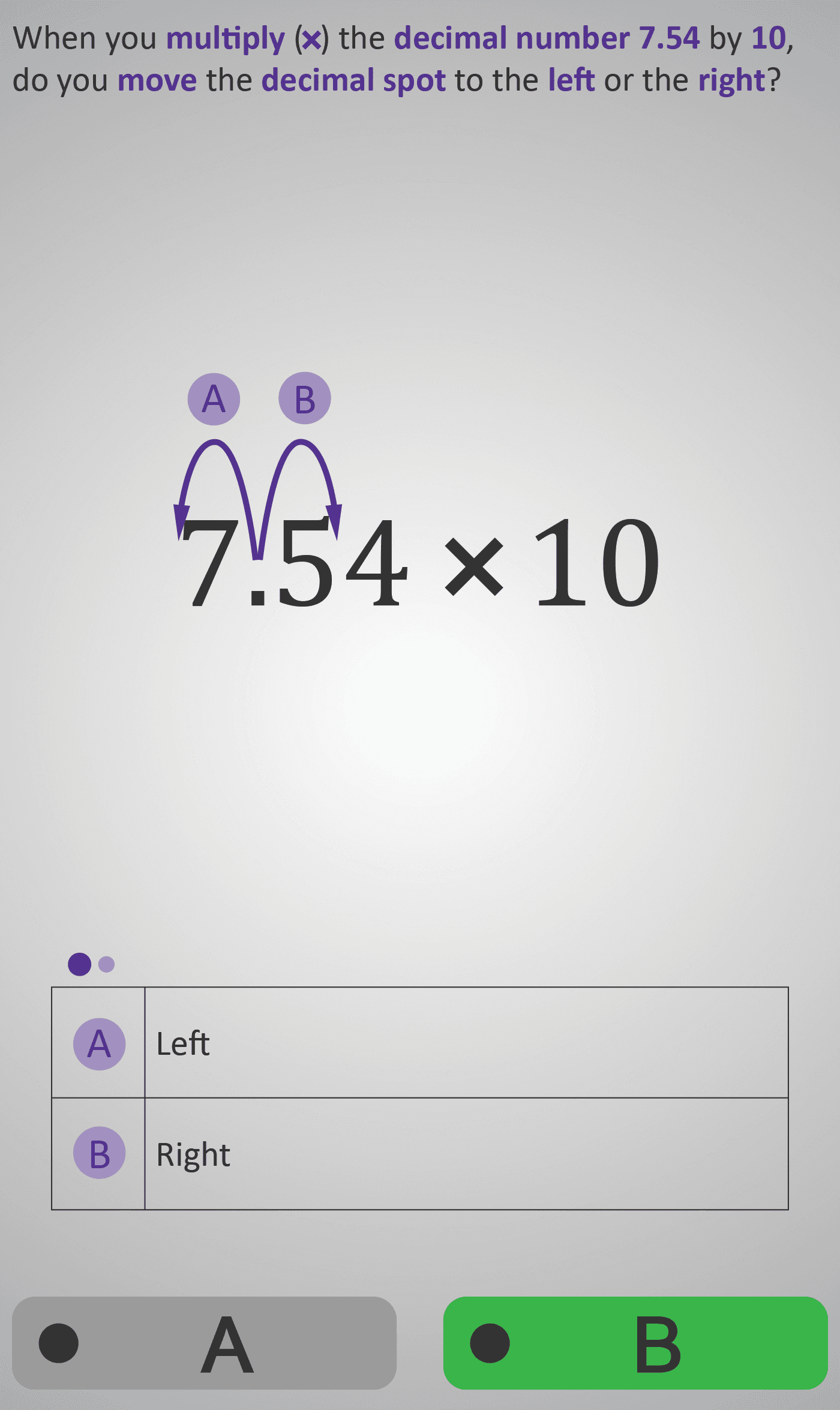
In this Phlow, learners discover how multiplying or dividing a decimal number by 10 changes its size and place value. The sequence begins with 7.54 × 10, where students predict whether the decimal moves left or right. Visual arrows reinforce that multiplying by 10 makes a number ten times larger, moving the decimal one place to the right.
The second step checks understanding by asking for the new value of 7.54 × 10, confirming that the answer is 75.4. The pattern then reverses with 2.72 ÷ 10, guiding learners to realise that division makes a number ten times smaller, moving the decimal one place to the left. The final screen consolidates learning as students calculate 2.72 ÷ 10 = 0.272, linking place value movement with a visual arrow and correct positioning.
By alternating between multiplication and division examples, learners internalise a key pattern of decimal behaviour — movement of digits relative to the decimal point — which underpins later topics such as scaling, metric conversion, and powers of 10.
By the end, students can confidently:
- Predict the direction of decimal movement when × or ÷ by 10.
- Apply the rule consistently across different decimals.
- Understand that multiplying increases a number’s value and dividing decreases it.
Prerequisite Knowledge Required
- Understanding of place value (ones, tenths, hundredths).
- Familiarity with basic multiplication and division facts.
- Recognition of the decimal point and its role separating whole and fractional parts.
- Completion of QMARK by 10 – Level 2 or relevant Place Value Phlows.
Main Category
Number & Operations / Decimals and Place Value
Estimated Completion Time
Approx. 5–6 minutes (four interactive visual screens).
Cognitive Load / Step Size
Low — each screen isolates a single operation (multiply or divide) with clear visual arrows and minimal text. The repetition strengthens recognition of consistent place-value patterns.
Language & Literacy Demand
Low — concise, repeated phrasing like “move the decimal to the left/right.” Mathematical terms (multiply, divide, decimal) are highlighted in purple for emphasis.
Clarity & Design
- Consistent use of arrows to indicate direction of decimal movement.
- Large, uncluttered numerals with strong visual contrast.
- Clear logical flow: multiply → confirm → divide → confirm.
- Alternating colour cues aid immediate understanding of each directional change.
Curriculum Alignment
Irish Junior Cycle Mathematics – Learning Outcome 1.6
- Multiply and divide decimal numbers by 10 and 100, recognising patterns in place value movement.
- Understand and describe how digits shift relative to the decimal point.
- Apply this knowledge in metric and scaling contexts.
Engagement & Motivation
High — the use of arrows, movement, and visual transformation keeps students attentive. Immediate feedback through alternating operation types builds confidence and curiosity.
Error Opportunities & Misconceptions
- Reversing the direction of decimal movement (thinking multiply moves left).
- Counting decimal places incorrectly when shifting digits.
- Forgetting that it’s the digits that move, not the decimal itself.
These are resolved through visual reinforcement and consistent repetition across examples.
Transferability / Real-World Anchoring
Strong — connects directly to scaling units (cm → mm), money (euro ↔ cent), and scientific notation. Builds essential understanding for later topics involving metric conversions and powers of 10.
Conceptual vs Procedural Balance
Conceptual: understanding why multiplying by 10 enlarges and dividing by 10 reduces value.
Procedural: applying the decimal movement correctly in each direction.
Learning Objectives Addressed
- Multiply and divide decimals by 10 accurately.
- Predict and explain the direction of decimal movement.
- Strengthen number sense through consistent place value reasoning.
What Your Score Says About You
- Less than 15: Review which direction the decimal moves — remember, multiply → right, divide → left.
- 16–22: You understand the pattern — practise applying it across different examples.
- 23–29: You’re confident and consistent in shifting decimals accurately.
- 30 / 30: Excellent! You’ve mastered how × and ÷ by 10 affect decimals — ready for QMARK by 10 – Level 4, where you’ll explore × and ÷ by 100 and 1000, and apply this to metric conversions.