
QMARK by 10 3B
Overview
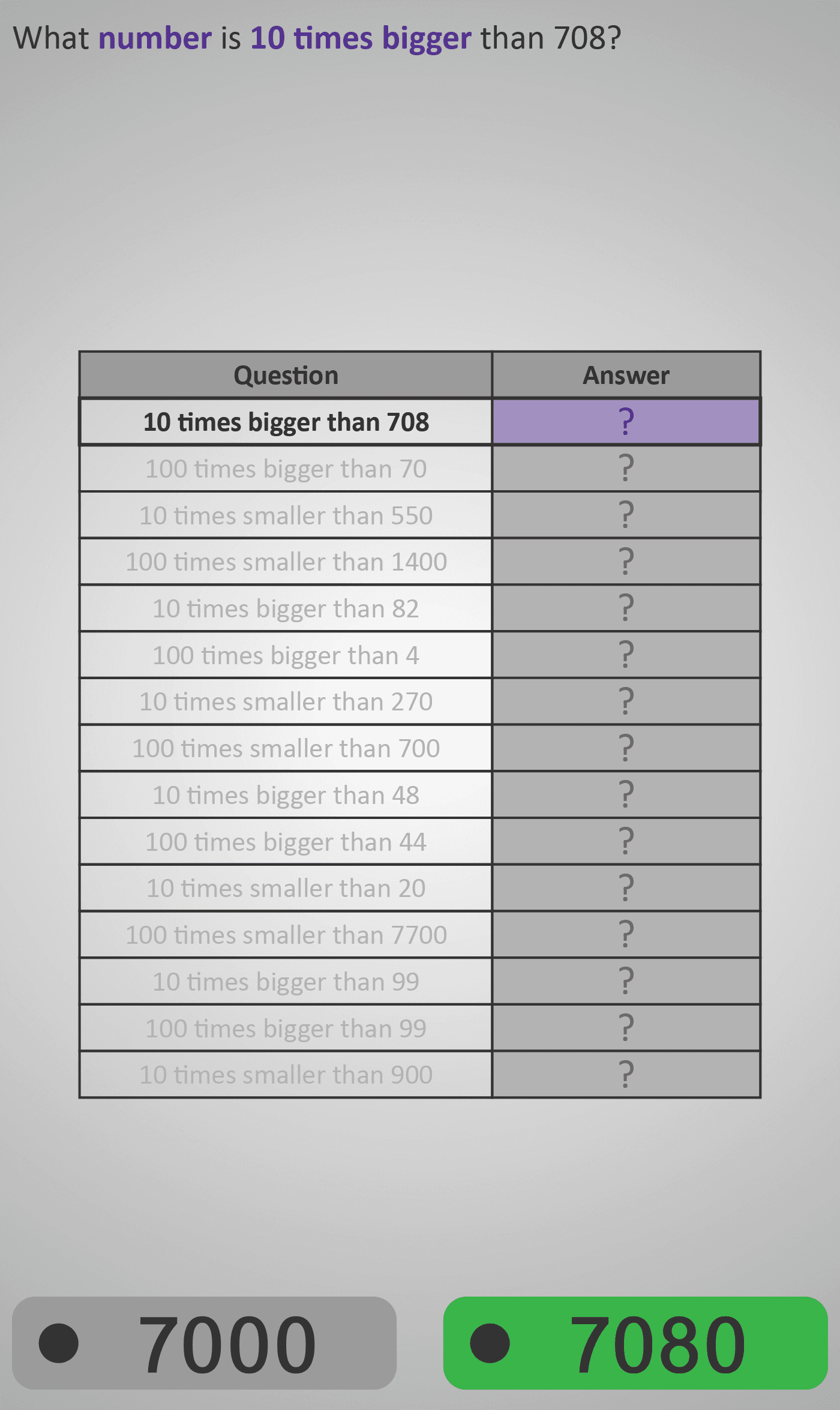
In this Phlow, learners move beyond single examples and apply their understanding of place value shifts through a sequence of contextualised comparison questions. Each screen presents prompts such as “What number is 10 times bigger than 708?” or “What number is 100 times smaller than 1400?”, alongside a visual question-and-answer table.
The interaction reinforces that multiplying by 10 or 100 makes a number larger, while dividing makes it smaller. Each factor introduces a predictable shift in zeros or decimal positions. For instance:
- 708 × 10 = 7080
- 70 × 100 = 7000
- 550 ÷ 10 = 55
- 1400 ÷ 100 = 14
Each example builds on the same pattern, helping students internalise how “times bigger” means multiplication and “times smaller” means division — an area where learners often confuse direction or magnitude.
The mix of whole-number and realistic numerical contexts encourages flexibility and automaticity. By scanning the question table and filling in the correct answer, learners practise mental multiplication and division while visually connecting size changes with numerical patterns.
By the end of this Phlow, students can confidently determine any number’s scaled value when multiplied or divided by 10 or 100, directly linking this to place value, scaling, and proportional reasoning.
Prerequisite Knowledge Required
- Understanding that multiplying increases and dividing decreases a number’s value.
- Familiarity with the meaning of “times bigger” and “times smaller.”
- Basic multiplication and division facts up to 10 and 100.
- Completion of QMARK by 10 – 3A or equivalent Place Value Phlows.
Main Category
Number & Operations → Multiplication, Division & Place Value
Estimated Completion Time
Approx. 6–7 minutes (five interactive question screens).
Cognitive Load / Step Size
Medium — learners move from single examples (3A) to multi-step reasoning with varying operations and scale factors (×10, ×100, ÷10, ÷100). The table structure supports working memory by showing relationships between examples.
Language & Literacy Demand
Low–Moderate — consistent phrasing such as “times bigger” and “times smaller” ensures clarity. The question table layout reinforces understanding through visual repetition rather than long text.
Clarity & Design
- Simple, consistent structure with alternating examples for × and ÷.
- Table format provides a visual anchor for scaling patterns.
- Purple highlight draws focus to the active question row.
- Green correct-answer feedback reinforces retention visually.
Curriculum Alignment
Irish Junior Cycle Mathematics – Learning Outcomes 1.6 & 1.7
- Multiply and divide whole numbers and decimals by 10, 100, and 1000.
- Understand and apply “times bigger/smaller” relationships.
- Recognise how multiplication and division affect place value patterns.
Engagement & Motivation
High — the repetitive rhythm and visible progress create a satisfying sense of flow. Students see their table fill as they master each scaling pattern, reinforcing progress.
Error Opportunities & Misconceptions
- Confusing “times bigger” with addition instead of multiplication.
- Reversing direction when scaling (shrinking instead of enlarging).
- Miscounting zeros or misaligning digits when multiplying by 100.
Immediate correction and clear visual cues address these misconceptions directly.
Transferability / Real-World Anchoring
Strong — builds the foundation for metric conversions (cm ↔ m, g ↔ kg), money calculations, and understanding scientific notation. Prepares students for flexible reasoning in real-world scaling.
Conceptual vs Procedural Balance
Balanced — conceptual understanding of “times bigger/smaller” paired with procedural fluency in multiplication and division by powers of 10.
Learning Objectives Addressed
- Multiply and divide numbers by 10 and 100 with accuracy.
- Understand that each zero represents a place value shift.
- Distinguish clearly between “times bigger” and “times smaller.”
- Build speed and fluency in scaling and number pattern reasoning.
What Your Score Says About You
- Less than 15: Revisit what “times bigger” and “times smaller” mean — focus on direction and magnitude.
- 16–22: You recognise scaling patterns — practise fluency with ×100 and ÷100.
- 23–29: Great progress — your place value reasoning is strong across most examples.
- 30 / 30: Excellent! You’ve mastered scaling by 10 and 100 — ready for QMARK by 10 – 3C, where you’ll extend this to × and ÷ by 1000 and connect it to metric and decimal conversions.