
Sets 3
Overview
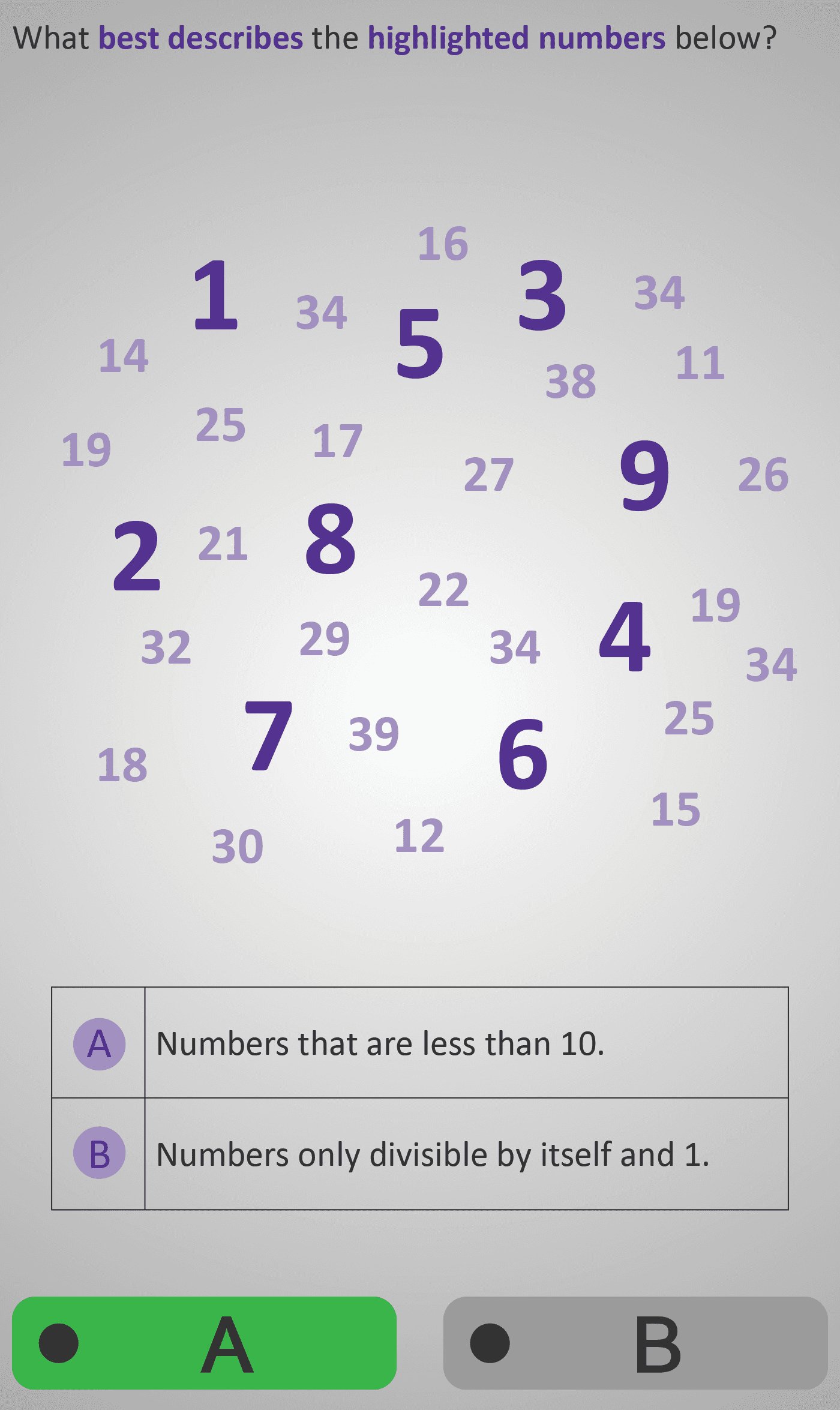
In this Phlow, students deepen their understanding of sets by recognising, describing, and listing groups of numbers that share a common property. The task begins by asking which description best matches the highlighted numbers — introducing the idea that sets can be defined by a rule or property (e.g., “numbers less than 10”).
Next, learners identify the members of that set in ascending order, constructing the set step-by-step. They are prompted to select the first, next, and last numbers, gradually building the notation {1, 2, 3}. This reinforces the connection between visual patterns, verbal descriptions, and formal mathematical notation.
The Phlow uses engaging visuals — scattered numbers where only some are highlighted — to make pattern recognition intuitive. By the end, learners can confidently identify, describe, and write simple sets using correct symbols. This lays the groundwork for future Phlows involving Venn diagrams, unions, and intersections.
Prerequisite Knowledge Required
- Understanding of whole numbers and basic number order.
- Ability to identify numbers that meet a simple condition (e.g., less than 10).
- Familiarity with:
- Sets 1 – Recognising Sets
- Sets 2 – Describing Sets by a Rule
Main Category
Algebra / Sets and Relations
Estimated Completion Time
Approx. 8–12 seconds per question (30 questions total). Total: 4–6 minutes.
Cognitive Load / Step Size
Low to Moderate — each step introduces one small decision: describing the set, identifying its rule, or adding a new element. The repetition strengthens pattern recognition and procedural fluency while maintaining a smooth learning flow.
Language & Literacy Demand
Low — short, clear prompts (“lowest number,” “numbers less than 10”) minimise reading load. Visual highlighting ensures comprehension relies primarily on numerical reasoning rather than text interpretation.
Clarity & Design
- Numbers displayed clearly in a random but readable arrangement.
- Purple highlights guide attention to relevant numbers and notation.
- Progressive display ({1}, {1, 2}, {1, 2, 3}) mirrors classroom practice.
- Balanced use of visuals and notation promotes deep understanding.
Curriculum Alignment
Irish Junior Cycle Mathematics – Learning Outcome 3.5
- Identify and describe sets of numbers by a defining property.
- List elements of a set using correct set notation.
- Recognise that sets can be described verbally or by listing members.
Engagement & Motivation
Moderate to High — the visual scatter of numbers creates a game-like puzzle that encourages curiosity. Building a set step-by-step provides clear progress and positive reinforcement.
Error Opportunities & Misconceptions
- Including boundary numbers incorrectly (e.g., 10 when rule is “less than 10”).
- Omitting curly brackets or commas in set notation.
- Assuming sets must include consecutive numbers.
Each misconception is addressed through feedback and guided correction steps.
Transferability / Real-World Anchoring
Moderate — understanding sets prepares students for later concepts in logic, coding, probability, and data classification. The reasoning built here supports structured thinking in a range of subjects.
Conceptual vs Procedural Balance
Conceptual: Understanding that sets are defined by a shared property or rule.
Procedural: Writing and ordering elements correctly using curly brackets {} and commas.
Balanced design ensures clarity and fluency.
Learning Objectives Addressed
- Identify numbers that satisfy a given rule.
- Describe sets in words and list elements in order.
- Use curly brackets {} to represent sets formally.
- Understand that sets are defined by properties, not appearance.
What Your Score Says About You
- Less than 15: Review the meaning of a set — focus on recognising which numbers fit the rule.
- 16–22: You can identify and list sets correctly — practise ordering and notation carefully.
- 23–29: Excellent — you understand how sets are described and represented using notation.
- 30 / 30: Perfect! You’re ready for Sets 4, where you’ll compare two sets using Venn diagrams and explore shared and unique elements.