
Shared Equally 3
Overview
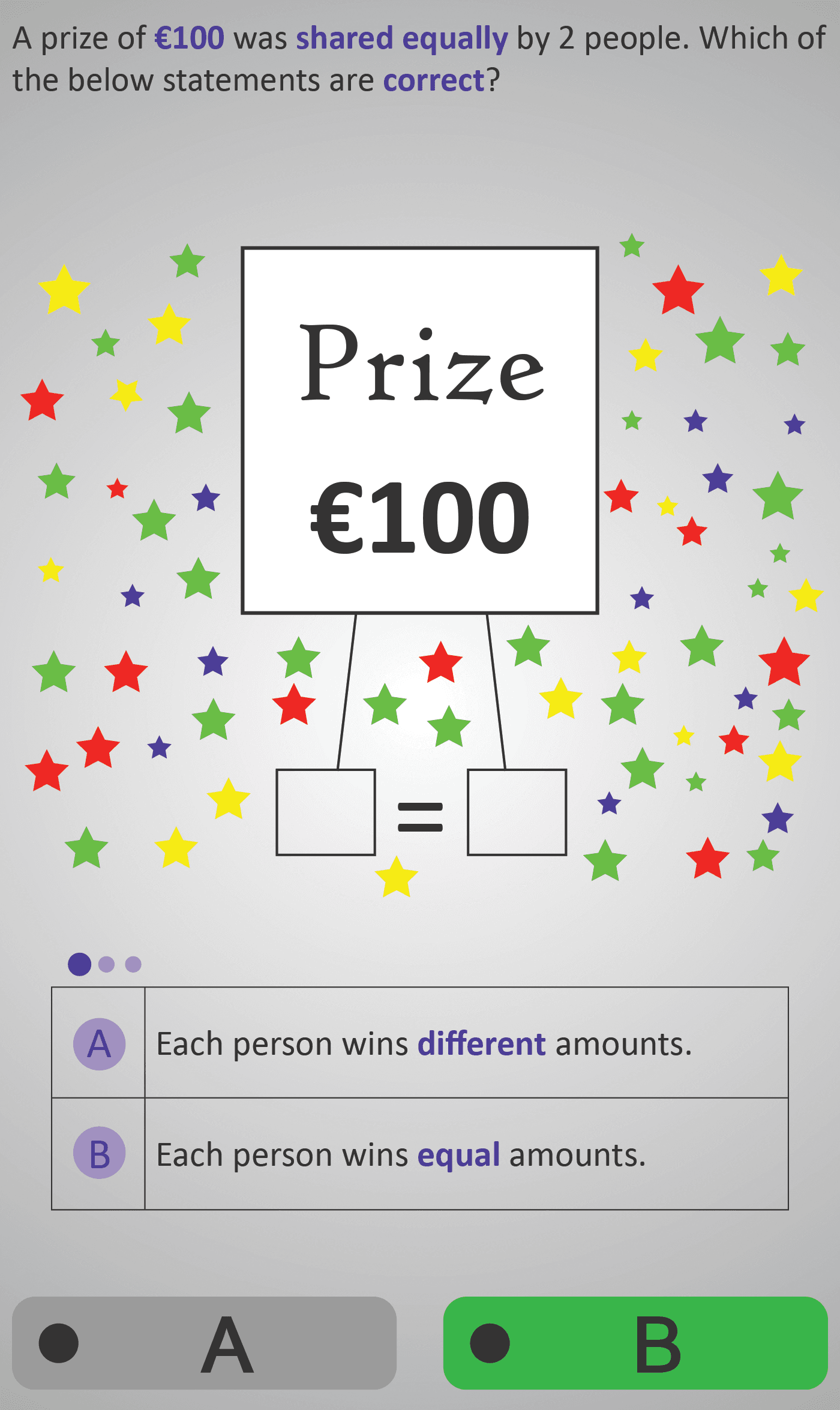
In this Phlow, learners build an intuitive understanding of division as equal sharing. The scenario shows a €100 prize being shared equally between two people. Through visual and verbal cues, students reason that “equal sharing” means both people receive the same amount. They then select the correct mathematical expression to find each share — €100 ÷ 2 — reinforcing the link between real-world situations and division notation.
Finally, learners calculate that each person wins €50, connecting fairness and equality with mathematical reasoning. The colourful visuals and balanced layout help students visualise equal division clearly and memorably.
This Phlow bridges conceptual understanding (“equal parts”) with procedural skill (“divide by 2”), setting up later lessons that introduce division by larger numbers, fractions, and ratios.
By the end, learners can confidently:
- Recognise that “shared equally” means fairness and equal parts.
- Translate a word problem into a division expression.
- Calculate one person’s share accurately using division.
Prerequisite Knowledge Required
- Understanding of equal groups and fair sharing.
- Familiarity with the ÷ symbol or the concept of dividing into parts.
- Basic knowledge of multiplication facts for 2.
- Prior completion of:
- Shared Equally 1 – Understanding Fair Sharing
- Shared Equally 2 – Sharing Numbers and Objects Equally
Main Category
Arithmetic / Division and Multiplication Relationships
Estimated Completion Time
Approx. 8–12 seconds per question (30 questions total). Total: 4–6 minutes.
Cognitive Load / Step Size
Low to Moderate — each step introduces one small idea at a time: first conceptual (“equal shares”), then symbolic (“divide by”), then numerical (“100 ÷ 2 = 50”). The transitions are predictable and well-scaffolded to maintain flow and understanding.
Language & Literacy Demand
Low — short, simple sentences such as “A prize of €100 was shared equally by 2 people.” The visuals anchor meaning, reducing literacy demand. Mathematical terms like shared equally and divided by are reinforced with colour highlights.
Clarity & Design
- Central prize graphic (€100) provides a clear visual anchor.
- Two equal boxes represent the recipients, reinforcing fairness and symmetry.
- Stars and balanced design enhance engagement without distraction.
- Purple highlights connect equality, balance, and division symbols visually.
Curriculum Alignment
Strand: Number
Strand Unit: Operations – Division
- Understand division as the inverse of multiplication.
- Interpret division as equal sharing and grouping.
- Solve simple division problems in real-life contexts.
- (Aligned with Junior Cycle Mathematics Learning Outcome 1.11 and Primary Transition Strand on Number Operations.)
Engagement & Motivation
High — the prize-sharing story creates an immediate emotional connection. The visuals and tone make division feel purposeful and rewarding, promoting curiosity and confidence.
Error Opportunities & Misconceptions
- Confusing division with multiplication (choosing €100 × 2 instead of €100 ÷ 2).
- Interpreting “shared equally” as subtraction or halving incorrectly.
- Forgetting both people receive the same amount.
Repetition of key words (“equal”, “each”, “shared”) and immediate visual feedback corrects these errors quickly.
Transferability / Real-World Anchoring
Very Strong — this scenario mirrors real-life financial and fairness decisions (sharing prizes, costs, or resources). The reasoning applies directly to daily contexts and leads into future learning on fractions and ratios.
Conceptual vs Procedural Balance
Conceptual: Understanding fairness and equality.
Procedural: Applying division (÷) to calculate one share.
The Phlow transitions smoothly from intuitive reasoning to mathematical execution.
Learning Objectives Addressed
- Recognise that “shared equally” means equal parts for all.
- Use division to calculate equal shares of a total.
- Represent division using mathematical notation (÷).
- Connect division to fairness in everyday life.
What Your Score Says About You
- Less than 15: Focus on the meaning of “equal” — practise halving simple totals.
- 16–22: You understand equal shares — practise dividing by 2 and 5 to improve fluency.
- 23–29: Strong understanding — you can divide totals accurately and explain your reasoning.
- 30 / 30: Excellent! You’ve mastered equal sharing — ready for Shared Equally 4, where you’ll divide larger amounts and connect division to fractions.