
Small–Large 3
Overview
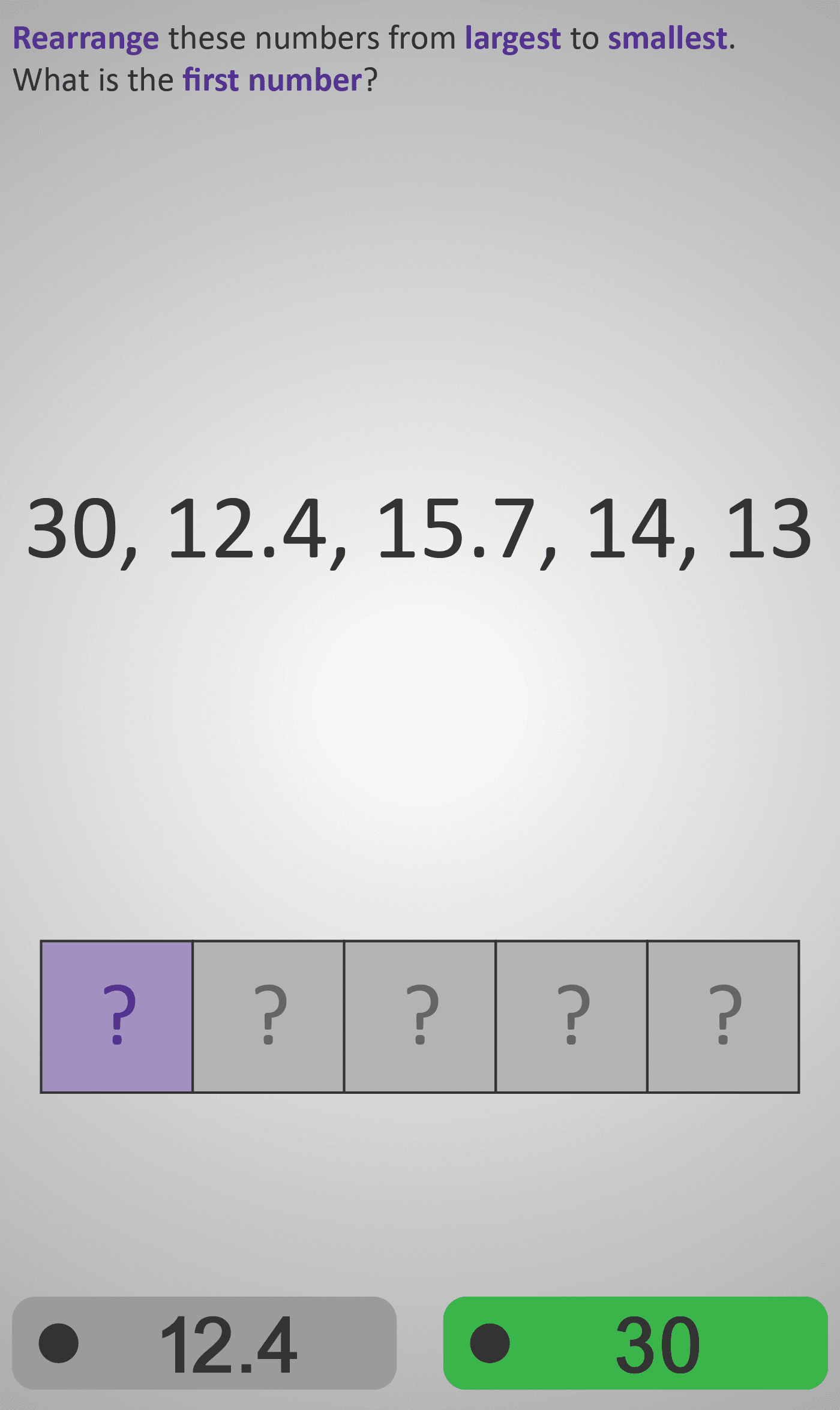
In this Phlow, learners arrange a mix of whole and decimal numbers (e.g., 30, 12.4, 15.7, 14, 13) from largest to smallest. Each step focuses on selecting the next number in order, helping learners reason through comparisons and observe patterns in size and value.
The sequence strengthens number sense by requiring students to compare both whole-number and decimal parts of each value. By reasoning about place value — tens, ones, and tenths — learners build fluency in ordering data, a foundational skill for reading tables, charts, and interpreting everyday quantities like money and measurement.
Through interactive steps, students explore questions such as “Which is larger — 15.7 or 14?” and see the ordered list grow dynamically as they make correct choices. The visual layout reinforces understanding of magnitude and decimal position without overwhelming working memory.
- Compare mixed decimal and whole numbers.
- Arrange values from largest to smallest.
- Use place value reasoning to identify order accurately.
- Recognise decimal positions between whole numbers on the number line.
Prerequisite Knowledge Required
- Understanding of place value, including tenths.
- Ability to compare whole numbers using greater than / less than.
- Awareness that decimal values fall between two whole numbers.
- Familiarity with reading decimal notation (e.g., “fifteen point seven”).
- Linked earlier Phlows: Small–Large 2 – Ordering Whole Numbers; Decimals 2 – Understanding Tenths and Hundredths.
Main Category
Number → Comparing and Ordering → Decimals and Whole Numbers
Estimated Completion Time
Approx 5–6 minutes (5 interactive selections).
Learning Outcomes
- Order mixed numbers containing decimals and whole numbers.
- Identify the largest and smallest correctly using place value logic.
- Compare decimals by examining whole-number and fractional parts.
- Recognise that 15.7 lies between 15 and 16 on the number line.
Cognitive Load / Step Size
Low to moderate — the Phlow introduces a small, manageable number of values and isolates one comparison per step. This gradual pacing ensures cognitive clarity while consolidating understanding before more complex decimal comparisons.
Language & Literacy Demand
Low — mathematical terms like “largest,” “smallest,” and “decimal” are used in short, clear instructions. Visual displays reduce reliance on text, supporting learners with varying reading proficiency.
Clarity & Design
- Large, well-spaced numbers make comparisons easy and engaging.
- Purple-highlighted key words (“largest,” “smallest”) guide focus.
- Progressive highlighting emphasises one decision at a time.
- Sequential layout visually reinforces number magnitude relationships.
Curriculum Alignment
Strand: Number
Learning Outcome: Students order and compare whole numbers and decimal numbers, understanding their relative sizes and positions on the number line.
(Aligned with Junior Cycle Mathematics – Strand 1: Number, Learning Outcome 1.3.)
Engagement & Motivation
Each correct choice immediately advances the sequence, rewarding accurate reasoning. The simple rhythm of compare → choose → confirm keeps learners engaged and in flow. The satisfaction of building a complete ordered list reinforces mastery and confidence.
Error Opportunities & Misconceptions
- Reading 12.4 as larger than 13 due to focus on digits rather than place value.
- Comparing only the digits after the decimal point.
- Reversing order (“largest to smallest” vs “smallest to largest”).
Corrective prompts and clear feedback guide learners toward understanding why one number is greater or smaller, reinforcing conceptual accuracy.
Transferability / Real-World Anchoring
Skills apply directly to real-world contexts — comparing prices (€12.40 vs €13.00), measuring lengths (15.7 cm vs 14 cm), or reading times (15.7 minutes vs 14 minutes). Learners build transferable reasoning that supports data interpretation and estimation.
Conceptual vs Procedural Balance
Conceptual emphasis — learners reason about why one number is larger or smaller, not just perform ordering by rote. Procedural sequencing supports and deepens this conceptual grasp.
What Your Score Says About You
- Below 20: Needs more confidence comparing decimals with whole numbers.
- 21–30: Understands general order but may confuse decimal comparisons.
- 31–39: Accurately sequences most numbers; strong grasp of place value.
- 40 / 40: Mastery — confidently orders and explains decimal–whole relationships.