
Squared 3
Overview
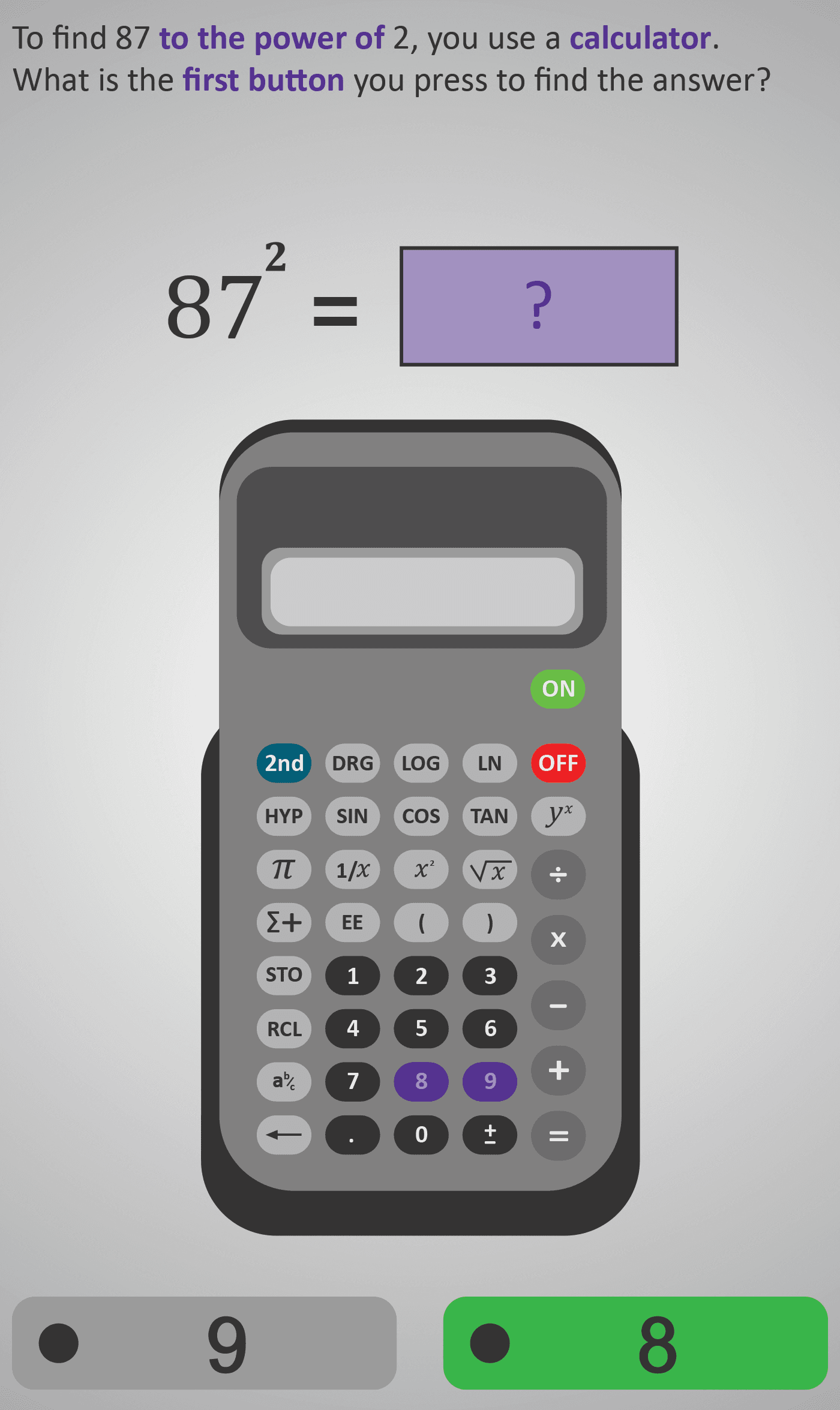
In this Phlow, learners practise squaring numbers using a calculator — an essential skill that combines conceptual understanding with digital fluency. The task guides students through each step of the calculator process: entering 8, then 7, pressing the x² button, and finally pressing = to display the result.
Through this structured sequence, learners connect the idea that squaring means “a number multiplied by itself” with the calculator’s power function. The Phlow reinforces both procedural fluency (how to use the calculator correctly) and conceptual understanding (what “to the power of 2” represents).
By comparing their calculated answer (87² = 7569) with nearby values, students practise estimation and verification, improving their number sense and confidence with large results. This Phlow supports essential calculator literacy for future work in algebra, geometry, and applied maths.
Prerequisite Knowledge Required
- Understanding that “squared” means multiplying a number by itself (e.g. 6² = 6 × 6).
- Familiarity with powers and exponents, especially power of 2.
- Ability to enter and read multi-digit numbers correctly on a calculator.
- Prior completion of:
- Square 1 – Understanding Squaring Conceptually
- Square 2 – Estimating Squares Without a Calculator
Main Category
Number / Powers and Roots
Estimated Completion Time
Approx. 8–12 seconds per question (30 questions total). Total time: 4–6 minutes.
Cognitive Load / Step Size
Low to Moderate — each question isolates one calculator action: number entry, function use (x²), or result confirmation (=). The steady sequence scaffolds learning clearly and prevents overload, promoting both accuracy and confidence.
Language & Literacy Demand
Low — short, direct questions (“What is the next button you press?”). Keywords like power, squared, and button are reinforced with visuals, ensuring accessibility for all literacy levels.
Clarity & Design
- Large, realistic calculator display for authentic interaction.
- Colour-coded highlights show the correct button at each step.
- Sequential screens replicate real-world calculator operation.
- Clear digital layout mirrors the final on-screen result (87² = 7569).
Curriculum Alignment
Strand: Number
Strand Unit: Powers and Roots
- Represent and use powers of numbers, particularly squares and cubes.
- Use a calculator effectively to square numbers.
- Verify results through estimation and mental strategies.
- (Aligned with Junior Cycle Mathematics Learning Outcomes 1.11 and 2.6.)
Engagement & Motivation
High — the hands-on calculator task gives immediate feedback and encourages learners to predict and check their results. Seeing large squares (like 87²) strengthens curiosity and confidence in working with bigger numbers.
Error Opportunities & Misconceptions
- Entering digits in the wrong order (typing 78 instead of 87).
- Pressing × instead of x².
- Forgetting to press = before reading the answer.
Each potential error is pre-empted with clear visual guidance and immediate correction, reinforcing correct habits through repetition.
Transferability / Real-World Anchoring
Strong — calculator fluency applies to everyday problem-solving and exam contexts such as finding area, applying physics formulas, or manipulating algebraic expressions. Understanding squaring also supports future work with square roots, Pythagoras’ Theorem, and exponents.
Conceptual vs Procedural Balance
Conceptual: Understanding that squaring means “number × itself.”
Procedural: Following calculator steps to apply x².
Together, these form a strong bridge between mental understanding and calculator skill.
Learning Objectives Addressed
- Identify and use the square (x²) button on a calculator.
- Square two-digit numbers accurately and confidently.
- Verify results using estimation and comparison.
- Develop procedural fluency with exponential operations.
What Your Score Says About You
- Below 15: Review what “squared” means — practise small examples first.
- 16–22: You understand squaring — focus on calculator fluency and order of operations.
- 23–29: Great progress! You can square large numbers efficiently and check your work.
- 30 / 30: Excellent mastery — ready for Squared 4, where you’ll explore powers beyond 2 and link them to algebraic and geometric reasoning.