
Thermometer 3
Overview
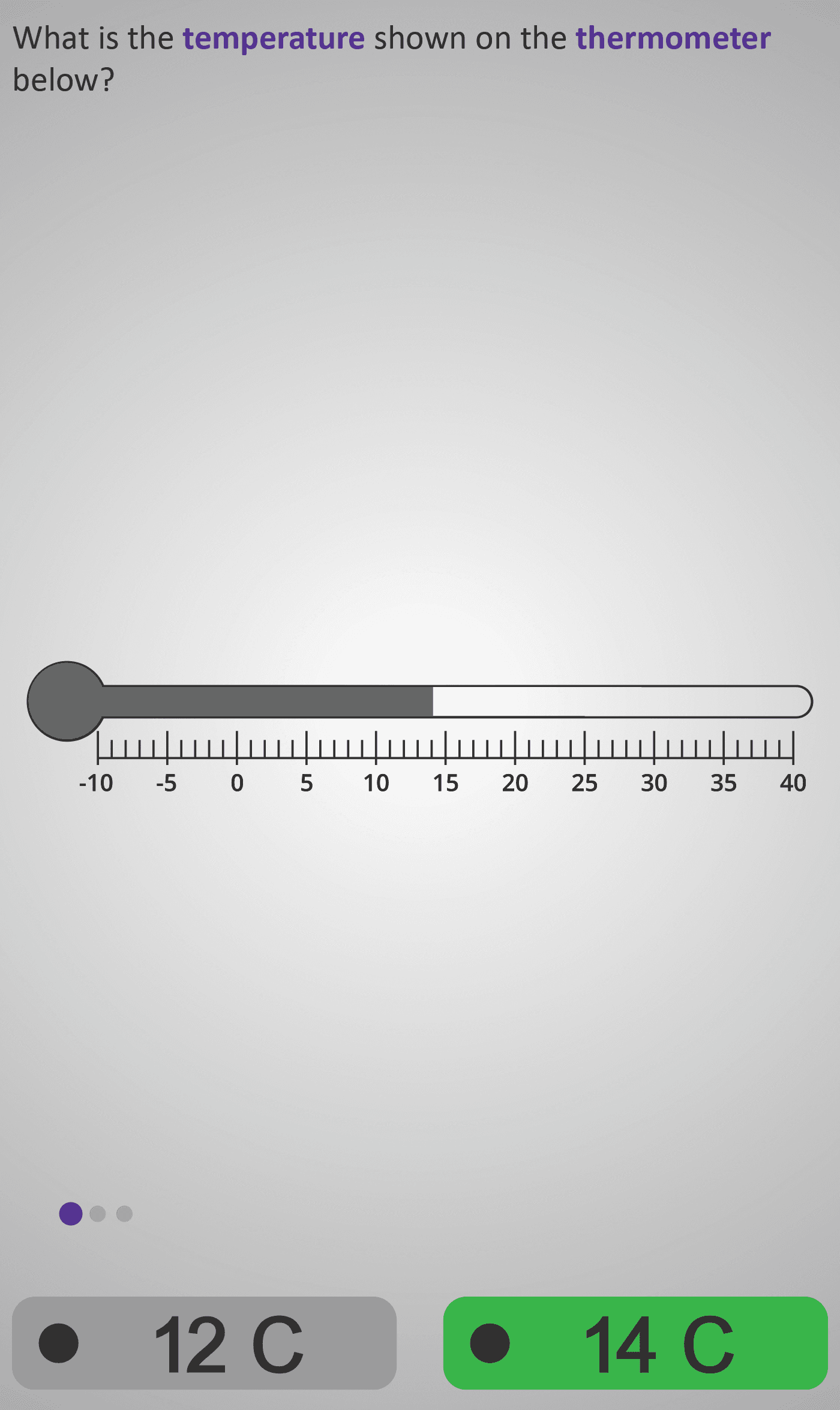
In this Phlow, learners build on their understanding of temperature by reading, interpreting, and comparing values on a thermometer. They identify the temperature shown, determine how many degrees the temperature has increased or decreased, and recognise when temperatures fall below zero.
Students answer simple yet conceptually rich questions such as:
- “What is the temperature shown on the thermometer?”
- “It has become colder. What is the temperature now?”
- “How many degrees has the temperature been reduced?”
The thermometer scale ranges from –10°C to +40°C, helping learners visualise both positive and negative values. Through guided choices and instant feedback, students gain confidence in:
- Reading scales accurately.
- Understanding comparisons of warmer and colder.
- Connecting temperature differences to real-world changes (e.g., weather, freezing point).
Clear colour cues and directional arrows (up = warmer, down = colder) reinforce numerical direction and introduce early ideas related to integers and measurement differences.
Prerequisite Knowledge Required
- Understanding of number sequences, including counting in ones and tens.
- Awareness of positive and negative numbers on a scale.
- Ability to identify increases and decreases in value.
- Familiarity with basic temperature contexts (hot, cold, freezing, etc.).
Main Category
Measurement – Temperature and Scale Reading
Estimated Completion Time
Approx 8–12 seconds per question (30 total). Total time: 4–6 minutes.
Cognitive Load / Step Size
Moderate — students interpret both visual and numerical cues. Repetition and directional scaffolding maintain focus and reinforce understanding without overloading working memory.
Language & Literacy Demand
Low — key words such as temperature, degrees, colder, and reduced are repeated with visual context. Minimal text and consistent phrasing support accessibility for learners with developing literacy skills.
Clarity & Design
- Large, clearly marked thermometer with evenly spaced intervals.
- Purple arrows and highlights guide focus toward temperature changes.
- Includes both positive and negative ranges to build understanding of integers.
- Two-option format ensures clarity and direct engagement on each question.
Curriculum Alignment
Strand: Measures
Strand Unit: Temperature
- Read temperatures on thermometers using the Celsius scale.
- Recognise and interpret temperatures below zero.
- Describe and calculate temperature changes using difference and direction.
- (Aligned with Junior Cycle Mathematics Learning Outcome 3.9 and Primary Level Measure Strand – Temperature.)
Engagement & Motivation
High — relatable weather contexts and visual thermometers make learning interactive and concrete. Immediate visual feedback sustains curiosity while reinforcing real-world relevance.
Error Opportunities & Misconceptions
- Confusing “warmer” with “colder.”
- Misinterpreting negative numbers as “smaller” rather than “colder.”
- Forgetting that 0°C represents the freezing point, not the lowest temperature.
Each misconception is addressed through guided questions and corrective feedback.
Transferability / Real-World Anchoring
Strong — temperature reading is a universal life skill relevant in weather, science, and everyday measurement. Learners gain both numerical precision and contextual awareness.
Conceptual vs Procedural Balance
Conceptual: Understanding what “colder” and “warmer” mean numerically.
Procedural: Reading thermometer scales and identifying directional changes.
The blend supports reasoning about integers through tangible, visual experiences.
Learning Objectives Addressed
- Read and interpret temperature on a thermometer.
- Compare temperatures using “warmer” and “colder.”
- Identify and calculate temperature changes in degrees.
- Relate numerical temperature changes to real-world experiences.
What Your Score Says About You
- Below 15: Practise reading scales carefully and reviewing warmer/colder direction.
- 16–22: You can read temperatures accurately — work on comparing and calculating changes confidently.
- 23–29: Excellent understanding of temperature difference and direction.
- 30 / 30: Perfect! You’re ready for Thermometer 4A – Temperature Change and Difference Calculations.