
Time 3A
Overview
In this Phlow, learners build foundational skills in reading analogue clocks. The focus is on recognising whole hours (e.g. 2:00, 8:00) and half hours (e.g. 9:30, 12:30) by interpreting the relative positions of the hour and minute hands.
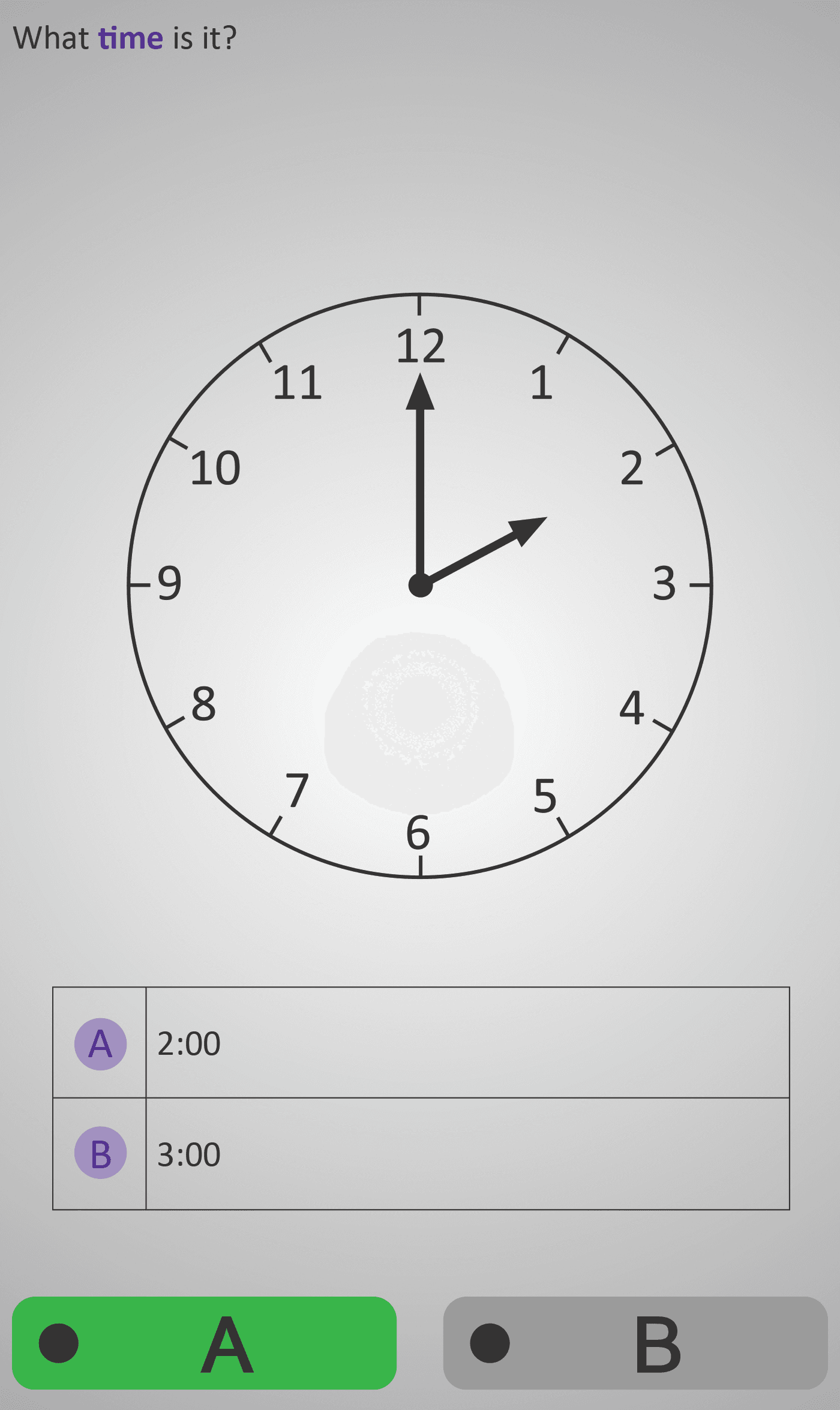
Students are shown a clock face alongside two answer options. They must observe the shorter hand (hours) and longer hand (minutes) to determine the correct time. The examples progress from clear “on-the-hour” times to slightly more complex “half past” cases where the hour hand is positioned between two numbers.
This Phlow strengthens visual and spatial reasoning by linking clock patterns to familiar daily contexts (e.g., 8:30 as school time, 12:30 as lunchtime). Consistent visuals and repetition support learning through recognition and reasoning rather than memorisation.
By the end, students will confidently:
- Identify and read times to the nearest hour and half hour.
- Distinguish between the hour and minute hands.
- Recognise when the hour hand is between numbers at half past.
Prerequisite Knowledge Required
- Understanding that an analogue clock shows 12 hours, repeating twice per day.
- Recognition of numbers 1–12 on the clock face.
- Awareness that the short hand shows the hour and the long hand shows the minutes.
- Understanding that half an hour equals 30 minutes.
Main Category
Measurement – Time (Analogue Clock Reading)
Estimated Completion Time
Approx 8–10 seconds per question (30 total). Total time: 4–5 minutes.
Cognitive Load / Step Size
Low to Moderate — each task involves observing visual details and comparing two options. Consistent formatting and progressive complexity (hour → half-hour) support a steady learning curve.
Language & Literacy Demand
Low — concise, repeated phrasing (“What time is it?”) lets students focus on visual reasoning. Time-related vocabulary is reinforced naturally through repetition and context.
Clarity & Design
- Large, clearly marked clock faces with readable hour numerals.
- Distinct colour and length differences between hands.
- Neutral background focuses attention on time elements.
- Gradual transition from hour to half-hour examples to build confidence.
Curriculum Alignment
Strand: Measures
Strand Unit: Time
- Read times in hours and half hours from analogue clocks.
- Associate positions of the hands with “o’clock” and “half past.”
- Relate clock readings to real-life routines and events.
- (Aligned with Primary Mathematics Curriculum – Measure: Time, and Junior Cycle Numeracy outcomes.)
Engagement & Motivation
High — learners enjoy the quick visual challenge of matching clock readings with written times. The immediate feedback and relevance to daily routines make this Phlow engaging and rewarding.
Error Opportunities & Misconceptions
- Confusing the hour hand with the minute hand.
- Reading the number near the hour hand instead of its position at half past.
- Misinterpreting half past times (e.g. reading 12:30 as 12:00).
Visual clarity, repetition, and consistent reinforcement address these misconceptions effectively.
Transferability / Real-World Anchoring
Strong — reading analogue clocks links directly to daily life, schedules, and time estimation skills. Understanding hours and half hours builds readiness for reading quarter hours and digital equivalents.
Conceptual vs Procedural Balance
Conceptual: Understanding the relationship between hand position and time intervals.
Procedural: Reading and selecting the correct written time from visual input.
This dual focus promotes fluency and comprehension.
Learning Objectives Addressed
- Read and identify times to the nearest hour and half hour.
- Differentiate between hour and minute hands.
- Connect analogue clock readings to written digital time.
- Strengthen number sense and pattern recognition through time intervals.
What Your Score Says About You
- Below 15: Practise recognising the hour and minute hands separately.
- 16–22: You can read “o’clock” times — now focus on half past examples.
- 23–29: Strong understanding of hour and half-hour readings.
- 30 / 30: Excellent! You’re ready for Time 3B – Quarter Hours and Time Differences.