
Time 3B
Overview
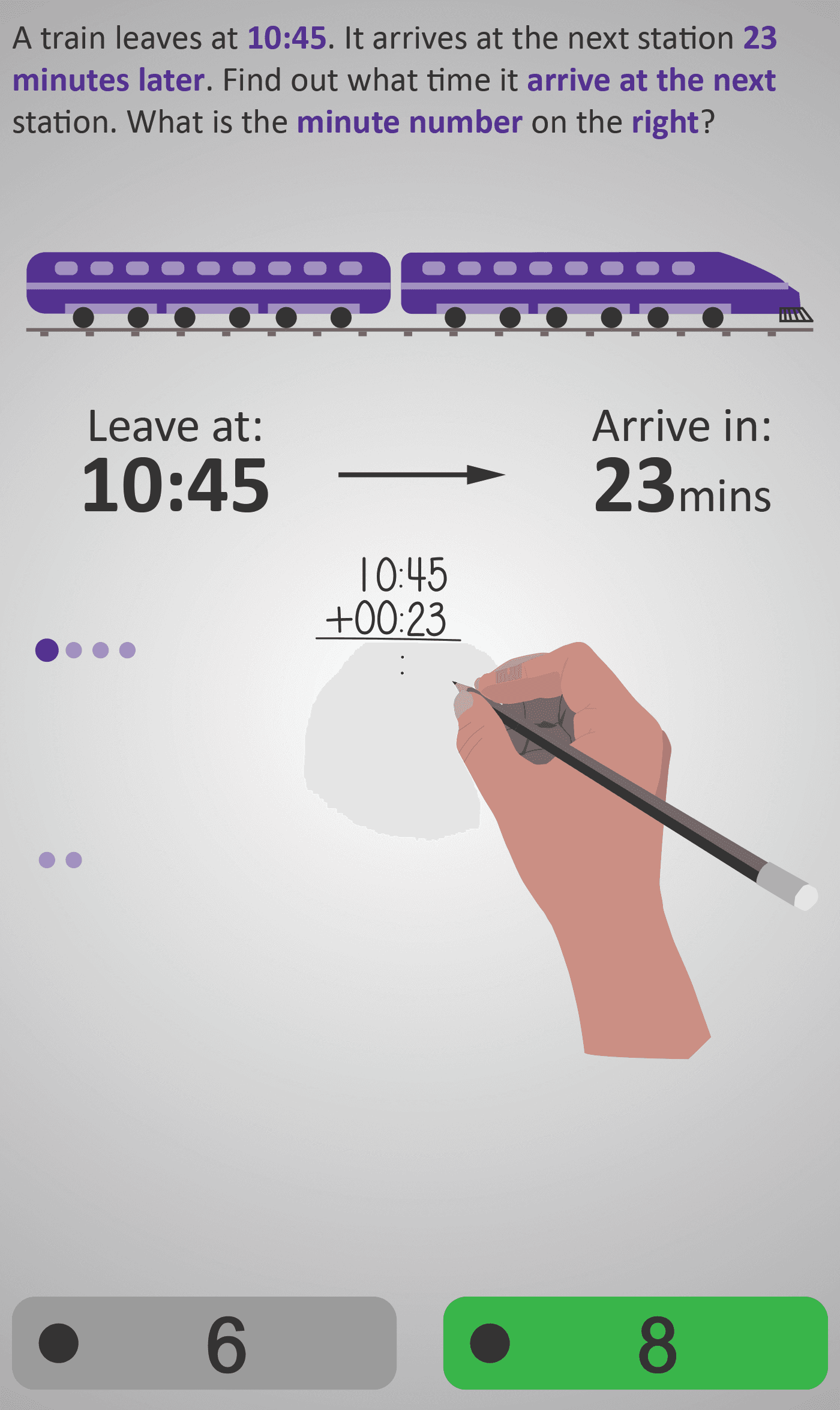
In this Phlow, learners explore how to calculate elapsed time using real-world contexts like train timetables. They begin with examples such as a train leaving at 10:45 and arriving 23 minutes later, using vertical addition to determine the new time. Students focus on the structure of digital time (hh:mm), identifying and manipulating the hour and minute digits separately.
The Phlow then reverses the process — finding scheduled times when a train arrives late — introducing subtraction of minutes and the concept of borrowing across the hour. Learners discover how the 60-minute system differs from standard base-10 arithmetic, developing fluency through step-by-step reasoning and repetition.
By following scaffolded examples, students gain confidence in both adding and subtracting time, connecting mathematical precision with practical scheduling skills. The scenario-based design strengthens conceptual understanding of time flow and place value within the hour-minute format.
Prerequisite Knowledge Required
- Understanding of digital clock format (hh:mm).
- Awareness that 60 minutes = 1 hour.
- Familiarity with addition and subtraction with regrouping (carrying and borrowing).
- Ability to interpret phrases like 23 minutes later or 3 minutes earlier.
- Experience with Time 3A or equivalent — reading hours and half hours.
Main Category
Measurement – Time (Elapsed Time and Digital Calculation)
Estimated Completion Time
Approx 10–12 seconds per question (30 total). Total time: 5–6 minutes.
Cognitive Load / Step Size
Moderate — learners manage both numerical operations and conceptual time flow. Visual scaffolding breaks problems into hour and minute parts, supporting understanding of the 60-minute crossover while minimising working-memory load.
Language & Literacy Demand
Medium — terms like later, earlier, carry, and borrow are introduced through simple, context-rich sentences. Visual aids (train icons, clock graphics) support comprehension for learners at varying literacy levels.
Clarity & Design
- Realistic travel scenario adds context and meaning.
- Handwriting animation demonstrates vertical addition and subtraction clearly.
- Purple highlights emphasise key numeric steps (carry, borrow, minute regrouping).
- Visual separation of hour and minute sections prevents alignment errors.
Curriculum Alignment
Strand: Measures
Strand Unit: Time
- Add and subtract time intervals using hours and minutes.
- Understand and apply regrouping across the 60-minute boundary.
- Solve problems involving time differences and elapsed time.
- (Aligned with Primary Mathematics Curriculum – Measure: Time, and Junior Cycle Mathematics Learning Outcome 3.9.)
Engagement & Motivation
High — the travel context makes arithmetic purposeful and relatable. Students enjoy the puzzle-like process of determining when trains arrive or depart, while immediate feedback reinforces correct time reasoning.
Error Opportunities & Misconceptions
- Forgetting to carry 1 hour when minutes exceed 60.
- Confusing hour and minute positions.
- Treating time as a base-10 number instead of base-60.
- Misreading direction (“later” vs “earlier”).
Visual explanations and feedback reinforce correct regrouping and time flow understanding.
Transferability / Real-World Anchoring
Strong — this skill directly applies to reading and planning timetables, managing travel times, and estimating durations. It connects mathematical understanding with everyday tasks requiring punctuality and time awareness.
Conceptual vs Procedural Balance
Conceptual: Understanding how 60 minutes make 1 hour and why regrouping is necessary.
Procedural: Applying structured addition and subtraction within time format.
Combined, these promote flexible, transferable time calculation skills.
Learning Objectives Addressed
- Add and subtract time intervals accurately.
- Apply carrying and borrowing across the hour boundary.
- Interpret “later” and “earlier” in practical time contexts.
- Understand place value in the base-60 time system.
What Your Score Says About You
- Below 15: Review how to align hours and minutes — remember to carry 1 hour when minutes exceed 60.
- 16–22: You can add and subtract within the same hour — practise across-hour examples for confidence.
- 23–29: Excellent — you apply time arithmetic and direction consistently.
- 30 / 30: Perfect! You’re ready for Time 4A – Duration and Timetable Problems.