
Time 3C
Overview
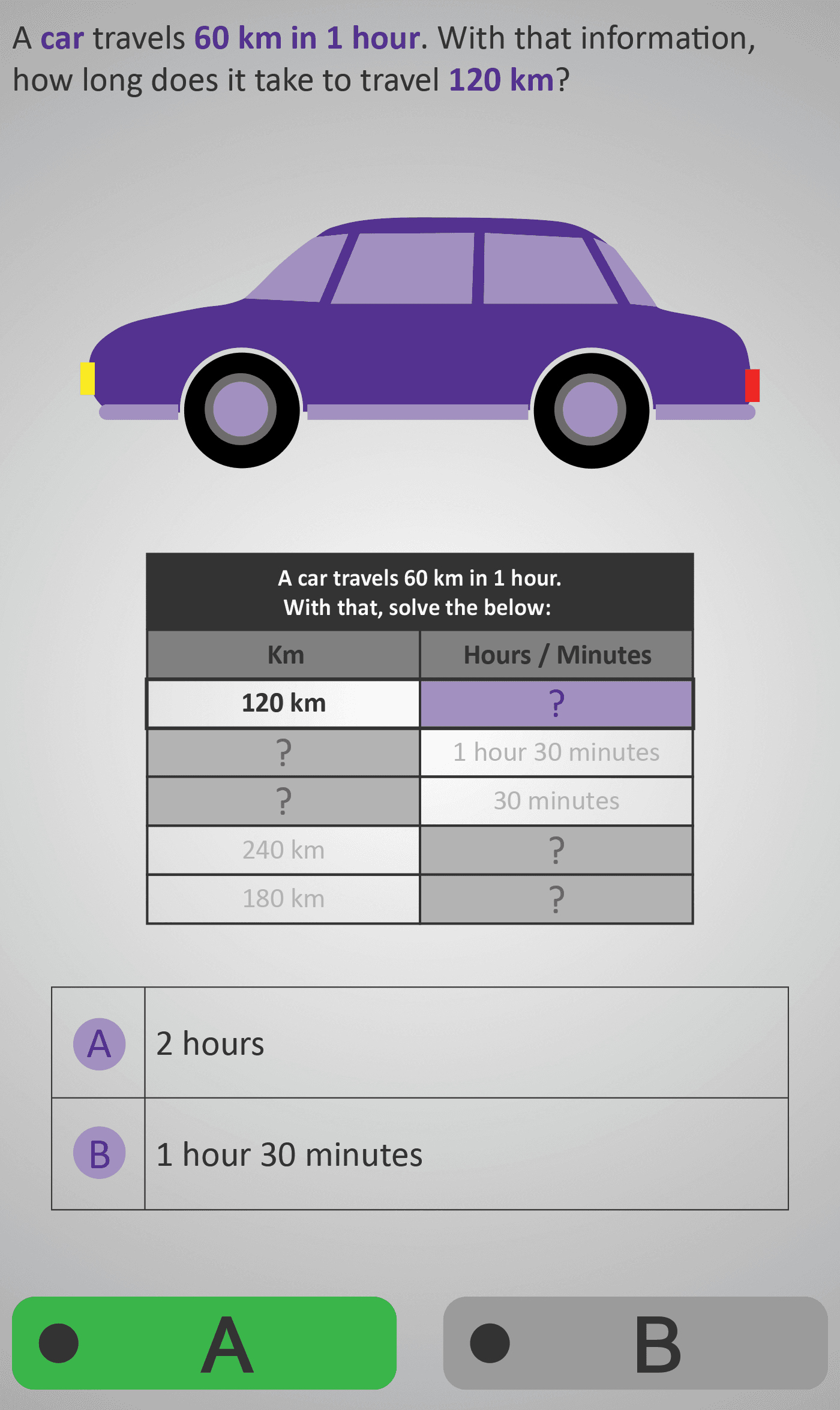
In this Phlow, learners explore how distance, time, and speed are related through proportional reasoning. Using a constant rate of 60 km per hour, students calculate how far a car travels for different time intervals and then reverse the process to find how long it takes to travel given distances.
The learning sequence begins with simple, direct relationships (60 km in 1 hour → 30 km in 30 minutes) and progresses to larger multiples (120 km in 2 hours, 240 km in 4 hours). Later screens introduce reverse reasoning — calculating the time taken when the distance is known.
The activity culminates in introducing the formula:
Speed = Distance ÷ Time
This approach develops students’ understanding of constant rate, unit conversion, and proportionality. Through consistent visual anchors (car and table), learners recognise patterns and form a conceptual model of how distance grows in proportion to time.
By the end, students will:
- Use tables to relate time, distance, and speed.
- Recognise and calculate proportional relationships.
- Apply the formula Speed = Distance ÷ Time in context.
Prerequisite Knowledge Required
- Understanding that 60 minutes = 1 hour.
- Basic multiplication and division with familiar factors (×2, ×3, ÷2).
- Comfort reading times like “1 hour 30 minutes.”
- Awareness that constant speed implies a fixed rate per unit of time.
- Linked earlier Phlows: Time 3A – Adding and Subtracting Minutes Across the Hour, Time 3B – Finding Elapsed Time on a Digital Clock.
Main Category
Measurement → Time → Speed and Rate
Estimated Completion Time
Approx 8–12 seconds per question (30 total). Total time: 4–6 minutes.
Cognitive Load / Step Size
Moderate — each step builds on the previous example, maintaining a smooth progression from direct to inverse reasoning. The fixed reference (60 km in 1 hour) reduces cognitive strain and supports retention of proportional rules.
Language & Literacy Demand
Low — concise text with familiar phrasing such as “how far” and “how long.” Numbers are displayed in tables and visuals, allowing learners to focus on reasoning rather than reading.
Clarity & Design
- Simple car and table visuals link distance and time intuitively.
- Purple highlights reinforce key figures like 60 km and 1 hour.
- Clean layout avoids clutter and supports focus on numerical relationships.
- Progressive visual scaffolding enhances comprehension of proportional growth.
Curriculum Alignment
Strand: Measures
Learning Outcome: Explore, estimate, measure, and solve problems involving time, speed, and distance, recognising relationships between these quantities.
(Aligned with Junior Cycle Mathematics – Strand 4: Measures.)
Engagement & Motivation
High — the car journey context provides an intuitive and relatable setting. The feeling of “filling in” the distance–time table creates a sense of achievement and pattern discovery.
Error Opportunities & Misconceptions
- Confusing minutes with hours (e.g. treating 30 minutes as 30 hours).
- Assuming 1:1 scaling without converting minutes to hours.
- Using incorrect operations when reversing time and distance.
- Forgetting that 30 minutes equals 0.5 hours.
The consistent car speed and guided feedback sequence correct these misconceptions effectively.
Transferability / Real-World Anchoring
Excellent — understanding speed, distance, and time relationships applies to travel planning, data rates, and interpreting graphs or timetables in everyday life.
Conceptual vs Procedural Balance
Conceptual: Recognising proportionality and constant rate relationships.
Procedural: Calculating time, distance, and speed using multiplication and division.
This balance ensures both practical skill and conceptual clarity.
Learning Objectives Addressed
- Use proportional reasoning to connect distance, time, and speed.
- Calculate time or distance given the other quantity and a fixed rate.
- Apply the formula Speed = Distance ÷ Time.
- Interpret and complete rate tables showing constant change.
What Your Score Says About You
- Below 15: Revisit how distance and time scale proportionally.
- 16–22: You understand direct proportion — practise reversing (distance → time).
- 23–29: Excellent — confident with conversions and rate reasoning.
- 30 / 30: Mastery! You’re ready for Time 4A – Advanced Speed, Distance, and Time Problems.