
Total Cost 3A
Overview
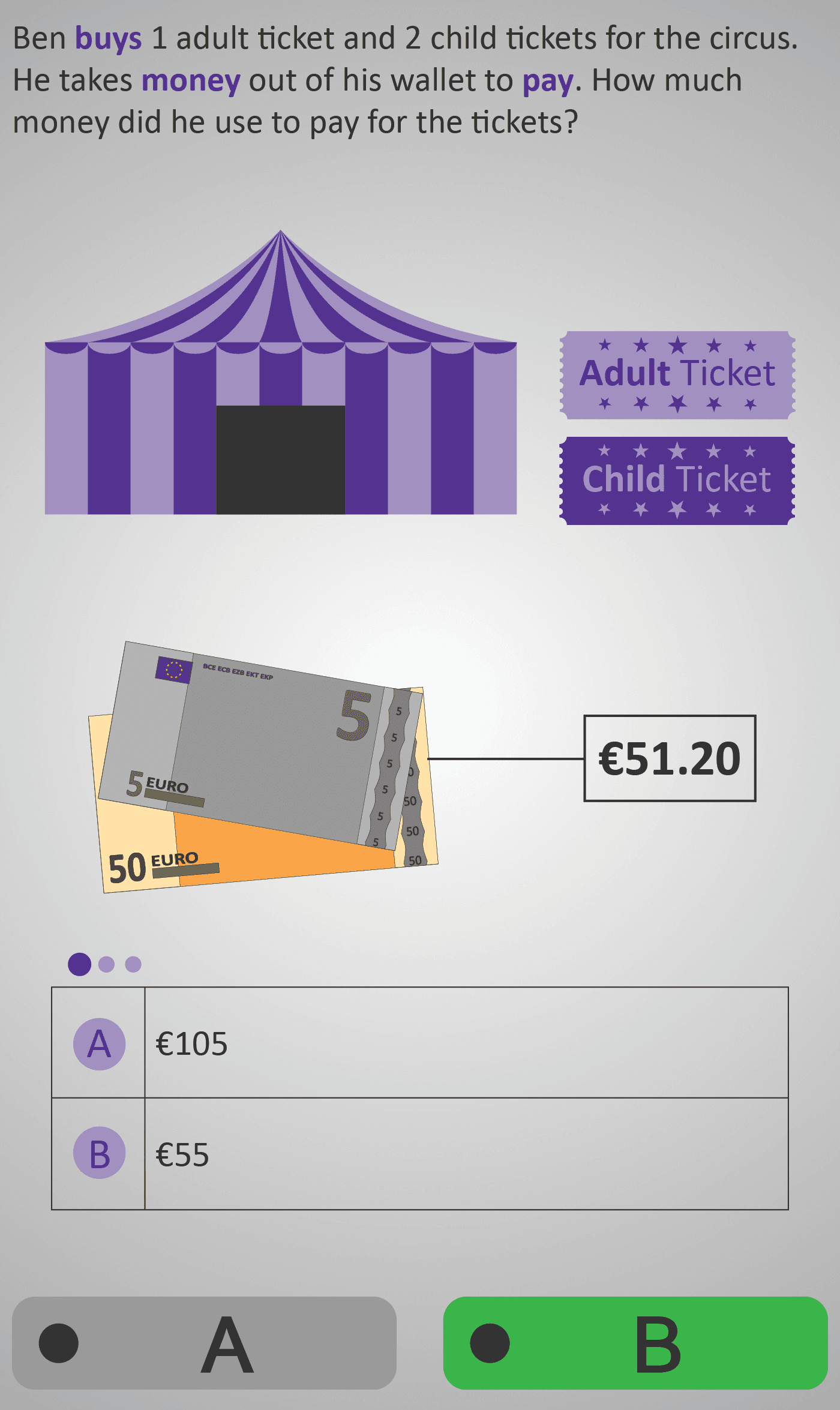
In this Phlow, learners solve a real-world problem involving money — calculating change after a purchase. Ben buys 1 adult ticket and 2 child tickets for the circus, costing €51.20 in total. He pays with €55, and students must determine how much change he should receive.
The step-by-step structure reinforces the logical connection between total cost and amount paid. Students first identify how much Ben gave, then decide which operation to use (addition or subtraction), before performing the correct calculation:
€55 − €51.20 = €3.80
Through this progression, learners strengthen their understanding of subtraction as finding the difference and improve fluency with decimal notation and money-based arithmetic. The context bridges earlier unit-price Phlows and prepares students for multi-step problems involving estimation, rounding, and financial reasoning.
- Recognise when subtraction represents change in real-world contexts.
- Align decimal values accurately for euro and cent.
- Perform subtraction to two decimal places with confidence.
Prerequisite Knowledge Required
- Understanding that subtraction finds the difference between two amounts.
- Ability to read and write money amounts using euros and cents (e.g., €51.20).
- Familiarity with decimal notation and place value to two decimal places.
- Knowing when to apply addition vs subtraction in contextual problems.
- Linked earlier Phlows: Total Cost 2B – Adding Prices in Euro and Cent; Subtract 2A – Finding Change with Whole Euro Amounts.
Main Category
Arithmetic → Money → Addition and Subtraction of Decimals
Estimated Completion Time
Approx 8–12 seconds per question (30 total). Total time: 4–6 minutes.
Cognitive Load / Step Size
Low to Moderate — each step isolates a single reasoning skill (identifying the total, choosing the operation, calculating change). The small conceptual jump from “amount paid” to “amount owed” encourages reasoning without overloading working memory.
Language & Literacy Demand
Low — short, clear sentences with everyday vocabulary (buy, money, change). Visuals of notes, tickets, and euro symbols reduce reliance on reading and reinforce meaning through context.
Clarity & Design
- Clean visuals of tickets, euros, and totals for contextual grounding.
- Contrasting colours between prices and totals enhance focus.
- Minimal background distractions to maintain attention on key amounts.
- Simple progression ensures smooth cognitive flow from reading to calculation.
Curriculum Alignment
Strand: Measures → Money
Learning Outcome: Solve practical problems involving total cost and change using euro and cent, recognising decimal representations of money.
(Aligned with Primary Mathematics Curriculum – Upper Level Transition and Junior Cycle Mathematics: Measures & Financial Mathematics.)
Engagement & Motivation
High — the circus theme is fun and relatable, making a familiar real-life scenario meaningful. Immediate visual feedback after each step keeps learners motivated and confident.
Error Opportunities & Misconceptions
- Reversing subtraction (using the wrong order).
- Decimal alignment mistakes (e.g., treating €51.20 as €5120).
- Multiplying instead of subtracting when finding change.
- Ignoring euro-cent structure when lining up digits.
Visual scaffolds and alignment cues address these common pitfalls effectively.
Transferability / Real-World Anchoring
Excellent — directly applies to everyday shopping, budgeting, and financial literacy. Builds readiness for advanced contexts like percentage discounts and VAT.
Conceptual vs Procedural Balance
Conceptual: Understanding why subtraction represents finding change.
Procedural: Performing decimal subtraction accurately.
Both aspects are reinforced through contextual reasoning and feedback.
Learning Objectives Addressed
- Identify when to use subtraction in money problems.
- Perform decimal subtraction accurately to two decimal places.
- Compute and interpret change in real-world contexts.
- Strengthen reasoning about totals, payments, and differences.
What Your Score Says About You
- Below 15: Practise aligning euro and cent decimals carefully.
- 16–22: Good progress — review when to subtract vs add in money scenarios.
- 23–29: Strong — confident with change and decimal accuracy.
- 30 / 30: Excellent mastery! Ready for Total Cost 3B – Multi-Item Purchases and Estimation.