
Total Cost 3B
Overview
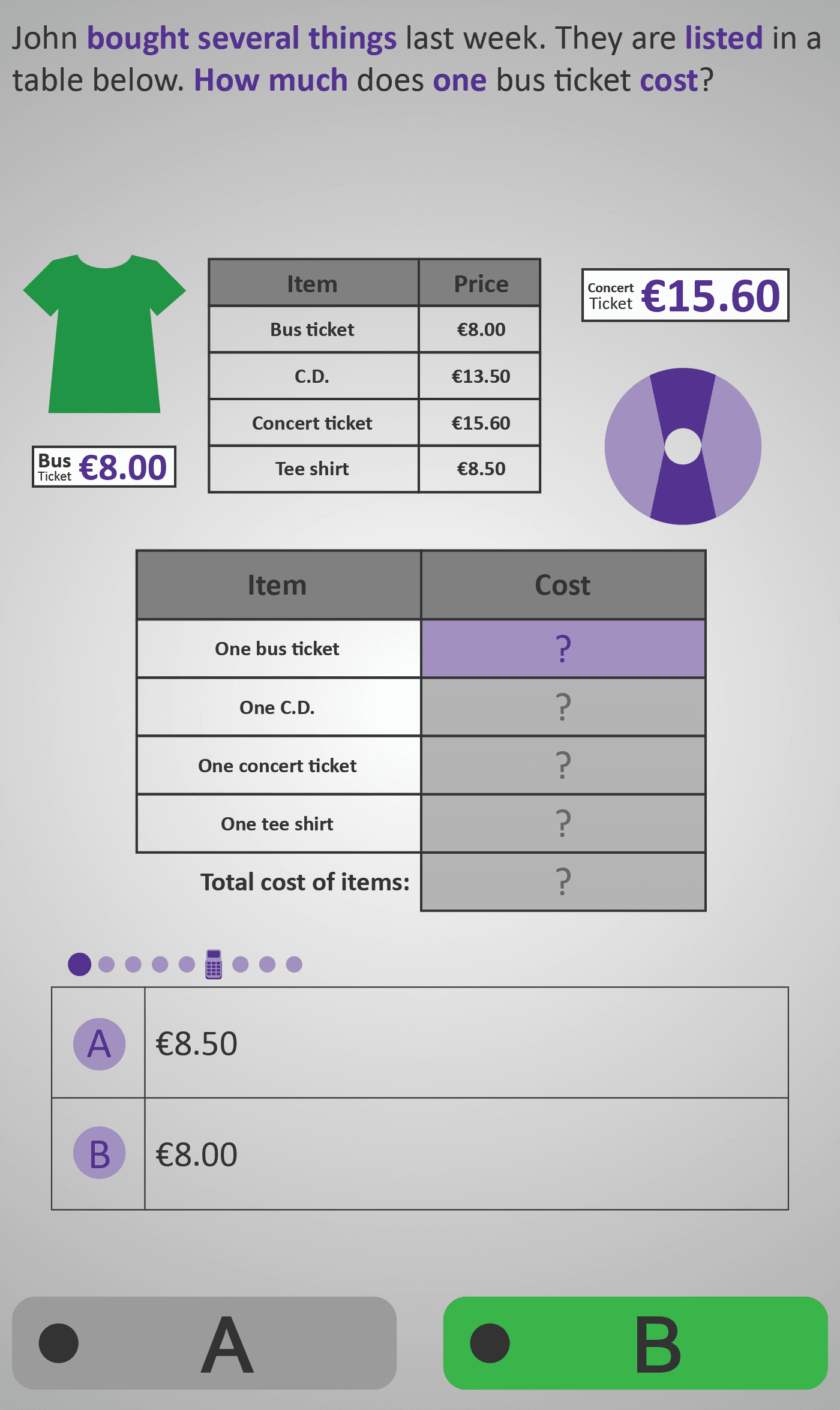
In this Phlow, learners build on their money-handling and decimal skills by calculating the total cost of several items and determining the correct change after payment. The real-world shopping scenario features items such as a bus ticket (€8.00), a CD (€13.50), a concert ticket (€15.60), and a tee shirt (€8.50).
Students first identify individual prices from a table, then combine them to find the total (€45.60). The next step introduces subtraction to find change when paying with €50 — computing €50 − €45.60 = €4.40.
Through step-by-step reasoning and visual cues, students strengthen their understanding of when to add or subtract, and why each operation applies. The use of realistic item visuals and calculator prompts reinforces how maths connects directly to everyday life — from buying tickets to checking receipts.
- Identify when to use addition and when to use subtraction in real-world contexts.
- Add and subtract decimals with correct alignment of euro and cent.
- Check answers using estimation and calculator verification.
Prerequisite Knowledge Required
- Understanding of euro and cent values written as decimals (e.g. €8.50 = 8 euro 50 cent).
- Ability to line up decimal points accurately when adding or subtracting.
- Recognising that “total cost” uses addition and “change” uses subtraction.
- Basic mental addition and subtraction within 20.
- Linked earlier Phlows: Total Cost 3A – Buying Tickets and Finding Change; Add 2B – Adding Two Decimal Amounts; Subtract 2A – Subtracting Whole Euro Amounts.
Main Category
Arithmetic → Money → Addition and Subtraction of Decimals
Estimated Completion Time
Approx 8–12 seconds per question (30 total). Total time: 4–6 minutes.
Cognitive Load / Step Size
Moderate — each stage introduces a single challenge: identifying prices, combining decimals, and finding change. The gradual complexity keeps cognitive engagement high while preventing overload. The consistent table format provides stability and confidence in reasoning.
Language & Literacy Demand
Moderate — everyday vocabulary like buy, cost, total, and change makes the task accessible. Visual supports (item icons, prices in tables, and calculator screens) reduce reading load and focus attention on number relationships.
Clarity & Design
- Clear, well-spaced visuals for each item to aid identification.
- Table layout for prices ensures readability and structure.
- Purple highlights mark totals, operations, and key numbers.
- Calculator screen visual reinforces accuracy and promotes self-checking.
Curriculum Alignment
Strand: Measures → Money
Learning Outcome: Estimate, calculate, and solve problems involving item cost and change to the nearest cent, using addition and subtraction of decimals.
(Aligned with Primary–Post-Primary transition and Junior Cycle Mathematics: Measures, Money, and Financial Mathematics.)
Engagement & Motivation
High — the shopping scenario feels familiar and relevant, connecting mathematical reasoning to real-life financial decision-making. The presence of a calculator boosts confidence and promotes independent verification.
Error Opportunities & Misconceptions
- Misaligning decimal points when adding or subtracting.
- Adding euros and cents separately without regrouping correctly.
- Choosing the wrong operation (adding instead of subtracting for change).
- Ignoring decimal places and reading €45.60 as €4560.
Visual alignment and feedback after each question help students correct and internalise proper decimal handling.
Transferability / Real-World Anchoring
Excellent — this skill directly applies to shopping, budgeting, and financial planning. It reinforces practical numeracy and supports progression toward percentage-based contexts like discounts and tax calculations.
Conceptual vs Procedural Balance
Conceptual: Understanding the relationship between total cost, payment, and change.
Procedural: Performing accurate addition and subtraction of decimal money values.
This dual focus ensures both practical fluency and deep conceptual grasp.
Learning Objectives Addressed
- Identify when to add or subtract in money contexts.
- Add and subtract decimals correctly to two decimal places.
- Interpret and solve multi-item total and change problems.
- Use estimation and calculators to verify results.
What Your Score Says About You
- Below 15: Review euro–cent conversion and decimal placement rules.
- 16–22: Good progress — practise distinguishing between total and change operations.
- 23–29: Excellent accuracy and reasoning — confident with multi-item totals.
- 30 / 30: Outstanding mastery! Ready for Total Cost 4A – Discounts, Tax, and Estimation.