
Total Cost 3C
Overview
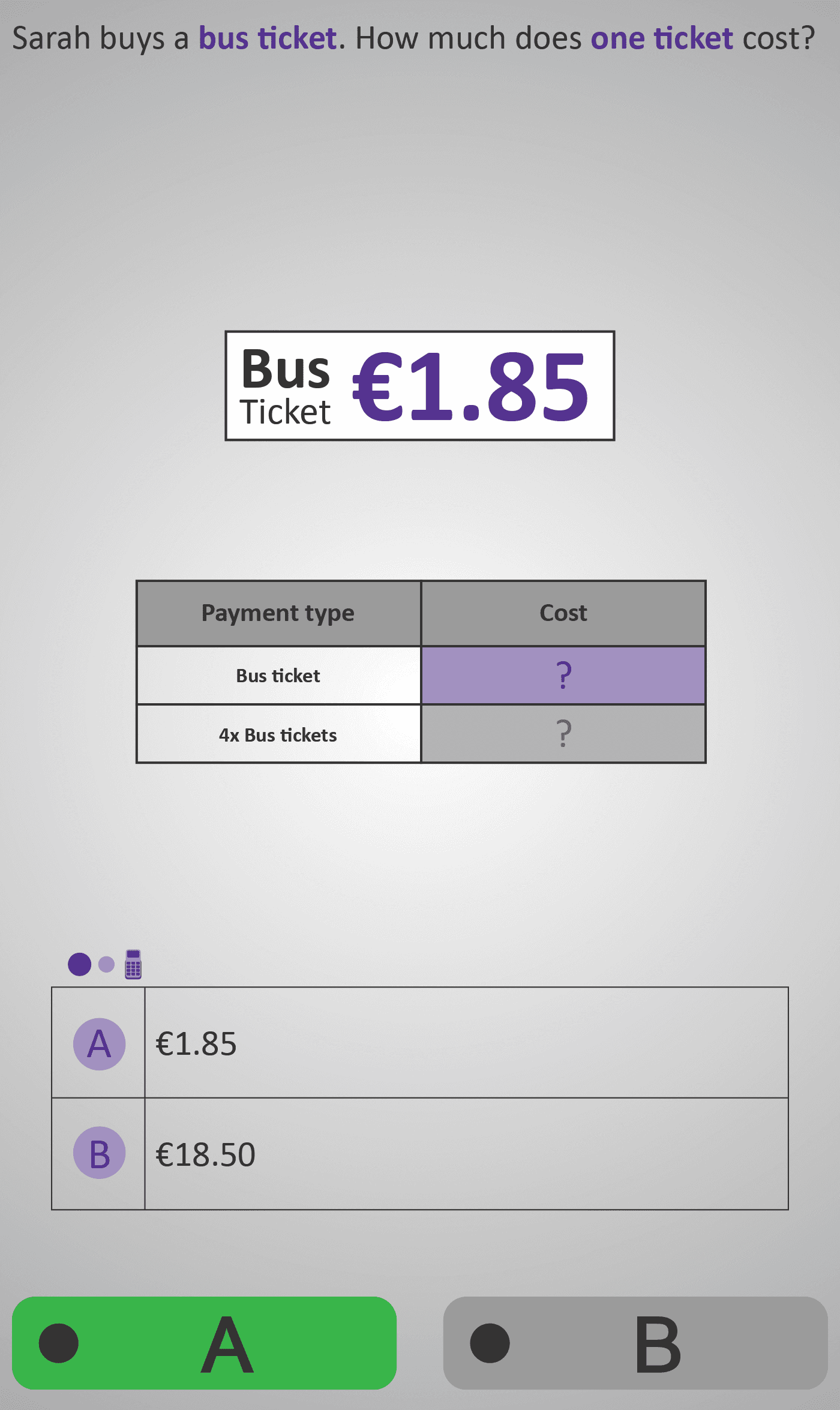
In this Phlow, learners apply multiplication to real-life money situations by finding the total cost of several identical items. Sarah buys one bus ticket for €1.85 and wants to know the cost of four tickets. Students reason whether to multiply or divide, confirming that €1.85 × 4 = €7.40. This reinforces multiplication as a faster and more efficient method than repeated addition.
The activity begins with recognising a single price, then progresses to operation selection, and finally to computing with decimals. Visuals such as ticket icons, calculator screens, and tabular layouts make the relationship between quantity and total clear. Students gain confidence handling decimals while also deepening conceptual understanding of repeated addition.
This Phlow bridges simple addition-based cost problems and proportional reasoning. It provides a strong foundation for more advanced topics like percentage increases, unit rates, and financial decision-making.
- Recognise multiplication as repeated addition in money contexts.
- Multiply decimal amounts accurately by whole numbers.
- Interpret totals as the combined cost of multiple identical items.
Prerequisite Knowledge Required
- Understanding of money written in euros and cents (e.g. €1.85 = 1 euro 85 cent).
- Ability to interpret “×” as repeated addition.
- Familiarity with basic multiplication facts and patterns.
- Recognising that multiplication increases a quantity, while division reduces it.
- Linked earlier Phlows: Total Cost 2A – Adding Identical Prices; Multiply 2B – Repeated Addition with Whole Numbers; Total Cost 3B – Adding Several Different Items.
Main Category
Arithmetic → Money → Multiplication of Decimals
Estimated Completion Time
Approx 8–12 seconds per question (30 total). Total time: 4–6 minutes.
Cognitive Load / Step Size
Moderate — each step adds a single layer of complexity: from identifying the single price, to selecting the correct operation, to performing multiplication. This smooth pacing supports comprehension and encourages flow without cognitive overload.
Language & Literacy Demand
Low — concise language and supportive visuals keep reading minimal. Key terms like divide, multiply, cost, and tickets are highlighted, enabling comprehension even for emerging readers.
Clarity & Design
- Purple highlights draw focus to the price, operation, and result.
- Ticket visuals create a tangible connection to real-life context.
- Tables reinforce number relationships between unit cost and total cost.
- Calculator images encourage accurate checking of decimal results.
Curriculum Alignment
Strand: Measures → Money
Learning Outcome: Solve real-world problems involving the total cost of multiple identical items using multiplication, recognising the link between repeated addition and multiplication of decimals.
(Aligned with Junior Cycle Mathematics – Measures & Financial Mathematics.)
Engagement & Motivation
High — the relatable travel context and the small cognitive challenge of deciding between multiplication or division sustain interest. Realistic euro amounts enhance authenticity and relevance.
Error Opportunities & Misconceptions
- Confusing multiplication with division (e.g. dividing €1.85 by 4).
- Incorrect decimal alignment when multiplying manually.
- Misplacing zeros or decimal points in written or calculator-based results.
- Assuming €1.85 × 4 = €1.85 + €4 (partial operation confusion).
Feedback and clear modelling of decimal placement correct these misconceptions effectively.
Transferability / Real-World Anchoring
Excellent — this reasoning applies to bulk purchases, ticket bundles, and any scenario involving multiple quantities at a fixed price. It lays groundwork for proportional reasoning and financial awareness in daily life.
Conceptual vs Procedural Balance
Conceptual: Understanding multiplication as repeated addition and as a way to scale totals.
Procedural: Performing decimal multiplication with precision.
This dual focus ensures conceptual clarity and practical accuracy.
Learning Objectives Addressed
- Multiply decimal values by whole numbers to find total cost.
- Select the correct operation (× or ÷) based on context.
- Link unit price to total price using visual and tabular reasoning.
- Apply arithmetic skills to real-world financial problems.
What Your Score Says About You
- Below 15: Practise connecting repeated addition with multiplication and decimals.
- 16–22: Good procedural control — refine decimal accuracy and calculator use.
- 23–29: Strong reasoning and confidence with operation selection.
- 30 / 30: Mastery achieved — fluent, accurate, and conceptually clear in multiplying decimals for real-life totals.