
Triangle 3A
Overview
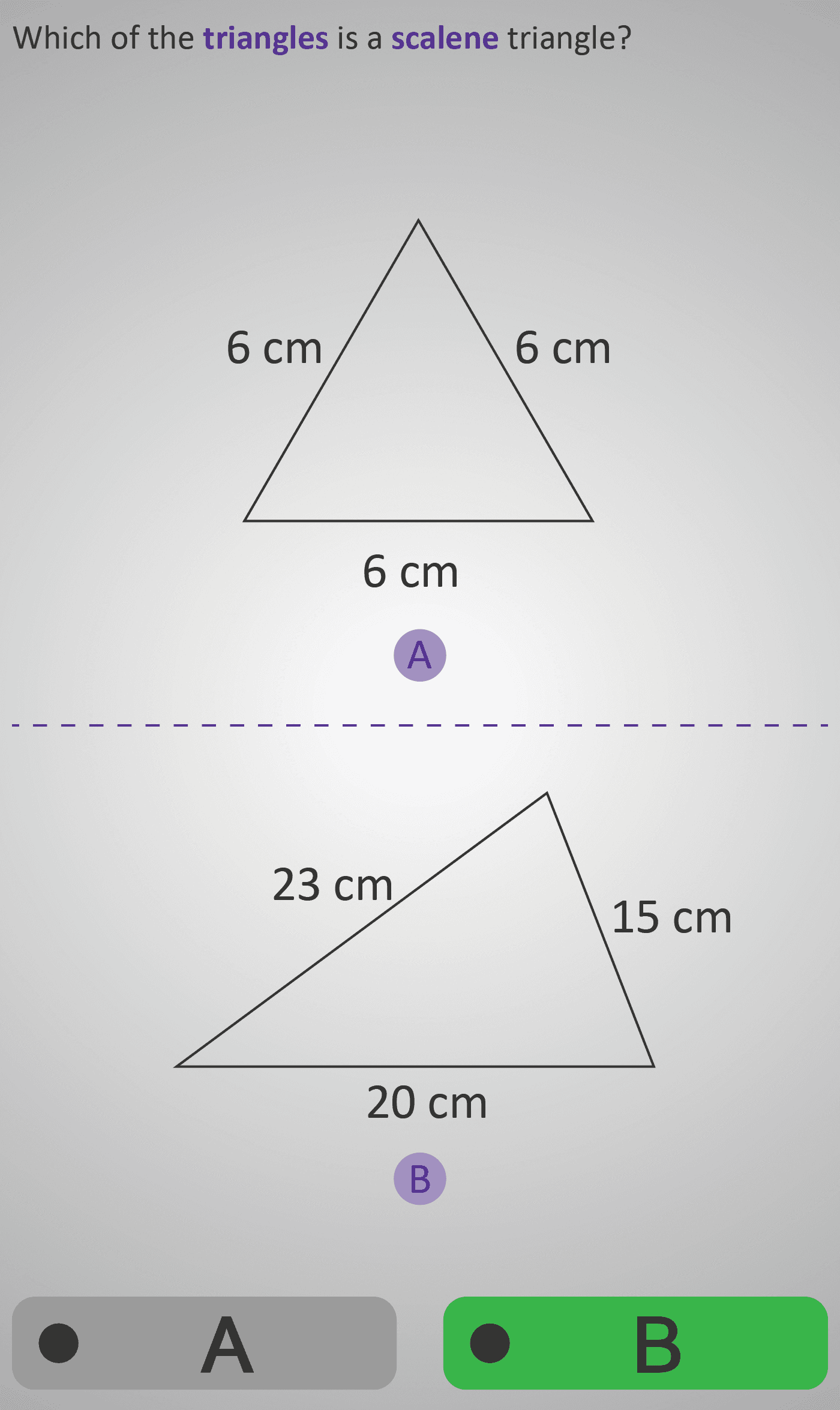
In this Phlow, learners strengthen their geometric reasoning by classifying triangles according to their sides and angles. Each question shows two triangles and asks which one fits a given description — such as equilateral, isosceles, scalene, acute, or obtuse.
Students analyse visual and numeric cues like side lengths (in cm) and angle measures (in °) to determine each triangle’s properties. They apply definitions — e.g., “all sides equal” for equilateral, “one angle greater than 90°” for obtuse — while comparing diagrams side-by-side. This encourages active visual reasoning and strengthens the connection between mathematical vocabulary and diagram interpretation.
Through progressive examples, learners internalise the characteristics of different triangle types, building fluency in both shape recognition and language comprehension. These skills lay essential foundations for future geometry, trigonometry, and applied design reasoning.
- Recognise and classify triangles by side and angle properties.
- Apply geometric terms correctly when describing shapes.
- Interpret diagrammatic information such as labels, side lengths, and angle symbols.
Prerequisite Knowledge Required
- Recognition of basic triangle shapes and structure.
- Understanding of angle measures: acute (< 90°), right (= 90°), and obtuse (> 90°).
- Awareness that equal side lengths imply symmetry or congruence.
- Familiarity with measurement units such as centimetres and degrees.
- Linked earlier Phlows: Shape 2B – Identifying 2D Shapes; Angles 2A – Naming and Comparing Angles; Measure 2B – Reading Centimetres and Degrees.
Main Category
Geometry → Properties of Shapes → Triangles
Estimated Completion Time
Approx 8–12 seconds per question (30 total). Total time: 4–6 minutes.
Cognitive Load / Step Size
The progression isolates one key property per question (sides or angles), maintaining a smooth cognitive rhythm. Alternating between numeric and visual comparisons keeps reasoning active while avoiding overload.
Language & Literacy Demand
Moderate — includes mathematical vocabulary such as scalene, isosceles, and equilateral, supported by colour highlights and direct visual examples. Contextual repetition builds familiarity with key terms and meanings.
Clarity & Design
- Consistent visual layout with clear symmetry and spacing.
- Angles and side lengths are labelled precisely using ° and cm symbols.
- Purple highlights reinforce the focus term (e.g., “obtuse”).
- Dotted dividing lines and minimal clutter improve visual discrimination.
Curriculum Alignment
Strand: Geometry and Measures → 2D Shapes
Learning Outcome: Identify, classify, and describe triangles according to sides and angles, using correct mathematical language and reasoning.
(Aligned with Primary–Junior Cycle transition and Junior Cycle Mathematics: Geometry and Trigonometry.)
Engagement & Motivation
High — the compare-and-choose format feels interactive and immediate. The visual contrasts between triangle types create a rewarding “spot the difference” challenge, reinforcing correct terminology through practice and feedback.
Error Opportunities & Misconceptions
- Confusing isosceles with equilateral (two vs. three equal sides).
- Believing obtuse triangles have an “obtuse side” instead of an angle.
- Misinterpreting small degree numbers as text labels.
- Judging triangles by orientation rather than measurable properties.
These misconceptions are addressed through side-by-side comparisons and precise use of visual cues and labels.
Transferability / Real-World Anchoring
Excellent — recognising triangle properties supports real-world applications in construction, engineering, art, and design. It also develops spatial reasoning needed for later geometry and trigonometric problem-solving.
Conceptual vs Procedural Balance
Conceptual: Understanding triangle properties conceptually rather than through memorisation.
Procedural: Applying definitions consistently to classify shapes.
The Phlow emphasises pattern recognition and reasoning over computation.
Learning Objectives Addressed
- Identify triangles by their sides: equilateral, isosceles, scalene.
- Identify triangles by their angles: acute, right, obtuse.
- Use precise mathematical language to describe geometric properties.
- Interpret side and angle measures accurately in diagrams.
What Your Score Says About You
- Below 15: Review definitions and practise linking shape features to terms.
- 16–22: Good recognition — strengthen vocabulary accuracy.
- 23–29: Strong understanding and confident classification.
- 30 / 30: Mastery — fluent, accurate, and conceptually clear identification of all triangle types.