
Triangle 3B
Overview
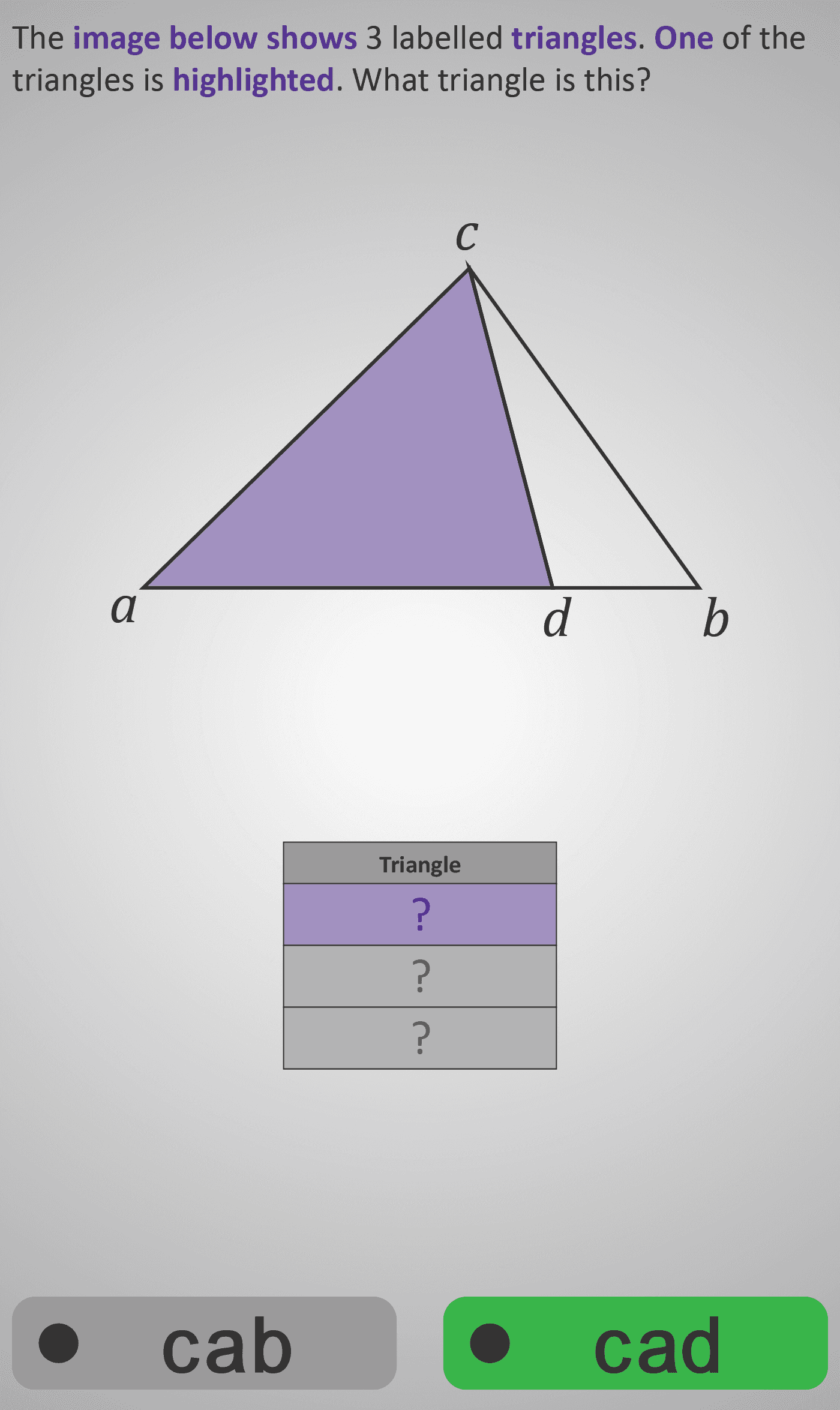
In this Phlow, learners explore how triangles are identified and named according to their vertices (corner points). Each triangle is labelled with letters such as A, B, C, or D, and students must determine which combination of vertices corresponds to the highlighted triangle in the diagram.
The Phlow begins with simple, single-triangle diagrams and gradually progresses to overlapping or nested triangles. Students practise careful observation, focusing on how labels are positioned at corners and how the order of letters represents the vertices rather than the triangle’s orientation or size. This reinforces a crucial skill for interpreting geometric diagrams accurately.
By the end of this activity, learners confidently read, interpret, and name triangles using conventional geometric notation (e.g., △ABC), developing spatial awareness and precision essential for later geometry, trigonometry, and coordinate work.
- Recognise and name triangles based on vertex labels.
- Understand that order of letters corresponds to vertices, not shape orientation.
- Identify shapes accurately within overlapping diagrams.
Prerequisite Knowledge Required
- Recognising that triangles are formed by connecting three points (vertices).
- Familiarity with letter labelling conventions on geometric diagrams.
- Understanding that vertex order describes the triangle’s corners, not its direction or rotation.
- Ability to distinguish between overlapping or adjacent triangles visually.
- Linked earlier Phlows: Triangle 2A – Identifying Triangles by Shape; Angles 2A – Naming Angles by Letters; Geometry 2B – Recognising Corners and Sides on Shapes.
Main Category
Geometry → Properties of Shapes → Naming and Labelling Triangles
Estimated Completion Time
Approx 8–12 seconds per question (30 total). Total time: 4–6 minutes.
Cognitive Load / Step Size
Light to moderate — students move from identifying isolated triangles to selecting among several overlapping ones. The consistent visual layout, colour highlighting, and lettered corners maintain engagement and reduce memory load while improving selective attention.
Language & Literacy Demand
Low to moderate — while the vocabulary is simple, understanding notation (△ABC, △CDB) requires interpreting symbols and visual correspondence. Highlighted text and visual cues reinforce comprehension.
Clarity & Design
- Subtle purple highlighting draws attention to the triangle under focus.
- Letter labels are clearly placed at vertices for easy recognition.
- Repetitive structure (“Triangle: ?”) reinforces consistent reasoning.
- Clean, uncluttered diagrams minimise confusion when shapes overlap.
Curriculum Alignment
Strand: Geometry and Measures → 2D Shapes
Learning Outcome: Identify and label triangles by their vertices, interpret diagrams accurately, and use conventional notation (e.g., △ABC) to describe geometric figures.
(Aligned with Junior Cycle Mathematics – Geometry and Trigonometry: Logical Reasoning and Spatial Awareness.)
Engagement & Motivation
High — the “find the triangle” puzzle format feels like a visual game, encouraging curiosity and attention to detail. Each question offers instant feedback that reinforces confidence and satisfaction.
Error Opportunities & Misconceptions
- Reversing the letter order and assuming it changes the triangle (e.g. thinking △CAD ≠ △DAC).
- Confusing shared sides or overlapping triangles when several appear in one diagram.
- Misinterpreting which triangle is highlighted when colours overlap.
- Believing triangle names depend on orientation or size rather than vertex labels.
These are corrected through repeated, visually guided comparisons and feedback on vertex selection.
Transferability / Real-World Anchoring
Transferable to reading geometry diagrams, technical drawings, and coordinate maps. The skill supports future learning in coordinate geometry, vector work, and geometric proofs — where accuracy in naming and referencing shapes is essential.
Conceptual vs Procedural Balance
Conceptual: Understanding how notation represents vertices and relationships between points.
Procedural: Practising reading and writing triangle names accurately.
This balance builds both geometric reasoning and notation fluency.
Learning Objectives Addressed
- Identify triangles by reading and interpreting vertex labels.
- Understand that the order of letters corresponds to vertices, not direction.
- Distinguish between overlapping or adjacent triangles visually.
- Apply correct mathematical notation for triangles (e.g. △ABC).
What Your Score Says About You
- Below 15: Review how to match highlighted triangles with vertex names.
- 16–22: Good progress — refine attention to letter order and overlapping shapes.
- 23–29: Strong awareness and confident recognition of labelled figures.
- 30 / 30: Excellent — full mastery in naming and interpreting geometric diagrams.