
Values Ratio 3A
Overview
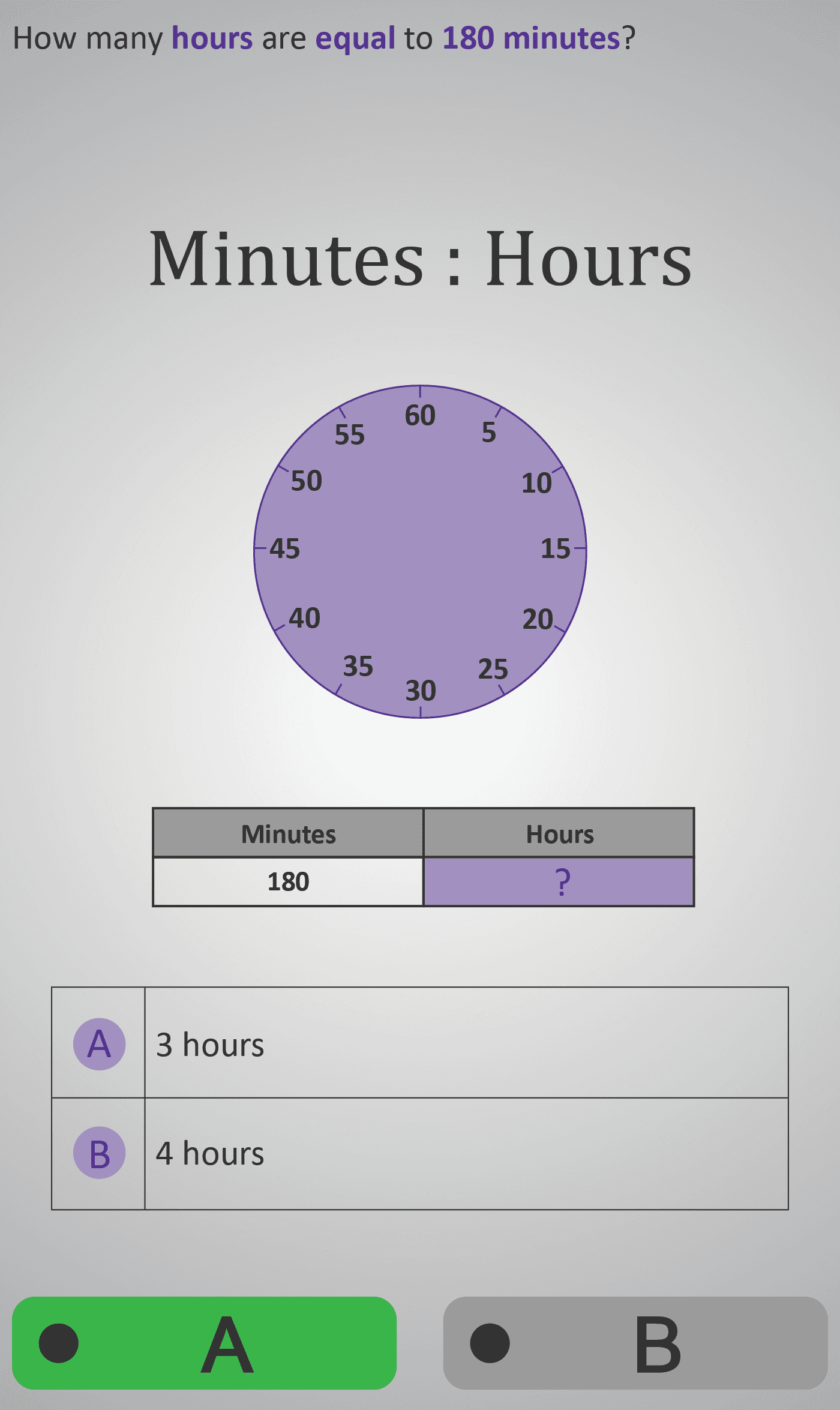
In this Phlow, learners explore how different time units relate to each other using ratios. Through structured examples such as “How many hours are in 180 minutes?” or “How many days are in 5 weeks?”, students apply multiplication and division to convert between time units.
The activity introduces and reinforces familiar relationships — 60 seconds = 1 minute, 60 minutes = 1 hour, 24 hours = 1 day, 7 days = 1 week, and 12 months = 1 year. By repeatedly applying these ratios, learners come to understand that conversions are multiplicative, not additive.
Visuals such as clock faces, day grids, and month charts accompany the questions, helping learners visualise the structure of time. The consistent use of conversion tables (e.g., “Minutes → Hours”, “Days → Weeks”) makes proportional reasoning clear and intuitive. This Phlow provides a strong foundation for later work in ratio, proportion, and unit conversions across mathematics and science.
- Understand how time units relate proportionally through fixed ratios.
- Convert between seconds, minutes, hours, days, weeks, and years.
- Use multiplication and division accurately to scale up or down between units.
Prerequisite Knowledge Required
- Familiarity with standard time units: seconds, minutes, hours, days, weeks, and years.
- Knowledge of multiplication and division facts.
- Understanding that conversions involve scaling rather than addition or subtraction.
- Ability to interpret simple tables and compare numerical relationships.
- Linked earlier Phlows: Time 2A – Reading Hours and Minutes on a Clock; Multiply 2B – Repeated Addition and Scaling; Divide 2C – Sharing Quantities Equally.
Main Category
Measures → Time → Ratio and Unit Conversion
Estimated Completion Time
Approx 8–12 seconds per question (30 total). Total time: 4–6 minutes.
Cognitive Load / Step Size
Steady and incremental. Each question focuses on one type of conversion at a time, avoiding mixed units. Familiar visual anchors (clock, week chart, month grid) reduce working memory load and reinforce conceptual recall.
Language & Literacy Demand
Low — concise phrasing and repeated question formats maintain accessibility. Keywords such as equal to, minutes, weeks, and ratio are highlighted for clarity. The emphasis is on number reasoning rather than language complexity.
Clarity & Design
- Clean, visual design with one conversion type per screen.
- Tables and arrows make the multiplicative relationships explicit.
- Colour-coded symbols (clocks, calendars) enhance conceptual links.
- Balanced use of visuals and text supports both visual and numerical learners.
Curriculum Alignment
Strand: Measures → Time
Learning Outcome: Convert between standard units of time using multiplication and division, and understand the proportional relationships between units.
(Aligned with Junior Cycle Mathematics – Measures and Number: Ratio and Proportion.)
Engagement & Motivation
High — the context of time is immediately relatable. Varied visuals (clock faces, daily routines, months) keep engagement strong while helping students visualise abstract ratios as part of everyday experience.
Error Opportunities & Misconceptions
- Adding instead of multiplying when scaling up (e.g., 5 weeks + 7 = 12).
- Dividing instead of multiplying when converting to larger units.
- Forgetting that time ratios are fixed (e.g., 60 minutes = 1 hour, not 100).
- Assuming all months have the same number of days when reasoning about years.
Feedback and visual supports (tables, charts) help correct these misunderstandings effectively.
Transferability / Real-World Anchoring
Strong — time conversion skills apply to real-world contexts like reading timetables, tracking sports durations, scheduling, and project management. It also lays the groundwork for converting rates and units in science and geography.
Conceptual vs Procedural Balance
Conceptual: Understanding why unit conversions use fixed ratios.
Procedural: Using multiplication or division to perform accurate conversions.
The Phlow integrates both to ensure deep understanding and lasting fluency.
Learning Objectives Addressed
- Convert between time units using multiplication and division.
- Recognise that unit relationships form fixed ratios.
- Represent conversions clearly in tables or structured layouts.
- Apply proportional reasoning to real-world time problems.
What Your Score Says About You
- Below 15: Practise recalling key ratios (e.g., 60 minutes = 1 hour, 24 hours = 1 day).
- 16–22: Understands basic conversions but may confuse multiply/divide direction.
- 23–29: Strong proportional reasoning and accuracy.
- 30 / 30: Mastery — fluent in time conversions and ratio-based reasoning.