
Values Ratio 3B
Overview
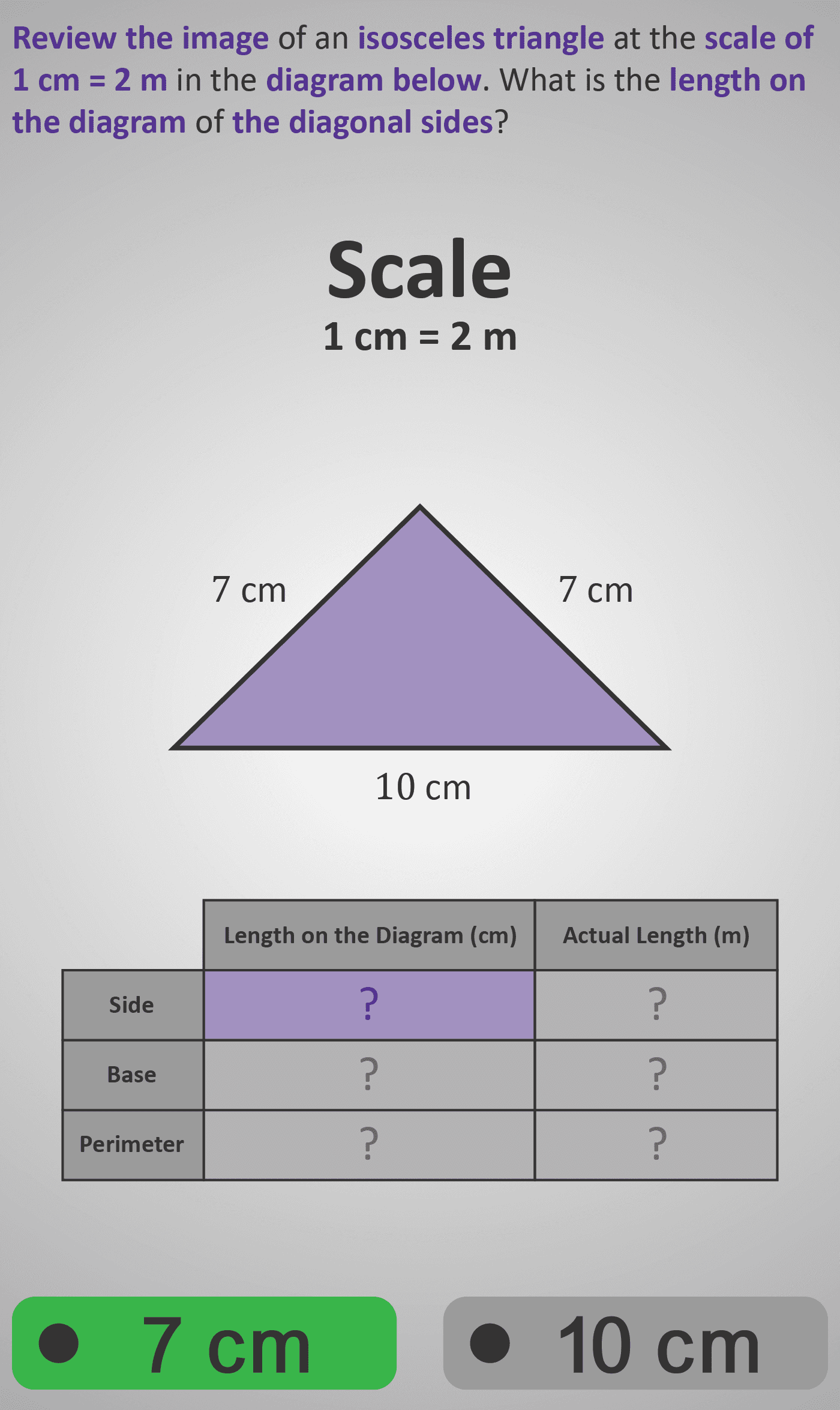
In this Phlow, learners apply ratio reasoning to interpret and calculate measurements from scale drawings — an essential skill in geometry, design, and real-world problem solving. Using an isosceles triangle drawn to a scale of 1 cm = 2 m, students learn to find both the diagram lengths and the corresponding actual lengths.
The activity progresses systematically — identifying side lengths on the diagram, converting these using the given scale, and finally calculating the perimeter both on paper and in reality. Each step reinforces the multiplicative nature of scaling, where every dimension increases or decreases by the same ratio.
The use of a clear visual triangle and a structured conversion table helps learners connect geometric understanding with ratio and proportion. This Phlow bridges earlier unit conversions (like time and distance) with spatial reasoning, preparing students for applications in map scales, architectural drawings, and technical design.
- Understand how scaling applies multiplicatively in geometric diagrams.
- Convert between diagram and real-world measurements using ratio reasoning.
- Calculate total perimeters using proportional methods.
Prerequisite Knowledge Required
- Understanding that ratios express multiplicative relationships between two quantities.
- Basic familiarity with length units (cm, m) and converting between them.
- Knowledge of isosceles triangle properties and how to find perimeter.
- Experience with simple multiplication and division in measurement contexts.
- Linked earlier Phlows: Values Ratio 3A – Converting Between Time Units; Triangle 3A – Identifying Triangle Types; Multiply 2B / Divide 2C – Using Multiplication and Division in Context.
Main Category
Measures → Ratio and Scale → Geometry Applications
Estimated Completion Time
Approx 8–12 seconds per question (30 total). Total time: 4–6 minutes.
Cognitive Load / Step Size
Moderate — each question isolates one part of the reasoning chain (e.g., find diagram side → convert → calculate perimeter). The stable visual structure and accompanying ratio table help manage cognitive load by keeping reference information visible.
Language & Literacy Demand
Moderate — includes key mathematical vocabulary such as scale, actual length, and perimeter. These are colour-highlighted and repeated throughout to ensure clarity and retention. Visual labels (“on the diagram” vs “actual”) further reduce linguistic complexity.
Clarity & Design
- Prominent display of the scale ratio (1 cm = 2 m) anchors all reasoning.
- Clean triangle diagrams use purple highlighting to focus attention.
- Conversion tables visually align “diagram” and “actual” columns to reinforce proportional structure.
- Repetition of the same geometric figure allows conceptual focus on ratio, not new shapes.
Curriculum Alignment
Strand: Measures → Ratio and Proportion → Scale
Learning Outcome: Interpret and use scale drawings, maps, and models to calculate actual measurements from scaled representations using ratio reasoning.
(Aligned with Junior Cycle Mathematics – Measures and Geometry, Learning Outcome 2.17.)
Engagement & Motivation
High — learners enjoy connecting mathematics with real-world design scenarios. The combination of visual shapes and practical context gives a sense of purpose, while progressive calculations foster confidence and mastery.
Error Opportunities & Misconceptions
- Reversing the ratio (dividing when multiplication is needed).
- Mixing up “diagram length” and “actual length.”
- Applying scale only to one side instead of all sides or perimeter.
- Confusing additive with multiplicative change.
Each misconception is pre-empted with visual prompts, consistent layout, and guided feedback on operation choice.
Transferability / Real-World Anchoring
Excellent — these skills apply directly to interpreting maps, blueprints, models, and engineering drawings. They develop spatial reasoning and proportional understanding critical for technical and design-based fields.
Conceptual vs Procedural Balance
Conceptual: Understanding how scale factors relate diagram and real-world measures.
Procedural: Accurately applying multiplication or division to scale values.
The Phlow integrates both, reinforcing understanding and fluency in one cohesive experience.
Learning Objectives Addressed
- Interpret and apply a scale ratio to calculate diagram or real-world lengths.
- Use multiplication/division to scale measurements correctly.
- Differentiate between “on diagram” and “actual” quantities.
- Compute perimeters accurately using proportional reasoning.
What Your Score Says About You
- Below 15: Review how ratio connects diagram and real-world values.
- 16–22: Good understanding — ensure consistent application of the scale factor.
- 23–29: Strong proportional reasoning and table interpretation.
- 30 / 30: Mastery — fluent and accurate in applying scale ratios to all geometric contexts.