
Values Ratio 3C
Overview
In this Phlow, learners practise converting between metric units — millimetres (mm), centimetres (cm), metres (m), and kilometres (km) — using ratio reasoning. They explore how these units are connected through powers of 10, seeing that the metric system is built on consistent, multiplicative relationships.
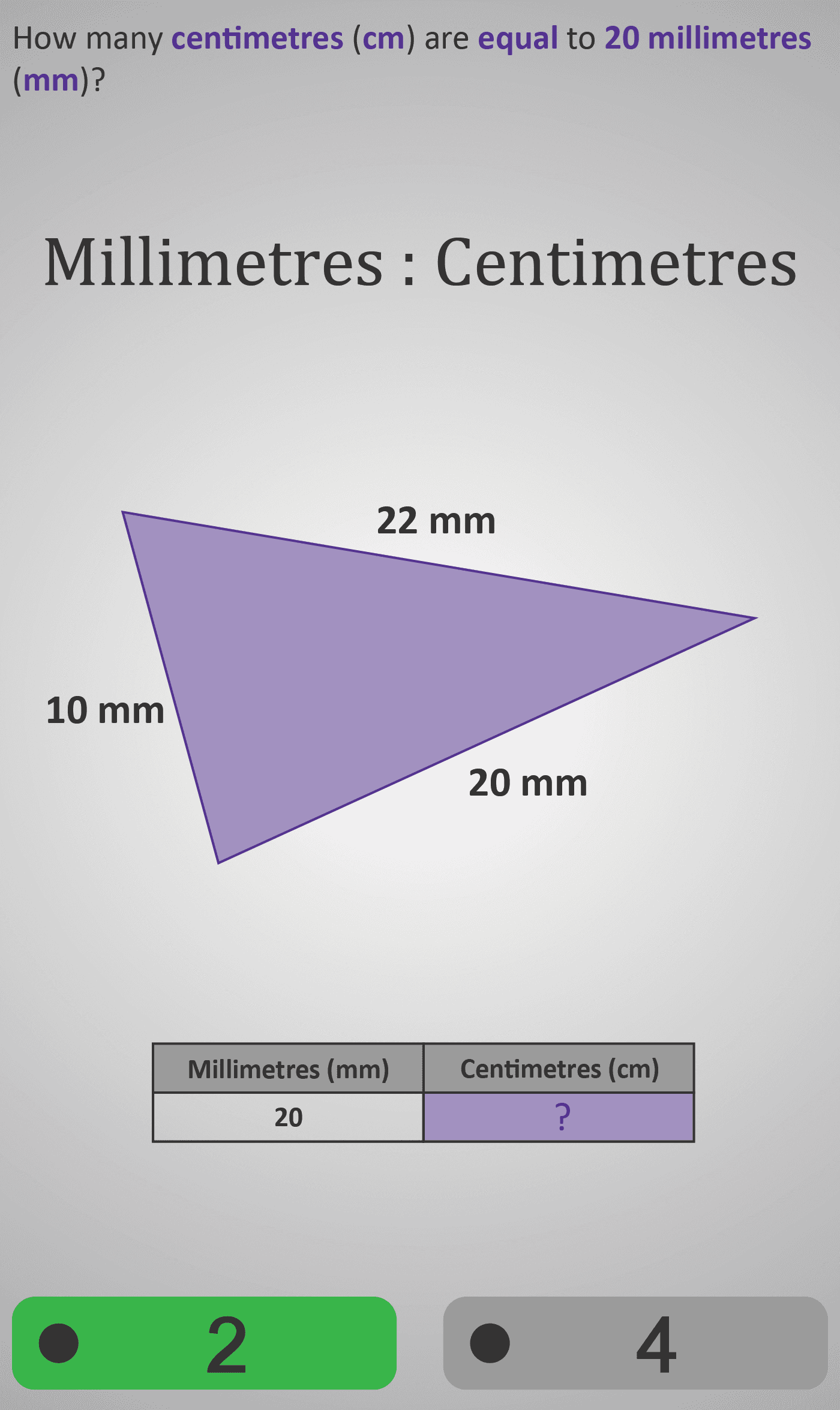
Students start by comparing smaller units, recognising that 10 mm = 1 cm. The sequence then scales up to 100 cm = 1 m and 1000 m = 1 km, helping learners apply multiplication or division by 10, 100, or 1000 depending on direction. Each example includes labelled triangle diagrams that visualise proportional scaling across units.
Learners complete tables showing equivalent values in different units — for example, converting 31 metres into centimetres or 9000 metres into kilometres. This approach reinforces pattern recognition, proportional thinking, and conceptual fluency in real-world measurement conversions.
- Understand that metric units are related by powers of 10.
- Use multiplication and division to convert between metric units.
- Recognise patterns in scaling from smaller to larger units.
- Apply ratio reasoning in real-world measurement contexts.
Prerequisite Knowledge Required
- Understanding that metric units increase or decrease by multiples of 10.
- Fluency with multiplying and dividing by 10, 100, and 1000.
- Ability to interpret tables comparing two related quantities.
- Basic awareness of length as a measurable quantity.
- Linked earlier Phlows: Values Ratio 3A – Converting Between Time Units; Values Ratio 3B – Scale Drawings and Real-Life Ratios; Measure 2A – Understanding Units of Length.
Main Category
Measures → Ratio and Conversion → Metric System
Estimated Completion Time
Approx 8–12 seconds per question (30 total). Total time: 4–6 minutes.
Learning Outcomes
- Convert between metric units (mm, cm, m, km) using multiplication and division by powers of 10.
- Identify and apply the correct ratio to find equivalent values in different units.
- Interpret structured tables comparing quantities across units.
- Recognise patterns in scaling between units within the metric system.
Cognitive Load / Step Size
The step size is well-scaffolded — beginning with straightforward conversions (mm ↔ cm) and gradually extending to larger-scale transitions (m ↔ km). Repetition of table layouts and the use of visual triangles keeps working memory demands low while promoting automaticity in proportional reasoning.
Language & Literacy Demand
Low — terminology such as centimetres, millimetres, and ratio is repeated in consistent patterns, supported by visual cues. Instructions are brief, predictable, and easy to follow, reducing cognitive and linguistic strain.
Clarity & Design
- Strong use of colour and layout consistency for visual clarity.
- The purple triangle design anchors attention to unit relationships.
- Tables reinforce understanding through side-by-side comparisons.
- Uniform visual structure encourages recognition of proportional patterns.
Curriculum Alignment
Strand: Measures → Length and Units → Ratio and Proportion
Learning Outcome: Use multiplication and division to convert between metric units, understanding that relationships between units are multiplicative.
(Aligned with Junior Cycle Mathematics – Strand 2: Measures and Number, Learning Outcomes 2.16 & 2.17.)
Engagement & Motivation
Learners enjoy the pattern-based challenge of conversions. Repetition of structure and gradual increases in complexity sustain engagement, allowing students to experience frequent success and measurable progress.
Error Opportunities & Misconceptions
- Adding zeros instead of multiplying by 10, 100, or 1000.
- Confusing direction — dividing instead of multiplying when converting to smaller units.
- Forgetting that conversions to larger units require division, not multiplication.
- Misreading abbreviations (e.g., cm vs mm).
Visual prompts, feedback, and consistent formatting help correct these errors through repetition and guided comparison.
Transferability / Real-World Anchoring
Highly transferable — metric conversions underpin practical measurement in everyday life, from reading rulers and measuring distances to interpreting maps, blueprints, and scientific data. The Phlow lays the foundation for advanced applications like scaling, rates, and density.
Conceptual vs Procedural Balance
Conceptual: Understanding that each metric conversion represents a fixed ratio based on powers of 10.
Procedural: Performing accurate multiplications and divisions by 10, 100, and 1000.
The Phlow unites both elements to ensure flexible, deep understanding of metric relationships.
What Your Score Says About You
- Below 15: Review key conversion ratios (10 mm = 1 cm, 100 cm = 1 m, 1000 m = 1 km).
- 16–22: Good grasp of process but may reverse operation direction occasionally.
- 23–29: Strong reasoning and consistent accuracy with powers of 10.
- 30 / 30: Mastery — instantly recognises and applies metric ratios with full confidence and understanding.