
Volume (L × W × H) 3A
Overview
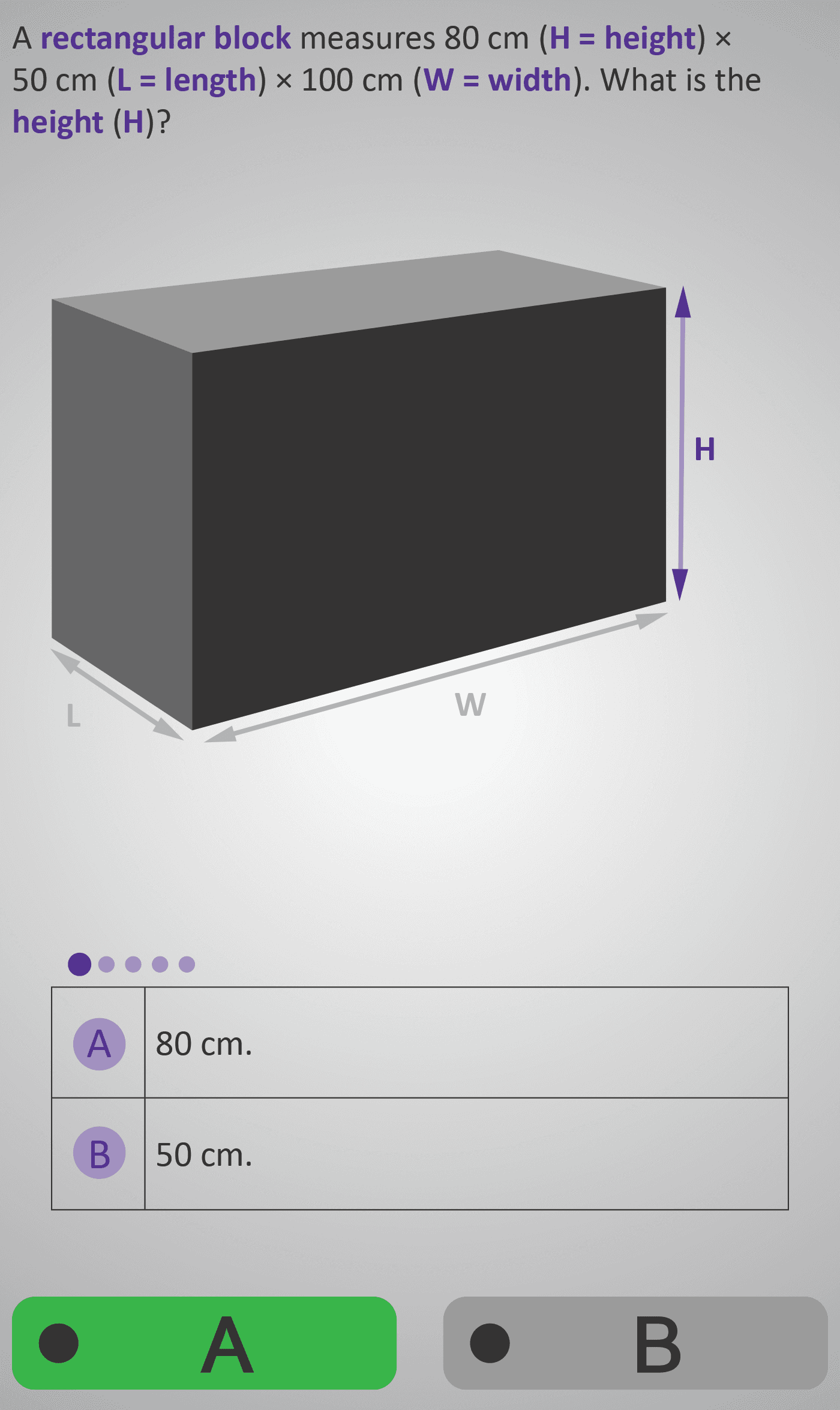
In this Phlow, learners develop spatial awareness by identifying and labelling the three dimensions of a rectangular block — length (L), width (W), and height (H). Visual cues such as arrows and colour-coded labels guide understanding of direction and measurement.
The activity then connects these dimensions to the concept of volume, explaining that volume measures the space an object occupies and is expressed in cubic units (cm³). Finally, learners link cubic centimetres to litres by discovering the relationship 1 litre = 1,000 cm³, bridging solid and liquid measurement concepts.
This sequence ensures that learners understand what each dimension represents before applying the formula Volume = L × W × H. It provides a strong conceptual foundation for later procedural work on calculating volume.
- Identify and label the three dimensions of a cuboid: length, width, and height.
- Recognise that volume is measured in cubic units (cm³).
- Relate volume in cm³ to capacity in litres (1,000 cm³ = 1 L).
- Interpret 3D diagrams before applying formula-based reasoning.
Prerequisite Knowledge Required
- Recognition of basic 3D shapes (cube, cuboid).
- Understanding of 2D dimensions such as length and width.
- Familiarity with metric units (cm, m, litre).
- Awareness that “³” represents cubic measurement — measuring space, not area.
- Linked earlier Phlows: Shape 2B – Recognising 2D and 3D Objects; Measure 2A – Estimating Lengths and Heights; Area 3A – Understanding Square Units (cm²).
Main Category
Measurement → Volume and Capacity
Estimated Completion Time
Approx 8–12 seconds per question (30 total). Total time: 4–6 minutes.
Learning Outcomes
- Identify and label the length, width, and height of a 3D shape.
- Understand that volume is measured in cubic units (cm³).
- Convert between cubic centimetres and litres (1,000 cm³ = 1 L).
- Build conceptual understanding before applying the volume formula.
Cognitive Load / Step Size
Low to moderate — each concept (dimension identification, unit understanding, capacity link) is introduced separately to prevent overload. The clear progression from visual recognition to conceptual linking supports deep, sustained understanding.
Language & Literacy Demand
Medium — new spatial terms such as “rectangular block,” “width,” and “height” are supported by visual arrows and consistent labelling. Colour-coded symbols (L, W, H) reduce reliance on reading and reinforce directional understanding.
Clarity & Design
- Clear diagrams isolate one dimension per screen before combining all three.
- Consistent colour and orientation guide visual learning.
- Gradual zoom-out from single arrows to fully labelled cuboid builds spatial meaning step-by-step.
- Simple background enhances focus on dimensional relationships.
Curriculum Alignment
Strand: Measurement → Length, Area, and Volume
Learning Outcome: Identify, measure, and interpret dimensions of 3D shapes and relate cubic centimetres to litres.
(Aligned with Junior Cycle Mathematics – Strand 2: Geometry and Measurement, Learning Outcomes 2.12 & 2.13.)
Engagement & Motivation
The 3D diagrams make learning tangible. Students connect mathematical labels with real-world spatial reasoning, encouraging curiosity and confidence. Immediate visual feedback helps learners self-correct quickly.
Error Opportunities & Misconceptions
- Confusing height and length when the block is rotated.
- Mixing area and volume units (cm² vs. cm³).
- Forgetting that “cubic” means multiplied in three dimensions.
The visual orientation and reinforcement of “³” notation directly address these misconceptions.
Transferability / Real-World Anchoring
Recognising and measuring 3D dimensions connects directly to packaging, construction, science, and design. The litre–cubic centimetre relationship provides everyday relevance through water, storage, and material contexts.
Conceptual vs Procedural Balance
Conceptual: Understanding what the three dimensions represent.
Procedural: Preparing to use the formula L × W × H.
Emphasis is on conceptual grounding first, ensuring fluency later in calculation.
What Your Score Says About You
- Below 15: Still developing understanding of dimensions — review L, W, and H orientation.
- 16–22: Understands measurements but may mix area and volume units.
- 23–29: Strong recognition of 3D labelling and units.
- 30 / 30: Mastery — confidently identifies all dimensions and applies correct volume units.