
Volume (L × W × D) 3B
Overview
In this Phlow, learners progress from recognising 3D dimensions to actively calculating volume using the formula Volume = L × W × H. They learn that unlike perimeter or area, volume requires multiplication of three measurements to find the total space inside a rectangular block.
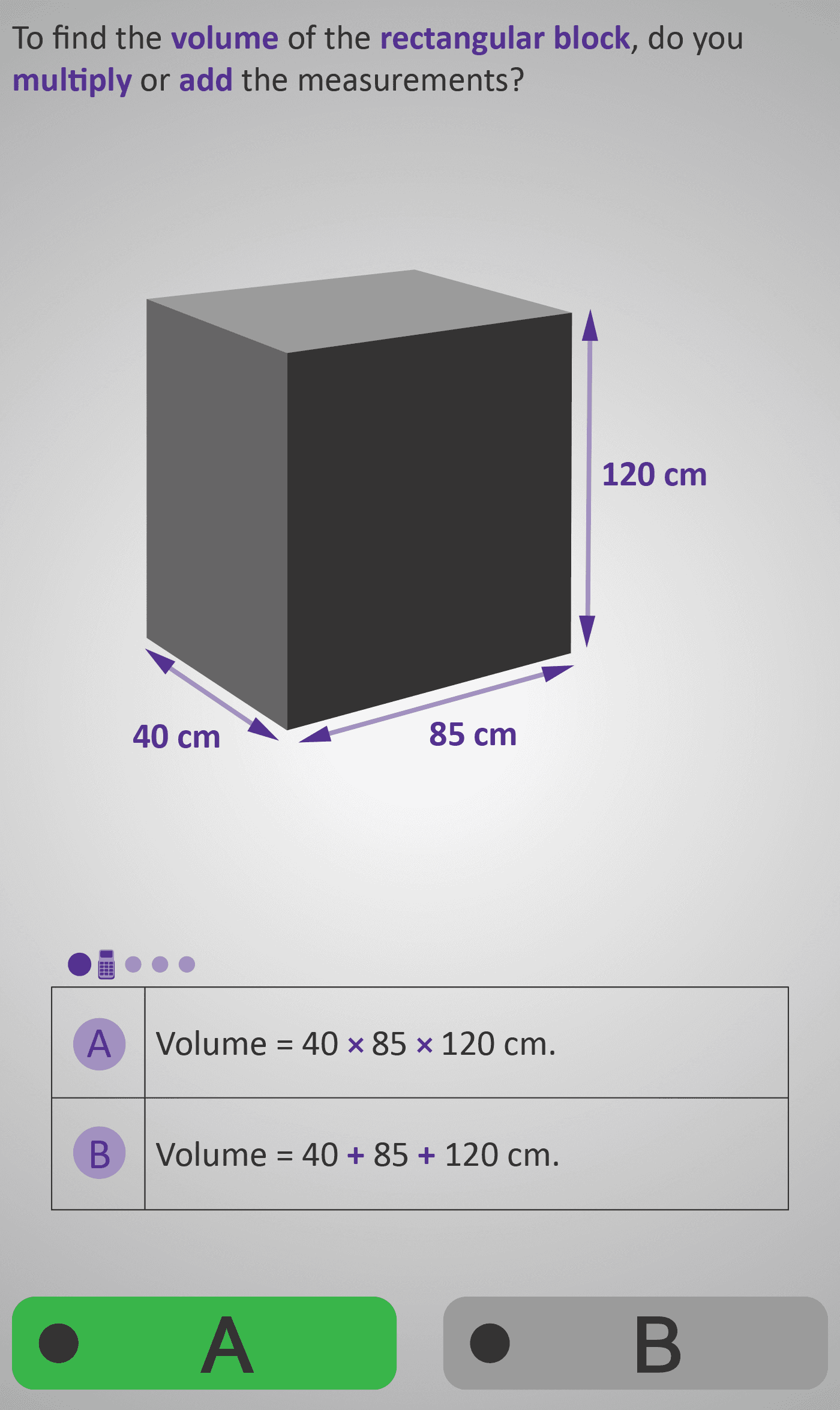
Using a practical example (40 cm × 85 cm × 120 cm), students use their own calculator to compute 408,000 cm³. The Phlow then introduces unit conversion, reinforcing that 1 litre equals 1,000 cubic centimetres, allowing them to convert 408,000 cm³ into 408 litres. This real-world link between volume and capacity brings meaning and context to mathematical calculation.
By blending spatial understanding, arithmetic reasoning, and metric conversion, learners develop both conceptual clarity and procedural fluency in calculating and interpreting volume.
- Calculate the volume of a cuboid using L × W × H.
- Differentiate between adding, multiplying, and cubing operations.
- Convert between cm³ and litres (1,000 cm³ = 1 L).
- Relate volume to real-world capacity and measurement contexts.
Prerequisite Knowledge Required
- Understanding of the three dimensions of a rectangular block (length, width, height).
- Familiarity with metric units such as centimetres and litres.
- Ability to multiply large numbers, including calculator use.
- Awareness that area involves two dimensions (L × W) and volume extends to three (L × W × H).
- Linked earlier Phlows: Volume 3A – Understanding Dimensions (L, W, H); Area 3A – Calculating with Two Dimensions; Measure 2B – Using Units of Length.
Main Category
Measurement → Volume and Capacity
Estimated Completion Time
Approx 10–14 seconds per question (30 total). Total time: 5–7 minutes.
Learning Outcomes
- Recall and use the formula Volume = L × W × H.
- Recognise when multiplication applies in measurement contexts.
- Convert between cubic centimetres and litres accurately.
- Understand that volume measures 3D space while capacity measures liquid held.
Cognitive Load / Step Size
Moderate — each phase introduces one new operation: identifying dimensions, choosing multiplication, performing the calculation, then converting to litres. The step-by-step sequence keeps mental load manageable and promotes strong understanding before automation.
Language & Literacy Demand
Medium — core vocabulary such as multiply, cubed, and convert is introduced in short, purposeful sentences supported by clear visuals and calculator cues. Text is concise to maintain focus on the mathematical reasoning process.
Clarity & Design
- 3D block diagrams labelled with L, W, and H provide consistent spatial orientation.
- Purple highlight draws attention to current dimension or calculation.
- Calculator icons encourage independence and confidence in computation.
- Clean layout focuses attention on operations and unit transitions.
Curriculum Alignment
Strand: Measurement → Length, Area, and Volume
Learning Outcome: Students calculate and convert the volume of 3D shapes and interpret the relationship between cubic centimetres and litres.
(Aligned with Junior Cycle Mathematics – Strand 2: Geometry and Measurement, Learning Outcomes 2.13 & 2.15.)
Engagement & Motivation
Learners experience a sense of accomplishment when their calculation produces a real, relatable result (e.g., 408 litres). The inclusion of real-world examples and calculator interaction keeps engagement high and learning relevant.
Error Opportunities & Misconceptions
- Adding instead of multiplying dimensions.
- Confusing cm² with cm³.
- Mixing up divide vs. multiply when converting litres and cubic centimetres.
- Interpreting “cubed” as ×3 instead of multiplying three distinct measurements.
Visual comparisons and explicit notation clarify these differences and strengthen conceptual accuracy.
Transferability / Real-World Anchoring
Calculating volume applies directly to everyday tasks — determining the capacity of containers, tanks, or boxes, or understanding liquid measures in science and design. These skills underpin practical reasoning in engineering, construction, and environmental studies.
Conceptual vs Procedural Balance
Conceptual: Understanding why multiplying three dimensions gives a 3D measure.
Procedural: Applying the formula and performing conversions.
This balance supports both accuracy and comprehension in volume reasoning.
What Your Score Says About You
- Below 15: Still developing understanding of how 3D measurements interact — review when to multiply.
- 16–22: Confident with formula but may need practice converting cm³ ↔ litres.
- 23–29: Fluent in both calculation and unit reasoning.
- 30 / 30: Mastery — calculates and converts any rectangular volume with full conceptual understanding.