
Volume (L × W × D) 3D
Overview
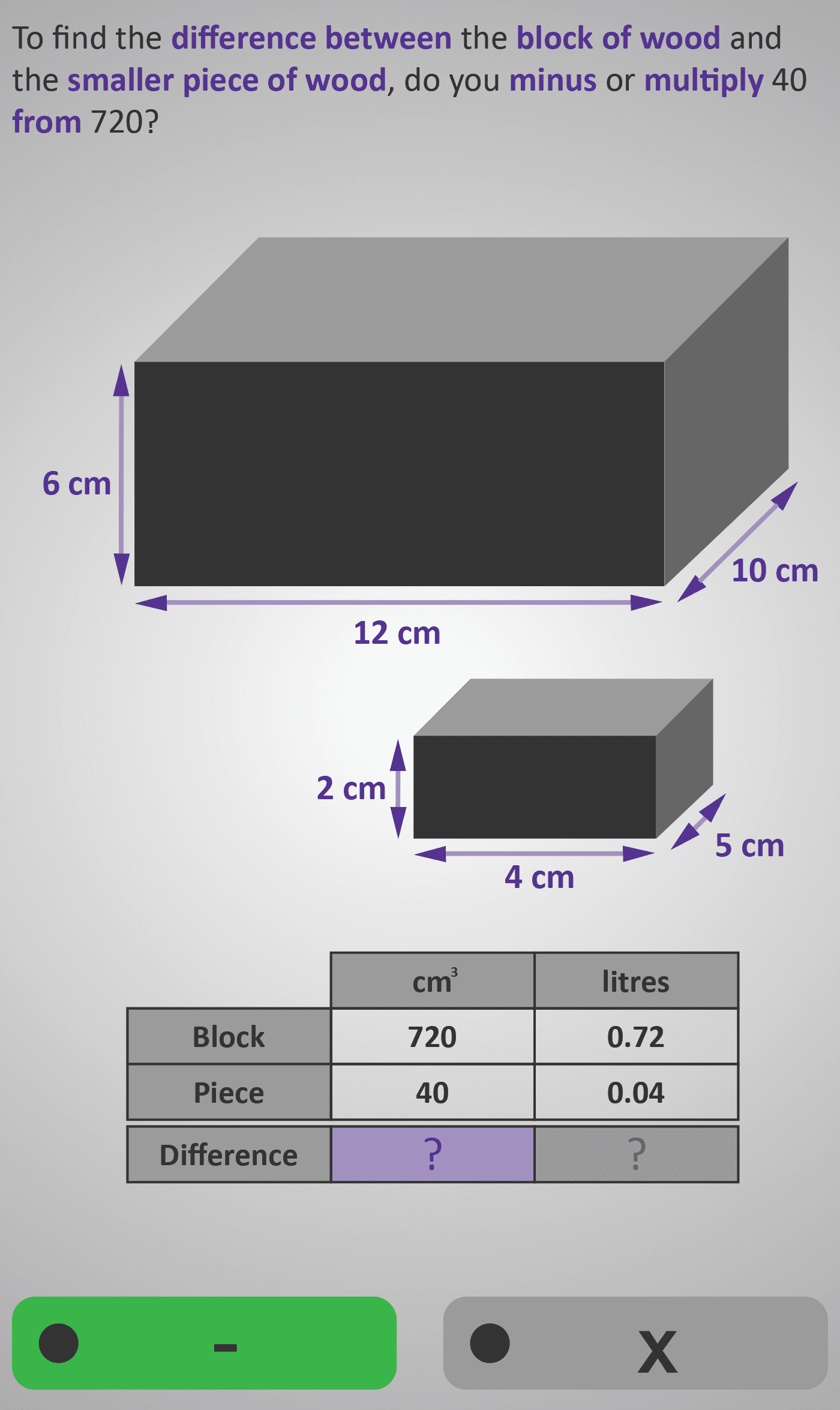
In this Phlow, learners explore how to calculate the difference in volume between two 3D objects, such as when a smaller block is removed from a larger one. They begin by finding the volume of both blocks — for example, a large block of 720 cm³ and a smaller piece of 40 cm³ — then calculate the remaining space (680 cm³) through subtraction.
Visuals and tables help students link subtraction to real-world spatial reasoning, showing how the operation represents a change in 3D space. Once the difference is found, students convert the result into litres using the conversion 1,000 cm³ = 1 L. This reinforces understanding of metric relationships and prepares learners for multi-step problem solving in real contexts.
The sequence connects calculation, comparison, and conversion — building fluency in applying mathematical reasoning to realistic 3D measurement challenges.
- Calculate the difference in volume between two cuboids.
- Apply subtraction to real-world spatial contexts.
- Convert between cubic centimetres and litres.
- Interpret and verify results using both numeric and practical reasoning.
Prerequisite Knowledge Required
- Understanding of how to calculate volume using L × W × H.
- Awareness of the metric relationship 1,000 cm³ = 1 L.
- Basic subtraction and number comparison skills.
- Familiarity with organising data in tables for calculation.
- Linked earlier Phlows: Volume 3B – Calculating and Converting Volume; Volume 3C – Dividing Volume into Equal Cubes; Subtract 2B – Subtraction with Larger Numbers.
Main Category
Measurement → Volume and Capacity
Estimated Completion Time
Approx 10–14 seconds per question (30 total). Total time: 5–7 minutes.
Learning Outcomes
- Find the difference in volume between two rectangular blocks.
- Use subtraction and conversion to interpret 3D changes.
- Accurately convert between cm³ and litres.
- Read and interpret tables displaying measured quantities and unit conversions.
Cognitive Load / Step Size
Moderate — the Phlow divides the process into clear stages: subtracting, interpreting, and converting. Each step includes strong visual support and calculator prompts, allowing learners to concentrate on conceptual links rather than arithmetic strain.
Language & Literacy Demand
Medium — terminology such as difference, convert, and capacity is introduced through practical examples and supported by tabular representation. Dual-format tables pair numeric results with units, helping students transition smoothly between cm³ and L.
Clarity & Design
- 3D visuals paired with data tables for clarity.
- Calculator icons reinforce independence and self-checking.
- Colour-coded dimensions and values focus attention on relationships.
- Sequential layout mirrors real-world process: calculate → compare → convert.
Curriculum Alignment
Strand: Measurement → Length, Area, and Volume
Learning Outcome: Students solve problems involving addition, subtraction, and conversion of 3D measurements, and interpret results within realistic contexts.
(Aligned with Junior Cycle Mathematics – Strand 2: Geometry and Measurement, Learning Outcomes 2.13, 2.15 & 2.18.)
Engagement & Motivation
The real-world scenario of removing part of a solid block makes abstract volume differences concrete and meaningful. Students experience satisfaction when connecting mathematical reasoning to physical outcomes. Calculator-supported interaction ensures success while encouraging autonomy.
Error Opportunities & Misconceptions
- Reversing subtraction (smaller minus larger).
- Mixing up cm², cm³, and L units.
- Incorrect decimal placement during conversion.
- Forgetting that the difference represents remaining volume, not total volume.
Step-by-step diagrams and guided conversion reminders mitigate these risks, promoting accurate reasoning.
Transferability / Real-World Anchoring
Subtracting and converting volumes applies to real-world contexts like manufacturing, packaging, and construction. It also supports science experiments and environmental calculations involving liquid displacement or material removal.
Conceptual vs Procedural Balance
Conceptual: Understanding subtraction as representing removal or difference in 3D space.
Procedural: Performing calculation and unit conversion steps accurately.
The integration of both promotes flexible, real-world mathematical thinking.
What Your Score Says About You
- Below 15: Still learning how subtraction connects to 3D change — review when to subtract and convert.
- 16–22: Accurate with subtraction but occasionally misapplies unit conversions.
- 23–29: Fluent and confident in all stages of calculation and interpretation.
- 30 / 30: Mastery — expertly analyses, subtracts, and converts 3D measurements across units.