
Add & Sub 4
Overview
In this Phlow, learners strengthen their understanding of the connection between addition and subtraction by identifying which operation completes a given number sentence.
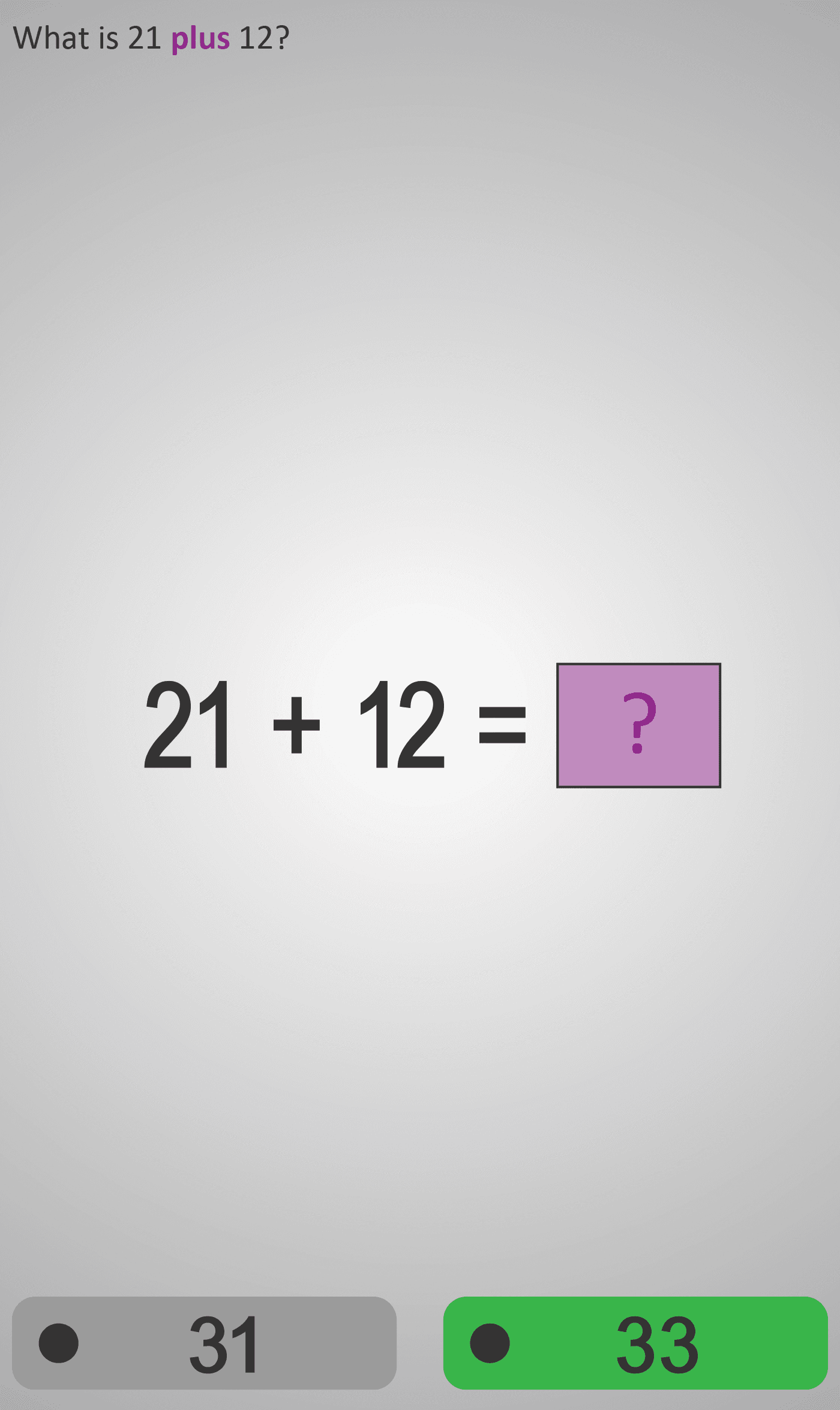
They begin with direct examples of each operation (e.g. 21 + 12 = 33, 83 − 55 = 28), before tackling missing-operation problems such as 55 ? 33 = 22. Through alternating examples, students practise reasoning about inverse operations — recognising that subtraction “undoes” addition, and addition can reverse subtraction.
Rather than relying on calculation alone, this Phlow develops logical equation reasoning. Students learn to ask questions like “What must I do to get from 25 to 40?” or “What operation links these numbers?”. By the end, they can confidently decide when to use plus or minus, deepening number sense and preparing for algebraic reasoning in higher levels.
- Decide whether addition or subtraction completes an equation.
- Recognise that the two operations are mathematical inverses.
- Read equations as balanced relationships rather than one-directional statements.
- Apply reasoning skills to missing-operator problems.
Prerequisite Knowledge Required
- Confidence adding and subtracting two-digit numbers.
- Understanding that addition and subtraction are inverse operations.
- Familiarity with using the equals sign to represent balance.
- Fluency with symbols (+, −, =) and their meanings.
- Linked earlier Phlows: Add 3A – Adding Two-Digit Numbers; Sub 3A – Subtracting Two-Digit Numbers; Add & Sub 3B – Mixing Addition and Subtraction.
Main Category
Number → Operations and Relationships
Estimated Completion Time
Approx 8–10 seconds per question (30 total). Total time: 4–6 minutes.
Learning Outcomes
- Identify whether addition or subtraction is needed to complete a problem.
- Recognise and explain the inverse relationship between operations.
- Solve missing-operator equations accurately.
- Develop flexible reasoning about how numbers relate and change.
Cognitive Load / Step Size
Moderate — questions alternate between familiar calculations and missing-operation reasoning, maintaining engagement while supporting transfer of understanding between addition and subtraction. Each item isolates one new reasoning step, building understanding through contrast and repetition.
Language & Literacy Demand
Low to moderate — concise phrasing and highlighted keywords (plus, minus, equals) support literacy development while reinforcing symbol–meaning connections. Consistent sentence structures reduce reading strain and keep focus on mathematical reasoning.
Clarity & Design
- Minimalist visuals emphasise the equation itself.
- Purple-highlighted operators draw focus to the missing element.
- Alternating examples sustain attention while promoting understanding of inverse relationships.
- Clear visual hierarchy ensures students can process number patterns efficiently.
Curriculum Alignment
Strand: Number → Operations and Relationships
Learning Outcome: Students solve problems using addition and subtraction, recognising that one operation can be used to check the other.
(Aligned with Primary/Junior Cycle Mathematics – Strand 1: Number, Learning Outcomes 1.7 & 1.9.)
Engagement & Motivation
Students gain instant feedback and confidence from rapid, logic-based decision-making. The alternating challenge style sustains curiosity and helps learners experience the satisfaction of understanding why an operation fits, not just which.
Error Opportunities & Misconceptions
- Choosing the wrong operation by guessing or using surface clues.
- Misinterpreting the equals sign as “the answer comes next.”
- Forgetting that subtraction can find a missing addend.
Repetition and logical questioning (“What operation connects these numbers?”) address these misconceptions and deepen conceptual understanding.
Transferability / Real-World Anchoring
This reasoning skill applies to practical decision-making — calculating differences in cost, distance, or quantity. It builds readiness for algebraic problem-solving where operations must be chosen, not given.
Conceptual vs Procedural Balance
Conceptual: Understanding relationships between numbers and operations.
Procedural: Applying addition and subtraction accurately.
The Phlow reinforces conceptual flexibility through procedural practice, preparing learners for equation solving.
What Your Score Says About You
- Below 15: Still learning to identify which operation fits each problem.
- 16–22: Understands operations but may occasionally misapply them in missing-operator cases.
- 23–29: Strong awareness of inverse operations and fluent reasoning.
- 30 / 30: Mastery — confidently chooses and justifies correct operations in all contexts.