
Algebra 4B
Overview
In this Phlow, learners practise factorising algebraic expressions by identifying and removing the highest common factor (HCF). Factorisation is introduced as the reverse process of expansion — instead of multiplying through brackets, students work backwards to find what can be taken out.
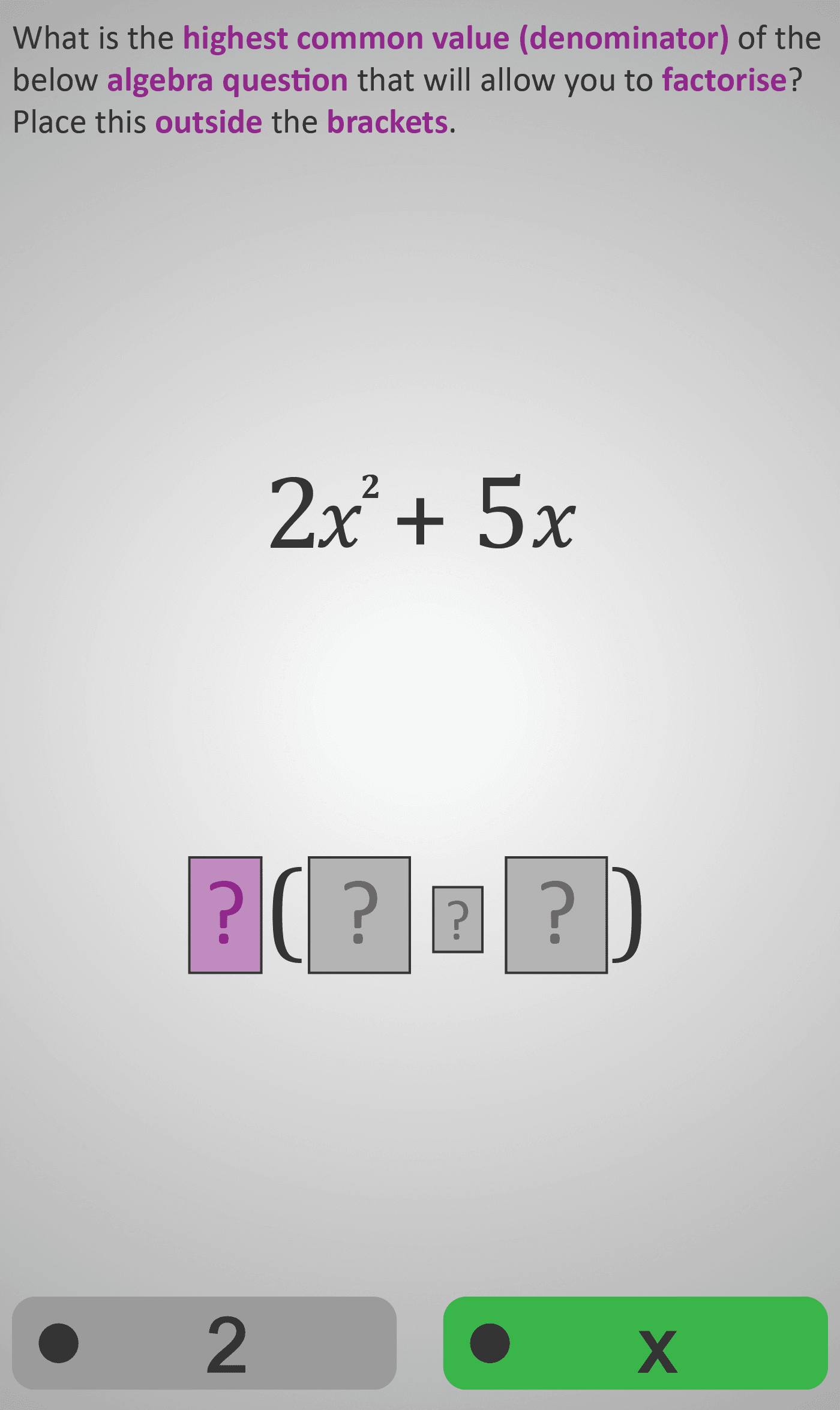
Starting with examples such as 2x² + 5x, learners first identify the common factor — in this case, x. They then divide each term by that factor: 2x² ÷ x = 2x and 5x ÷ x = 5, allowing them to rewrite the expression as x(2x + 5). Each stage isolates one step — identifying, dividing, and rewriting — making the process visual and logical.
The design of this Phlow ensures that learners not only follow the correct procedure but also understand why factorising works. This understanding builds confidence for later topics such as simplifying expressions, solving equations, and quadratic factorisation.
- Identify and extract the highest common factor in algebraic expressions.
- Recognise that factorising reverses the process of expanding brackets.
- Divide terms accurately by the common factor to simplify expressions.
- Write expressions in equivalent, factorised form.
Prerequisite Knowledge Required
- Understanding of the distributive law and expanding brackets.
- Ability to find common factors in numbers and algebraic terms.
- Knowledge that dividing powers of the same base subtracts exponents (e.g. x² ÷ x = x).
- Familiarity with the relationship between multiplication and division as inverse operations.
- Linked earlier Phlows: Algebra 4A – Expanding Brackets; Multiply 3A – Multiplying Terms; Divide 3B – Division and Factors.
Main Category
Algebra → Factorising and Simplifying
Estimated Completion Time
Approx 6–8 minutes (4–5 interactive screens).
Learning Outcomes
- Identify and extract the highest common factor (HCF) from an algebraic expression.
- Rewrite expressions in factorised form using brackets.
- Understand that factorising reverses expansion.
- Prepare simplified forms for solving algebraic equations.
Cognitive Load / Step Size
Moderate — each cognitive step (identify, divide, rewrite) is isolated and visually scaffolded. As students recognise the pattern, support is gradually reduced, enabling fluent and independent reasoning. The one-step-at-a-time approach ensures clear mental processing of division within algebraic terms.
Language & Literacy Demand
Medium — terminology such as factorising, highest common factor, divide, and brackets is explicitly taught and highlighted in purple. This supports vocabulary development and strengthens comprehension of algebraic language.
Clarity & Design
- Visual contrast between the original and factorised forms emphasises structure.
- Step-by-step cues highlight where learners should focus next (factor → divide → rewrite).
- Colour-coded signs and factors reinforce accuracy and confidence.
- Consistent visual flow encourages pattern recognition and conceptual clarity.
Curriculum Alignment
Strand: Algebra
Learning Outcome: Students factorise algebraic expressions by taking out common factors, connecting this to the distributive law and simplification.
(Aligned with Junior Cycle Mathematics – Strand 3: Algebra, Learning Outcomes 3.8 & 3.9.)
Engagement & Motivation
The process feels like solving a puzzle — learners identify what’s common, divide correctly, and reveal the simplified form. Each correct step provides visible progress and immediate satisfaction, helping students internalise factorisation as both logical and achievable.
Error Opportunities & Misconceptions
- Factoring only one term instead of all terms.
- Leaving out the variable when the HCF includes it (e.g. factoring 2 instead of 2x).
- Changing or misplacing signs within the bracket.
- Believing that factorisation alters rather than rewrites the expression equivalently.
Structured division steps and clear visual examples correct these issues early, reinforcing the idea that factorisation preserves equality.
Transferability / Real-World Anchoring
Factorising strengthens pattern recognition and logical reasoning — skills used across mathematics, science, and technology. It prepares learners for higher algebra, formula simplification, and problem-solving in contexts such as physics, coding, and finance.
Conceptual vs Procedural Balance
Balanced — conceptual recognition (finding what’s common) alternates with procedural accuracy (dividing terms). This interplay ensures both understanding and fluency, laying groundwork for more complex algebraic manipulations in future Phlows.
What Your Score Says About You
- Below 15: Beginning to recognise common factors — practise dividing terms carefully.
- 16–22: Understands logic but occasionally skips steps or confuses signs.
- 23–29: Confident and accurate with single-bracket factorisation.
- 30 / 30: Mastery — can factorise efficiently, maintaining signs and explaining reasoning clearly.